


The short answer
Under pig enrichment material legislation, every pig must always have access to sufficient material to investigate and play with. The material must not harm the animals’ health. In practice, that means providing material that is edible, chewable, investigable and manipulable, within reach of every animal and replenished whenever needed. When renovating nursery and finishing pens, Van Osch B.V. finds that the material itself is rarely the real bottleneck. More often, the problem lies with the holder, its position in the pen and the frequency with which staff need to refill it. Build these factors into the pen layout, and you can meet the requirements every day, not just on inspection day.
Key takeaways
- Article 2.14 of the Dutch Animals Keepers Decree requires straw or other material for weaned pigs and production pigs to help reduce aggression within groups.
- In 2024, the Rotterdam District Court ruled that the material referred to in Article 2.22 must be present in the barn continuously.
- European Commission Recommendation (EU) 2016/336 identifies four qualities: edible, chewable, investigable and manipulable. A loose metal chain has none of these qualities.
- NVWA inspectors assess accessibility, actual use, the type of material and how it is provided.
Why is a chain in the pen not enough to meet the legal requirements?
Walk through a nursery unit and you may see a chain with a plastic ball hanging in every pen. For years, this was the standard solution. Yet this exact setup is regularly flagged during inspections. The law does not simply require “something to play with”. It requires material that pigs can investigate, chew apart and eat.
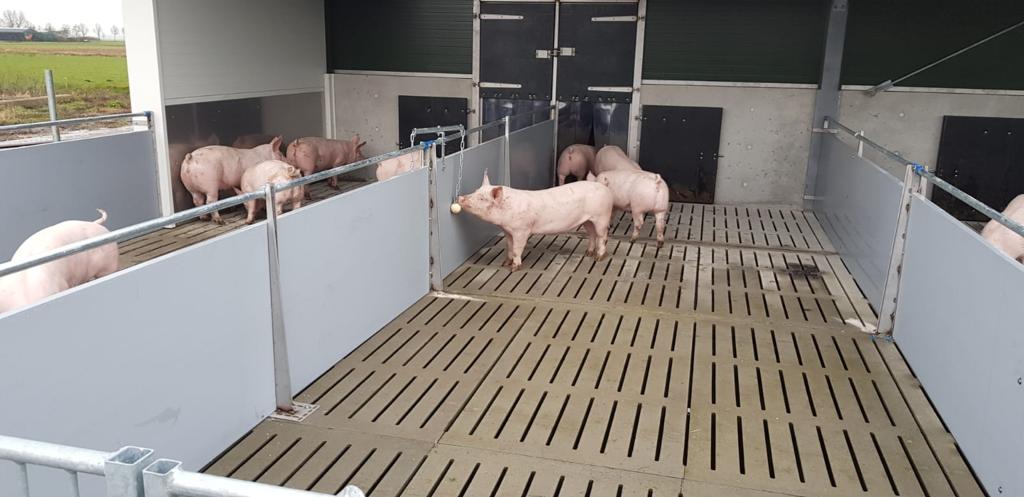
The standard is higher than many people realise, as shown in a European Commission evaluation from 2016. It found that a majority of officials in Member States considered unsuitable materials, such as metal chains, acceptable. Suitable material was also sometimes seen as incompatible with manure removal systems. Both issues are still common in pig housing today: a chain is not enough, while straw or other loose material can appear impractical on slatted floors.
Solving the issue means looking beyond the material itself. You need to consider the entire pen: where the holder will be installed, how easily pigs can reach it and what can fall through the slatted floor.
Pig enrichment legislation: what do the rules actually say?
Environmental enrichment is material that pigs can investigate, manipulate and partly consume on a permanent basis, without harming their health. This definition is built on three layers of legislation and guidance that reinforce one another. According to the Netherlands Enterprise Agency (RVO), enrichment materials sit alongside requirements for group housing, slatted floors and day and night rhythms.
The Dutch Animals Keepers Decree: Articles 2.14 and 2.22
The legal basis has been in place for many years. The original Pig Decree (Official Gazette 2003, 184) already required pigs to have permanent access to sufficient material for investigation and play. This requirement is now set out in Article 2.22 of the Dutch Animals Keepers Decree. In addition, Article 2.14 requires measures to reduce aggression in groups, including “the provision of straw or other material to weaned pigs and production pigs”.
The reasoning is explained in the Explanatory Memorandum (Official Gazette 2014, 210): lawmakers state that aggression in groups is largely caused by stress or boredom, and that distraction and enrichment materials can help reduce it. The strict interpretation of “permanent” was confirmed in a Rotterdam District Court ruling from 2024. The court found that Article 2.22 can only mean that the material must be continuously present in the barn.
The European guidance on four key qualities
Dutch rules are based on the European Pig Directive 2008/120/EC. In 2016, the European Commission clarified this in Recommendation (EU) 2016/336. The Explanatory Memorandum to Official Gazette 2023, 327 adopts the recommendation’s four key qualities: edible, chewable, investigable and manipulable. Material with all four qualities is considered optimal. Material with only some of them is suboptimal and should be combined with other material. Materials that merely distract pigs, such as chains, are of secondary importance.
What the NVWA and IKB assess in the barn
During inspections, NVWA inspectors assess among other things whether pigs can easily reach the material, whether they actually use it, what material is provided and how it is offered. For participants in IKB Varken, the requirements go further. The IKB Varken interpretation document uses nine indicators: safe, edible, chewable, rootable, degradable, novel, accessible, available and clean. Three of these, accessible, available and clean, are determined largely by the pen layout rather than the material you choose. To see how these requirements fit into the wider pen design, also read which legal requirements shape the design of a finishing pig barn.
Get started:
- Walk through every pen and record which of the four qualities the current material provides.
- Is there only a chain or ball? That pen does not meet the four qualities and needs additional enrichment.
- Check that the material is still available on Monday morning, after a weekend with fewer staff on site.
- If you take part in IKB, assess the nine indicators as well, not just the four legal qualities.
How do you design a pen so enrichment material is always within reach?
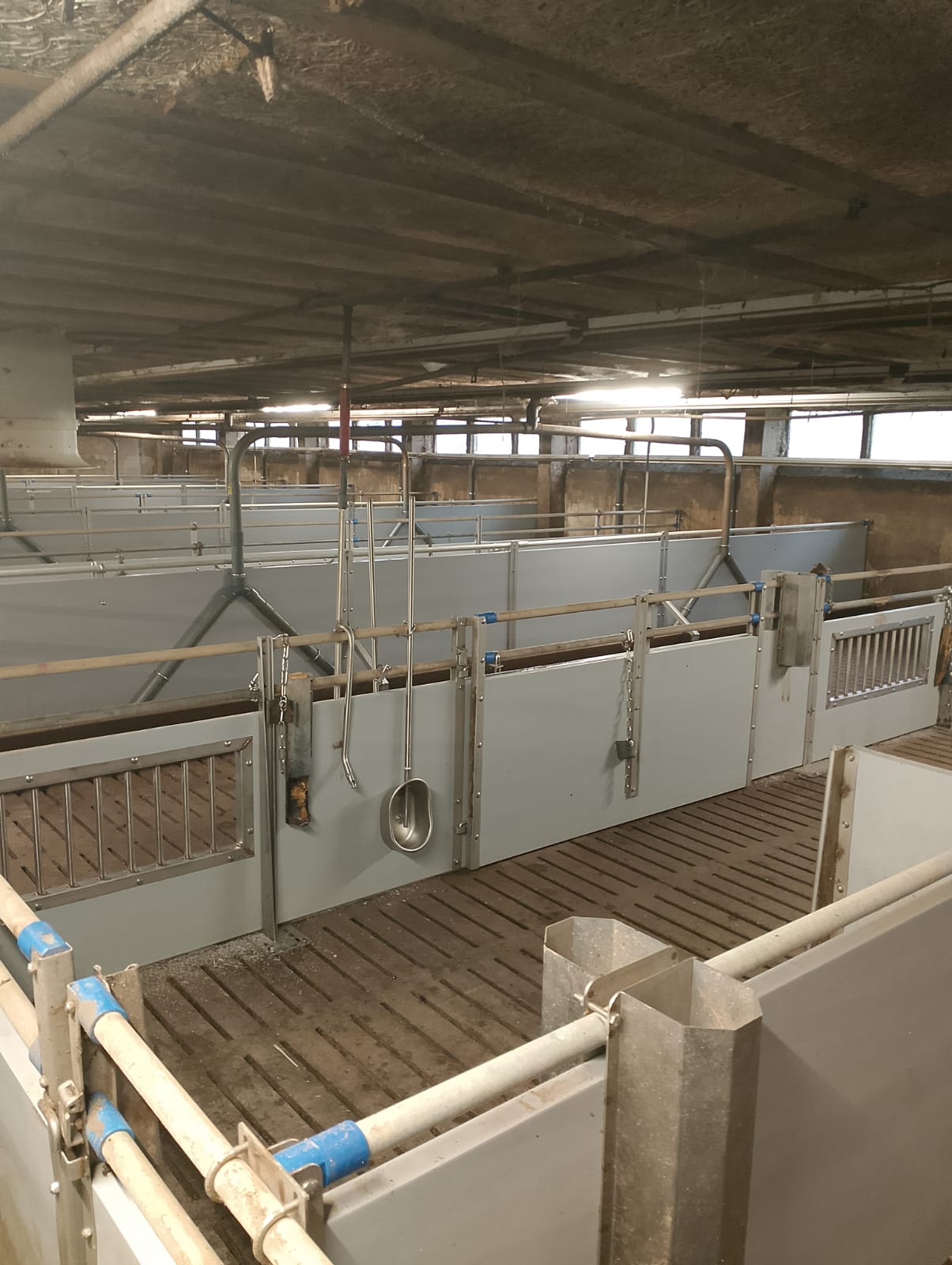
Treating environmental enrichment as a standalone purchase is a losing battle. Material runs out, drops into the manure pit or ends up in the wet area beneath the drinkers. That is why Van Osch B.V. starts custom projects with the holder and its location, then selects the material. A fixed stainless steel holder for enrichment materials becomes part of the pen design, just like the feeder and drinker.
Positioning within the pen
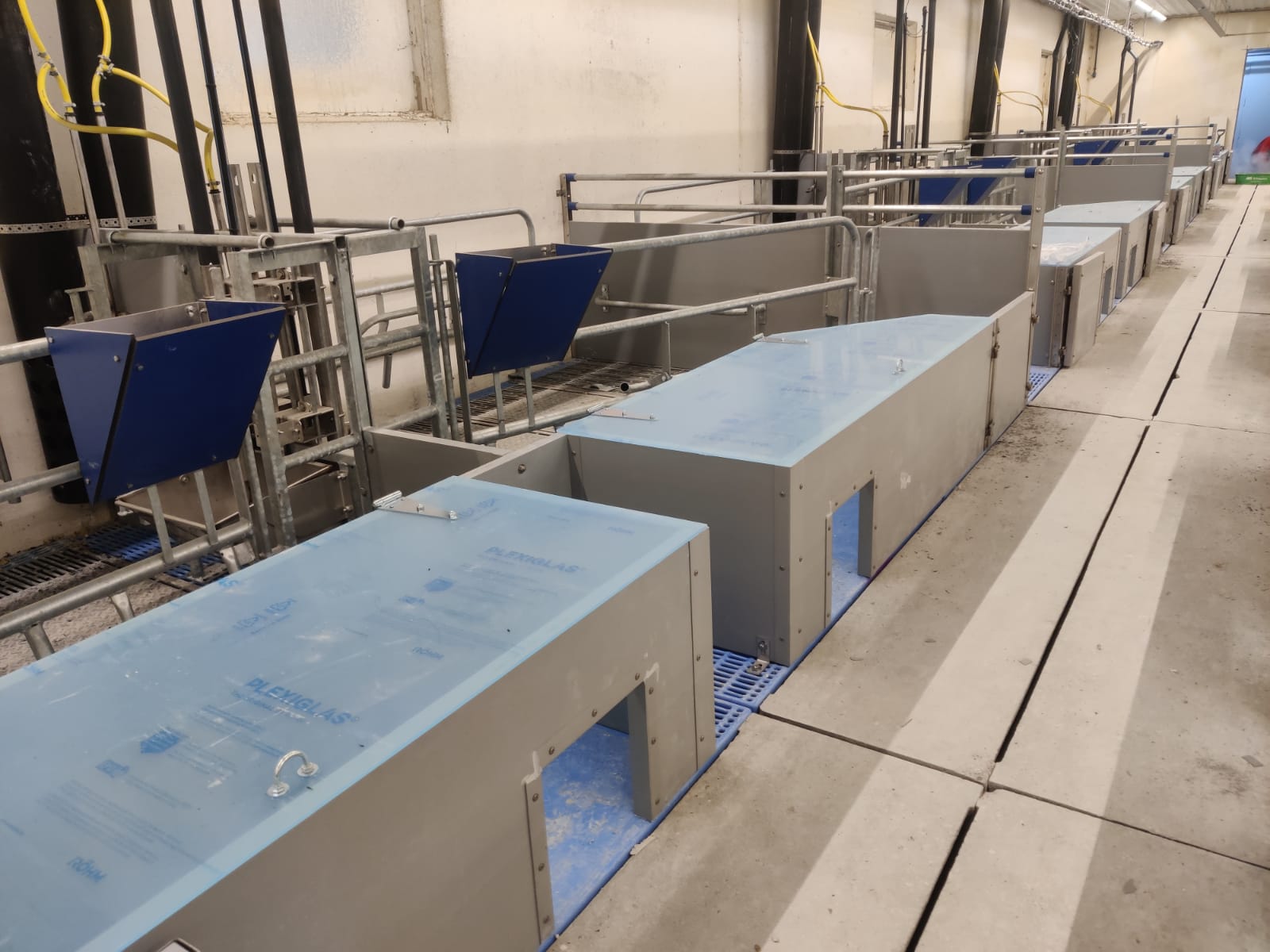
The enrichment point should be in the resting area, or on the boundary between the resting and activity areas, rather than in the dunging area. Once material becomes dirty, it no longer meets the “clean” requirement and pigs are less likely to use it. Avoid placing the holder directly next to the feeder or feed trough too. That area is already busy at feeding time and can lead to competition within the group.
Holder type, height and number of access points
The holder determines whether material can be dispensed in manageable quantities. A rack or dispenser with an open bottom allows pigs to pull out straw or roughage while keeping the supply dry. Set the hanging height for the age and size of the pigs: it will generally need to be much lower for weaned piglets than for finishing pigs nearing the end of the finishing period. As a rule of thumb, more pigs per pen means more opportunities for pigs to access the material at the same time. In larger groups, two access points will often work better than one large holder.
Material and slatted flooring
The concern that straw can block manure systems is valid when large quantities are spread directly on the floor. A holder that releases small portions greatly reduces the amount falling through slats. The holder material matters too. Stainless steel withstands urine, cleaning products and chewing behaviour. With plastic, suitability depends on wall thickness and placement, as explained in which plastic components are strong enough for farrowing and nursery pens.
| Setup | Qualities under 2016/336 (out of 4) | Classification | Refilling in practice | Risk to manure removal |
|---|---|---|---|---|
| Metal chain only | 0 out of 4 | Secondary importance | Not required | None |
| Chain with soft wood | 3 out of 4 (chewable, investigable, manipulable) | Suboptimal | Usually replaced every 1 to 4 weeks | Low |
| Straw or hay in a rack or dispenser | 4 out of 4 | Optimal | Usually daily or every other day | Low when small portions are used |
| Loose straw on the floor | 4 out of 4 | Optimal | Usually 1 to 2 times a day | High with fully slatted floors |
The table shows why the combination makes such a difference. A holder containing straw or roughage scores as optimal without the drawbacks of spreading loose straw. Here is a step by step approach for existing pens:
- Review the current setup in each unit and record the number of pigs per pen.
- Identify a location in every pen away from the dunging area, feeder and drinkers.
- Choose a holder that suits the pen dimensions and the available fixing points on the pen partitions.
- Make refilling part of the daily routine, linked to a fixed task such as checking feed.
What does this look like when renovating a nursery unit?
Theory is one thing. The following example shows how it can work in an existing barn with fixed dimensions.
Practical example: a typical pig farm scenario (illustrative)
Imagine a manager at a farrow to finish farm with several hundred sows who is renovating the nursery unit. Each pen has a chain with a piece of wood, but an inspection has identified that the wood is missing in some pens. Staff currently replace it “when they notice”, which often means too late during busy periods.
During the renovation, the enrichment point is included in the pen design, using an approach similar to that of a supplier of custom livestock housing equipment. Each pen receives a stainless steel holder for roughage or straw, fixed to the pen partition in the resting area. The chain and wood remain as additional distraction. The holders are installed on the aisle side, allowing staff to refill them from the feed passage without entering the pen.
After several months, the difference is easy to see. Refilling has become part of the morning routine and adds very little time per unit. At the next inspection, material is present and accessible in every pen. Exact results will vary from farm to farm, but the lasting improvement comes from the setup, not from relying on one staff member.
This example highlights a key point: legal compliance only becomes sustainable when it fits into staff routines. A holder that can only be reached by entering the pen is likely to be skipped during busy weeks. For more on nursery pen layouts, see the complete pen equipment range for piglets.
Get started:
- Measure how long staff currently spend refilling enrichment materials in each unit.
- Check whether the holder in each pen can be reached from the feed passage. If not, list it as an improvement point.
- Clearly assign responsibility for weekends and holiday periods.
- Schedule the modification alongside the next renovation or replacement of pen partitions.
What are the day to day benefits of a fixed enrichment point?
A well designed enrichment point makes compliance predictable. Instead of depending on who is on duty, it becomes a routine task in a fixed location. That reduces time spent searching and debating, and makes inspections far less stressful.
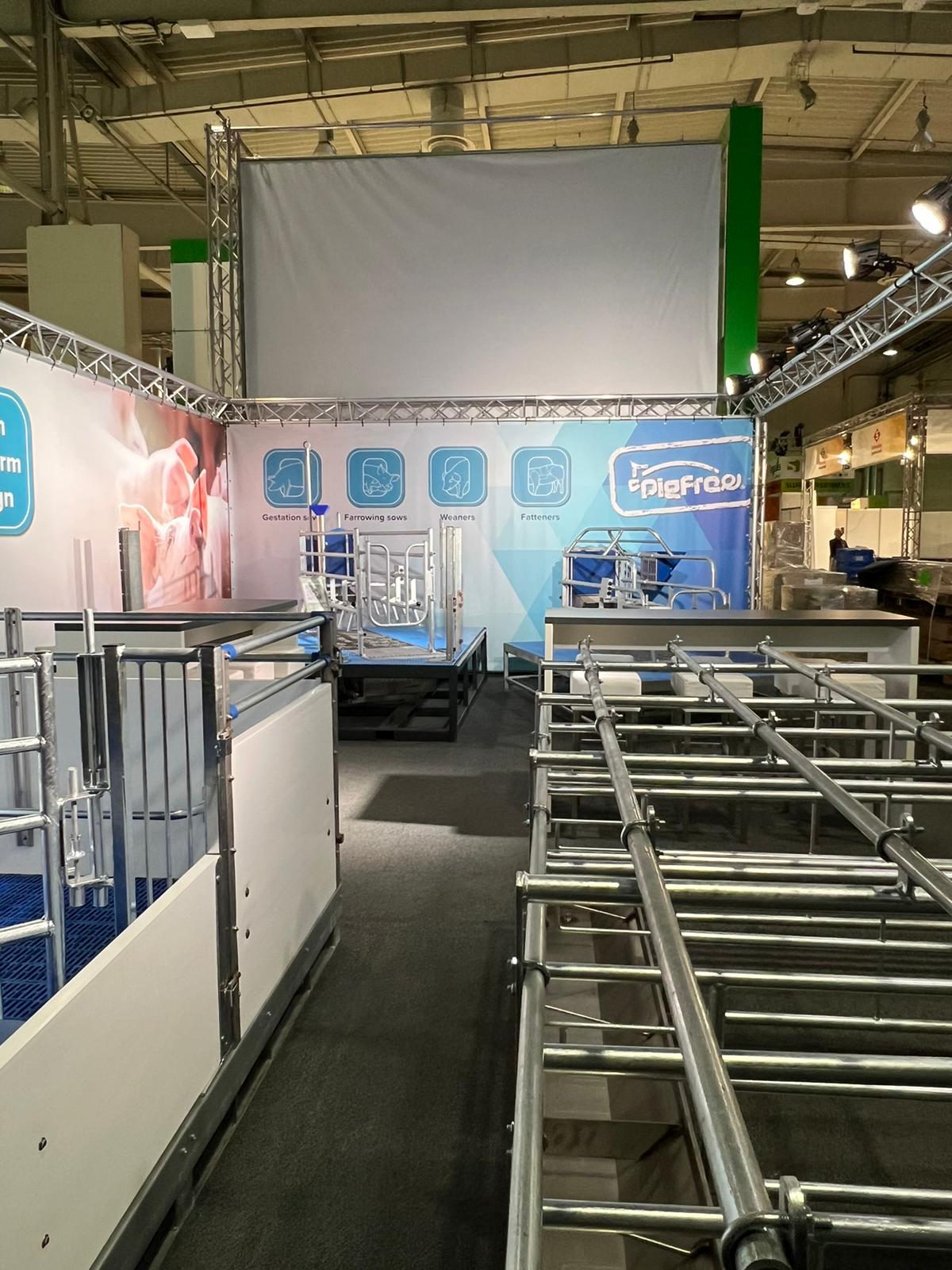
It is also easy to monitor. A staff member can see at a glance whether a holder is empty, just as they can with a feeder or drinker. In practice, farms often find that topping up a holder takes less work than repeatedly hanging new pieces of wood or clearing straw that has fallen through the slats. A stainless steel holder can also last as long as the pen equipment itself under normal use, while chains and wood need periodic replacement.
What mistakes are common with enrichment in nursery and finishing pens?
The most common mistake is assuming one type of material works throughout the entire production stage. Weaned piglets interact with material differently from finishing pigs weighing well over one hundred kilos. A holder set at the right height for piglets may become too low within weeks as they grow, and the opposite is equally true.
A second mistake is leaving the enrichment point until the end of the design process. That usually leaves only a spot beside the drinker or in the dunging area. Based on Van Osch B.V.’s renovation experience, the best results come when the holder is planned in the same design round as the feeder, drinker and slatted flooring. Drilling into pen partitions afterwards can create weak fixing points.
The third mistake is providing material that is present during an inspection but not actually used. The NVWA also looks at real use. A wooden block that remains untouched after several weeks is clearly not interesting to the pigs. Pigs need variety, which is exactly why “novel” is one of the IKB indicators.
Finally, many farms underestimate the impact on manure removal. Switching to straw without using a holder often leads to blockages, prompting a return to chains. Small portions from a dispenser help prevent this problem.
Get started:
- If piglets and finishing pigs remain in the same pen until slaughter, choose a holder with adjustable height.
- Has material remained untouched for 2 to 3 weeks? Replace it with another type.
- Is visible straw falling through the slatted floor every day? Reduce portion size or move the holder to the solid floor area.
- For new buildings, include the enrichment point on the first layout drawing, not during installation.
Frequently asked questions
Is enrichment material legally required for pigs?
Yes, environmental enrichment is mandatory for all pigs under Article 2.22 of the Dutch Animals Keepers Decree. Pigs must have permanent access to sufficient material to investigate and play with. For weaned pigs and production pigs, Article 2.14 also specifically requires straw or other material to help reduce aggression in groups.
Is a chain enough as pig enrichment material?
A chain on its own is not sufficient because it is not edible, chewable or degradable. European Recommendation 2016/336 classifies this type of material as being of secondary importance. Always combine a chain with material that offers all four qualities, such as straw or roughage in a holder.
What enrichment material is best for weaned piglets?
The best material for piglets is edible, chewable, investigable and manipulable, such as straw, hay or other roughage. Provide it in small portions through a low mounted holder so every piglet can reach it. Check daily that the holder is still filled.
Who can help fit enrichment equipment into an existing barn?
A livestock housing equipment supplier that provides custom solutions can match holders to your existing pen dimensions and fixing points. Van Osch B.V., for example, plans the enrichment point during the same design stage as the feeder, drinker and slatted flooring. Decide in advance whether you want to refill holders from the feed passage.
What does the NVWA look for when inspecting enrichment materials?
NVWA inspectors assess four things: whether pigs can reach the material, whether they actually use it, what type of material is provided and how it is offered. According to the Rotterdam District Court ruling from 2024, material must be continuously available. An empty holder at the time of inspection is therefore a non compliance issue.
Conclusion
The pig enrichment material legislation is clear about the goal: every animal must have continuous access to sufficient, suitable material. In practice, failures are rarely caused by unwillingness. They almost always come down to execution. A chain is hanging in the pen but does not meet the standard, material is placed in the dunging area, or the holder can only be reached by entering the pen.
For lasting compliance, start with the layout. Review what is currently available in each pen, assess it against the four qualities and choose a fixed location away from dunging and feeding areas. Then include the holder in the next renovation, so refilling becomes a routine part of the daily round. Van Osch B.V. links the enrichment point to pen dimensions, slatted flooring and staff routes, ensuring the solution continues to work for years to come.
About Van Osch B.V.
Van Osch B.V. is a Dutch family business from Uden, founded in 1939. The company designs, manufactures and supplies complete custom livestock housing systems for pig farms. Its range includes pen equipment for sows, farrowing sows, piglets and finishing pigs in stainless steel, plastic and steel. Pig farmers are served directly and through an international dealer network.
Sources
- de rechtbank Rotterdam (2024) — de rechtbank Rotterdam
- evaluatie van de Europese Commissie — Eur-lex
- Rijksdienst voor Ondernemend Nederland (RVO) — Rvo
- Varkensbesluit (Staatsblad 2003, 184) — Zoek
- artikel 2.14 — Wetten
- uitspraak van de rechtbank Rotterdam — Omgevingsweb
- onder meer — Varkensbedrijf
- interpretatiedocument van IKB Varken — Ikbvarken