


The short answer
A complete piglet pen is an integrated housing package for weaned piglets, including pen panels, gates, slatted flooring, a feed trough or feeder, drinkers, enrichment materials and all fixings, designed around one pen size. The main options for complete piglet pens are the panel material (plastic, galvanised steel or stainless steel), flooring layout, feeding system and gate position.
- Flooring requirement: where part of the floor is slatted, at least 40% must be solid (RVO)
- Panel options: plastic, galvanised steel or stainless steel, each with different cleaning and lifespan characteristics
- Feeding system: a dry feeder, wet feeder or long trough determines the required pen depth
- Enrichment: materials must be edible and suitable for rooting, with access for around a quarter of the group
- A complete package avoids the coordination issues that come with buying from four or five different suppliers
Why does a standard piglet pen rarely fit an existing housing unit?
You measure the room and find that thirteen pens, each 2.40 metres wide, fit perfectly. Then you notice a manure pit beam running through pen eight, while the ventilation duct is exactly where the gate needs to open. This is something Van Osch Uden consistently sees in piglet unit renovation projects: the pen size itself is rarely the issue. Making it work with what is already there is the real challenge.
That changes what people mean when they ask about complete piglet pen options. It is not simply a case of choosing one of three catalogue models. The real question is which components need to be fixed and which can remain flexible.
The piglet unit is also one of the hardest working areas on the farm. Weaned piglets arrive at around 7 to 9 kg and leave at roughly 25 kg, usually in cycles of 6 to 7 weeks. The room is emptied, cleaned and disinfected after every batch. On most farms, that means the same corners, hinges and trough edges are pressure washed 6 to 8 times a year.
Farms are getting bigger, too. According to CBS figures from the agricultural census, there were around 1,900 livestock farms keeping pigs on 1 April 2025, 7.1 percent fewer than a year earlier, while the average number of pigs per farm was approaching 5,000. Fewer farms, more animals at each site, and the same or fewer labour hours. Every task carried out in each pen therefore matters more than it did ten years ago.
What components and options are available for complete piglet pens?
A complete package usually consists of six groups of components. When these are bought separately, installation is often when mismatched dimensions become apparent.
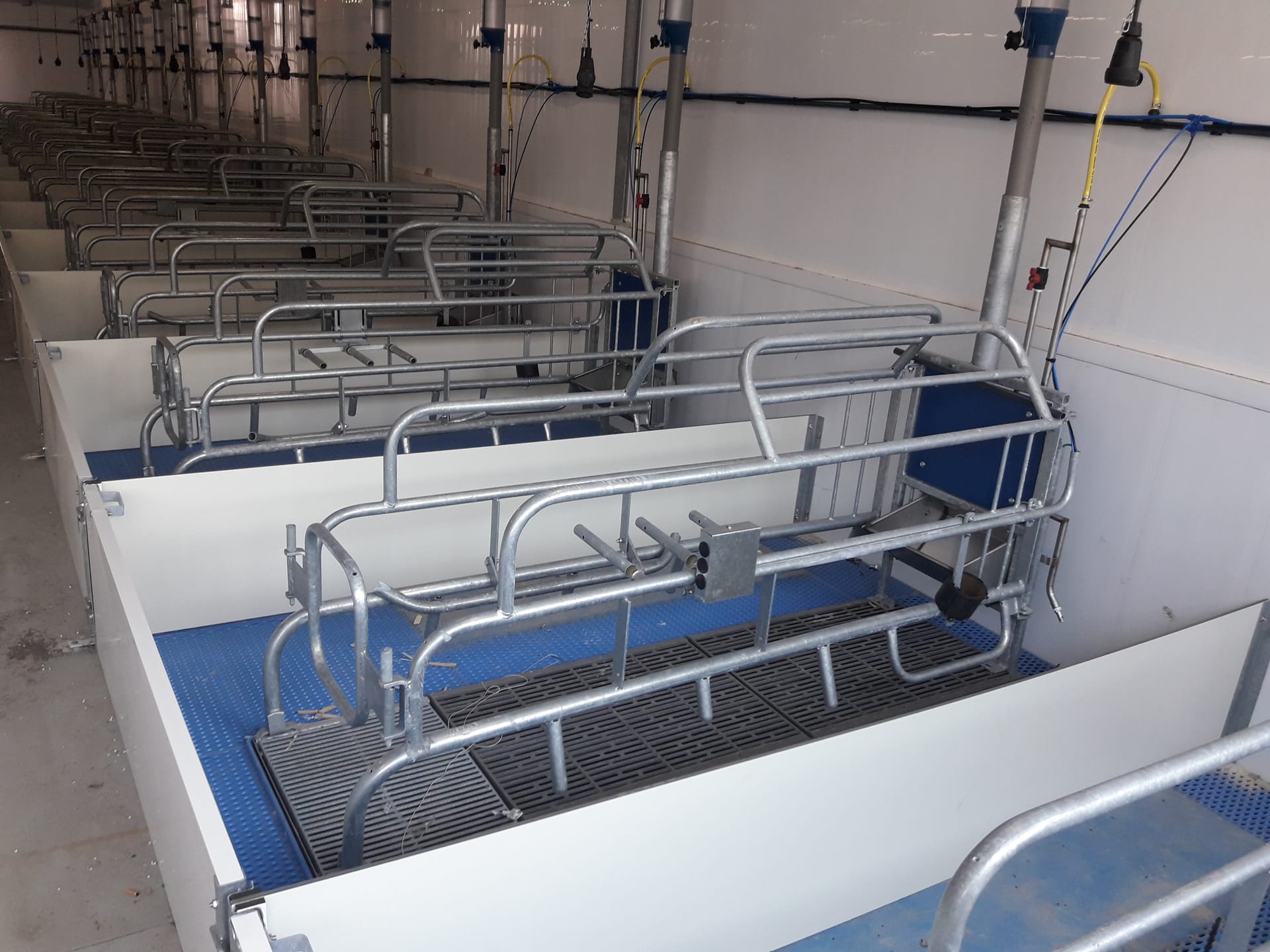
Pen panels, gates and support profiles
The pen division affects how the whole unit operates. Solid panels between pens reduce contact between groups, while open bar panels improve visibility and air movement. In practice, many pig farmers choose solid panels along the lying area and open panels on the passage side, so they can immediately see what is happening as they walk through the unit.
Gate width may seem like a minor detail, but it has a major impact. A gate that is too narrow for a sorting board adds extra minutes to every pen when animals are moved out. Across 60 pens and 6 batches a year, that soon adds up.
Flooring and feed troughs
Slatted flooring for piglets requires a different slot width from flooring used for finishing pigs. With the solid floor area, placement matters: it should be under the heat lamp or above underfloor heating, and away from the animals’ main traffic route. As a rule of thumb, the solid floor runs along one side of the pen, with the dunging area diagonally opposite and the trough on the passage side.
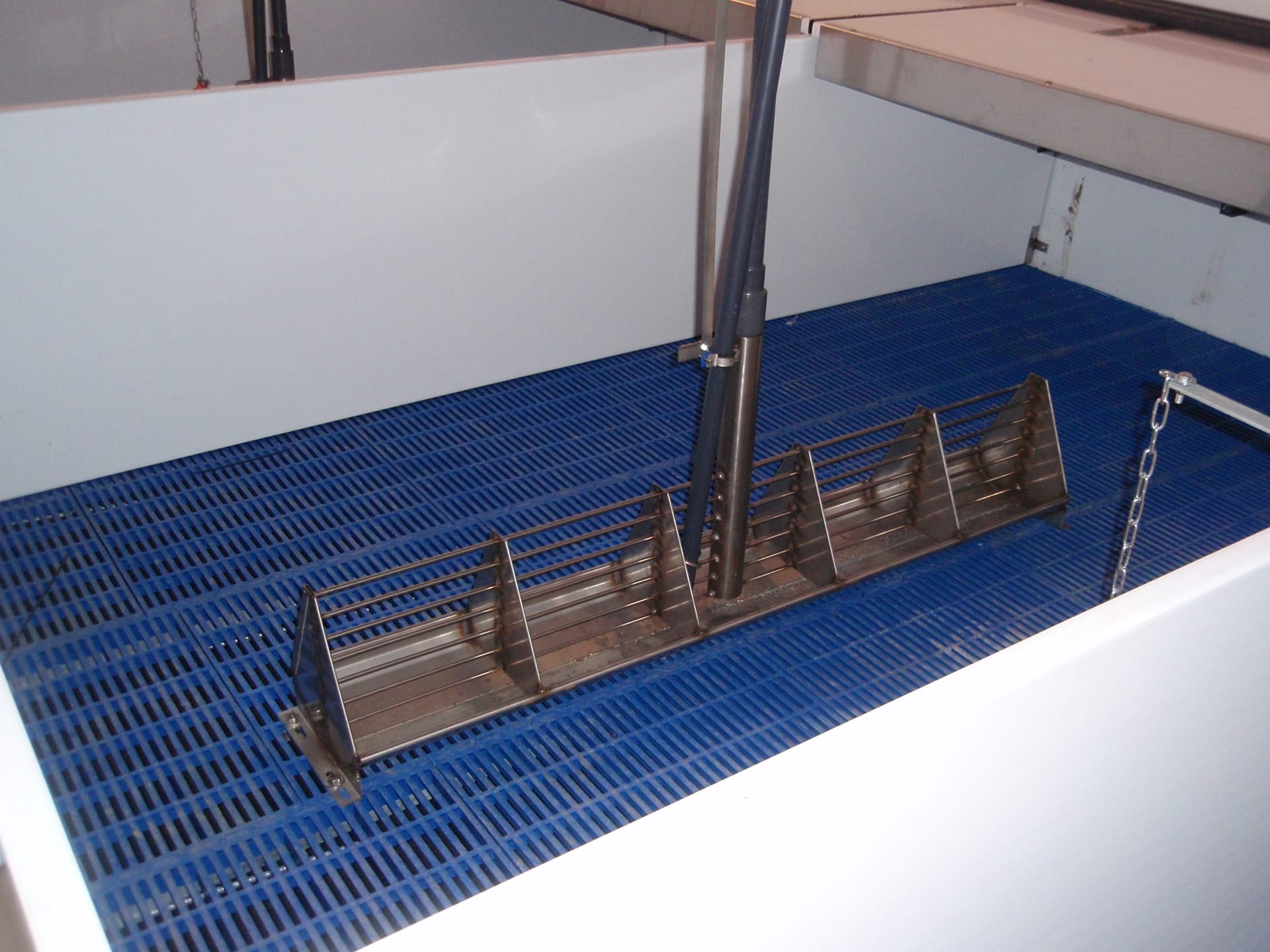
The choice of trough depends on the feeding regime. A stainless steel trough with dividers works well for restricted feeding, while a dry feeder or wet feeder is more suitable for ad lib feeding. Van Osch Uden supplies stainless steel troughs and drinkers made to the required pen width rather than in fixed modules, which is particularly useful when working around the leftover dimensions found in existing buildings.
Enrichment materials
This is the component most often treated as an afterthought, and the one most likely to cause a compliance issue. We will return to this below.
What are the requirements for flooring and enrichment in a piglet unit?
For weaned piglets, two figures matter most: the percentage of solid flooring and the proportion of animals that can access enrichment materials.
According to RVO, weaned pigs must have a minimum floor area per animal based on their weight. Where part of the floor is slatted, at least 40 percent must be solid. The same source also sets out group size adjustments: for groups of more than 40 animals, the total floor area may be 10 percent smaller, while groups of fewer than 6 animals require 10 percent more space.
This group size adjustment is more relevant to piglet pens than many farmers realise. Moving from pens of 30 piglets to pens of 45 piglets immediately changes the calculation for space per animal and the required trough space.
In practice, the requirements for enrichment are more specific than the wording of the legislation may suggest. Case law and NVWA inspections of enrichment materials apply the principle that at least 25 percent of the animals in a group must be able to interact with the material at any one time, and that the material must be both edible and suitable for rooting. In a pen with 40 piglets, this means access for around ten animals at once, not a single chain in one corner.
The scale of the issue is clear from the NVWA compliance survey for 2023-2024: of 170 inspected commercial pig farms, 58 inspections were compliant and 112 were not. The rules on enrichment materials and alarm plans were breached most often. Enrichment is not an optional extra when ordering a pen. It is the area most likely to cause problems during an inspection.
Checklist:
- Calculate the solid floor area for each pen and confirm that it exceeds 40 percent, including whether the trough base is included in the calculation
- Determine the number of piglets per pen and divide it by four: that is how many animals must be able to use the enrichment material at the same time
- Specify where edible, rootable material will be provided in every pen, and who is responsible for topping it up
- Check whether you want to apply the 10 percent floor area adjustment for groups above 40 animals or deliberately allow more space
How do you choose the right setup for your piglet unit, step by step?
Step 1: Measure the three fixed dimensions in the unit
Start with the manure pit layout, column positions and clear height beneath the ventilation system. These are fixed and determine the maximum possible pen depth. Van Osch Uden uses the existing pit layout as the starting point during the design stage, because a pen layout that does not align with the supporting beams will always require additional steelwork.
Step 2: Choose the group size before deciding on pen dimensions
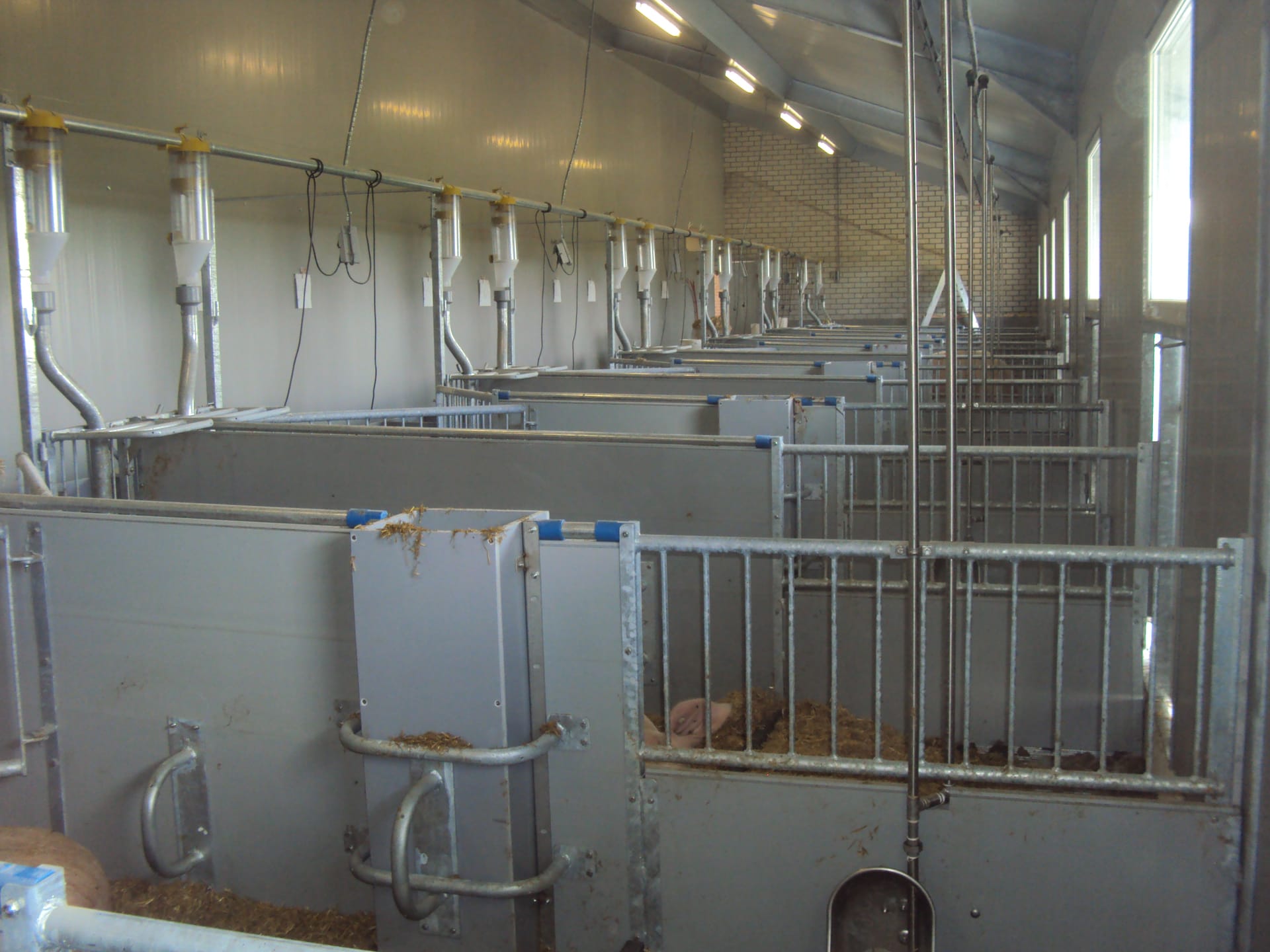
Group size should follow your weaning schedule and working method, not the available width. Smaller groups of 20 to 25 piglets tend to be calmer and easier to sort, while larger groups require fewer panels per animal. Calculate both options based on the number of pens needed in the unit.
Step 3: Decide on the feeding system and the trough space required
Restricted feeding requires sufficient trough space per animal. Ad lib feeding requires a feeder with enough feeding places. This decision affects the entire pen layout: a long trough along the passage side needs a different gate position from a dry feeder placed in the centre.
Step 4: Finalise the flooring layout
Put the solid floor area, slat type and location of the dunging area on one drawing. If the solid section is positioned too far from the heat source, piglets will lie on the slats and soil the solid floor. That creates extra scrubbing work with every batch.
Step 5: Choose materials by component, not for the entire pen
The best solution is rarely one material throughout. Use stainless steel in areas that get wet and dirty every day, such as the trough, drinker and lower edge. Plastic or galvanised steel can be suitable for surfaces that stay mostly dry. This approach to material choice and lifespan can reduce the initial investment without compromising on high wear areas.
Step 6: Review day to day operation with the person doing the work
Ask the stockperson to walk through the drawing: where will they stand when moving pigs out, where will the hose be, and how will a trolley get through? Ease of use matters more in piglet housing than in any other animal group, because the unit is completely emptied and cleaned 6 to 8 times a year.
Step 7: Put delivery, installation and components into one agreement
Using one supplier for panels, slatted flooring, troughs, drinkers and enrichment means one set of dimensions and one point of contact if something goes wrong. This is exactly where separate purchasing often fails, as shown in the choice between renovating and building new livestock housing equipment.
Which materials and designs deliver the best long term value?
Consider a pig farmer with around 500 sows who is refurbishing two piglet units with around 60 pens in total. The first unit uses plastic panels with stainless steel troughs and drinkers. The second uses fully galvanised steel with the same stainless steel components. After a few years, the difference is usually not in the panels themselves. It is in the fixing points and the lower edges that take the full force of every washdown. That is where material choice either pays off or does not.
| Design | Investment per pen (indicative) | Cleaning time per batch | Most vulnerable point | Expected lifespan |
|---|---|---|---|---|
| Plastic panels + stainless steel trough | lowest of the three | around 10 to 15% shorter than steel | fixings and flexing | typically 10 to 15 years |
| Galvanised steel + stainless steel trough | mid range | average | lower edge and zinc coating after damage | typically 12 to 18 years |
| Fully stainless steel | highest, often significantly more than steel | shortest, due to the smooth surface | very few, if properly finished | typically 20 years or more |
The figures in this table are indicative and vary by farm, cleaning routine and pen size. What they do show is that total cost over 20 years depends less on the purchase price than on how often a component has to be refitted or replaced.
One counterintuitive lesson from renovation projects is that the most expensive mistake in a piglet unit is almost never choosing the wrong material. It is choosing a pen size that does not quite suit the number of piglets per litter, forcing staff to redistribute piglets every batch. Over 20 years, that labour adds up to more than the price difference between plastic and stainless steel. When planning complete piglet pens, the calculation per pen is therefore more important than the material specification.
Which mistakes cost pig farmers the most when setting up piglet pens?
The first is deciding on trough space too late. If you order the panels before choosing the feeding system, you may end up short of trough width or with a pen that is too deep for the number of animals.
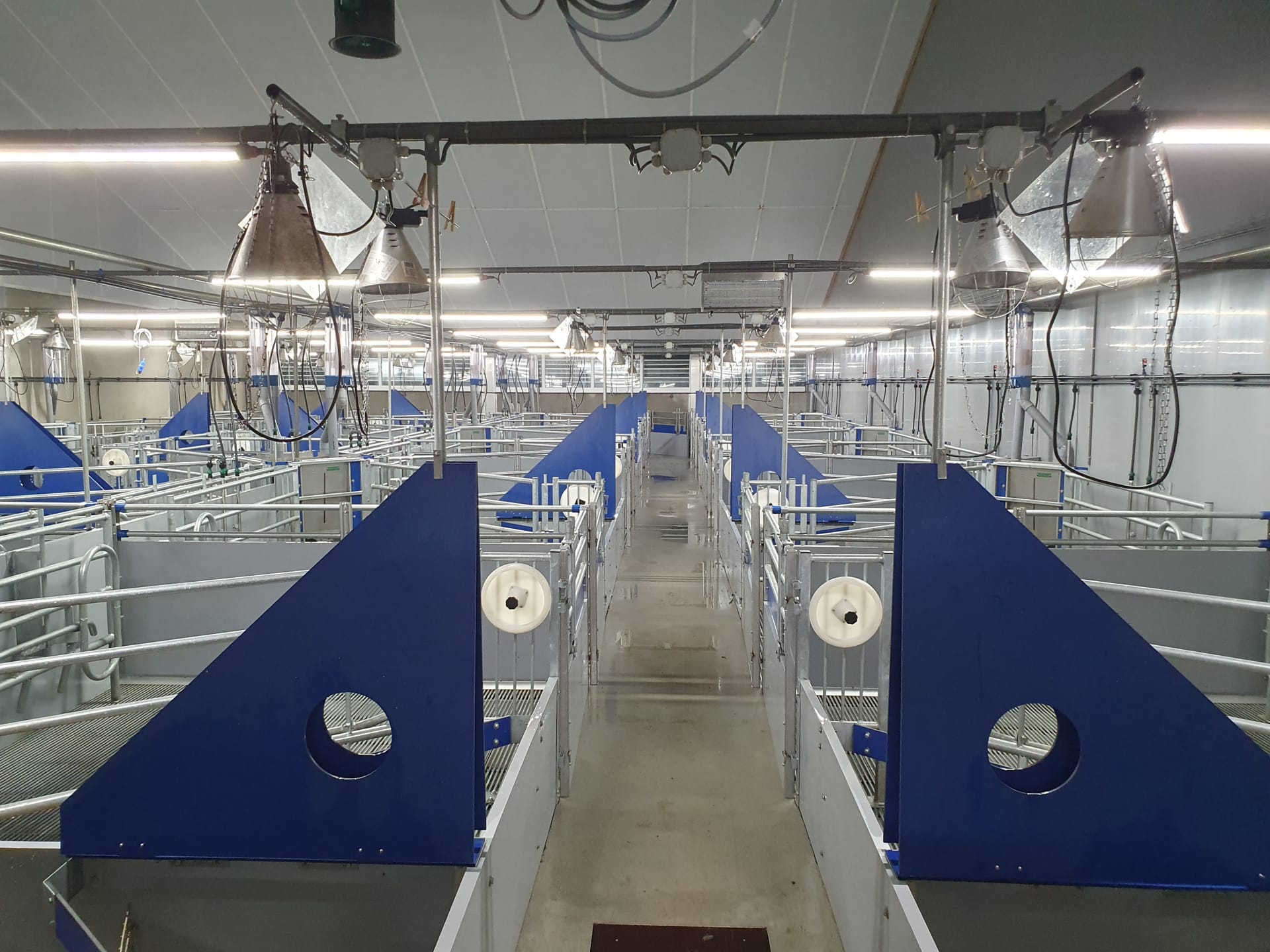
The second is treating enrichment as a final add on. Given the NVWA compliance survey above, this is the area most likely to result in a non compliance finding during an inspection. Include edible, rootable material in the pen drawing, rather than adding it in a separate order later.
The third is overlooking cleaning during the design stage. Every joint, horizontal rail and unfinished profile creates a place where dirt can collect. With 6 to 8 batches each year, a smoother finish can noticeably reduce scrubbing time across the unit.
The fourth is buying from four separate suppliers. Slats from one, panels from another and troughs from a third may look cost effective on paper, but it often creates an installation problem where nobody is responsible for dimensions that do not match. Van Osch Uden sets out its service commitment through the Five O’s: solution focused, supportive, open, organised and sincere. This includes a call back guarantee within one working day, because it is only after installation that you find out whether promises hold up.
Checklist:
- Include trough space per animal in the drawing before ordering the pen panels
- Include enrichment materials in the same order as the pen equipment, with the location and quantity specified for every pen
- Review the pen drawing for horizontal rails and open joints, and remove them wherever possible
- Ask one supplier for a complete dimension schedule covering panels, slatted flooring, troughs and drinkers
- Agree who to call if a hinge sticks after three months, and how quickly the issue will be addressed
Frequently asked questions
What exactly is a complete piglet pen?
A complete piglet pen is a made to measure housing package for weaned piglets, including panels, gates, slatted flooring, a trough or feeder, drinkers, enrichment materials and fixings, all designed to one set of dimensions. The difference from buying separate components is coordination: every measurement is based on the same pen width and depth. This reduces installation time and prevents problems such as a trough that is just too wide to fit between two panels.
How much solid flooring does a piglet pen need?
Where the floor is partly slatted, RVO requires at least 40 percent of the floor to be solid for weaned pigs and finishing pigs. The minimum floor area per animal also depends on weight. Calculate the solid area for each pen in square metres and check whether the trough base is included in your specific layout.
What enrichment materials are permitted for piglets?
Enrichment materials must be both edible and suitable for rooting. During NVWA inspections, the standard applied is that at least 25 percent of the animals in the group must be able to use the material at any one time. For 40 piglets in a pen, this means access for around ten animals at once. One single object per pen will therefore almost always be insufficient.
Is stainless steel or plastic better for a piglet unit?
Choosing the best material for each component delivers better value than using one material throughout the pen. Stainless steel pays for itself particularly well in troughs, drinkers and lower edges, which get wet and dirty with every batch. Plastic and galvanised steel are suitable for surfaces that remain largely dry, provided the fixings are properly designed.
Can a complete piglet pen be installed in an existing building?
Yes, provided the manure pit layout, column positions and available pen depth allow it. In practice, this type of renovation starts by measuring these three fixed factors. The pen size is then designed around them, rather than the other way round. Remaining dimensions at the end walls are normal and can be filled with made to measure components.
Conclusion
The range of complete piglet pen options is broader than most catalogues suggest, but the decision should not start with panel material. It should start with three factors: the fixed dimensions of your existing building, the number of piglets per pen in relation to your weaning schedule, and the feeding system that determines the whole pen layout. Material selection comes afterwards, preferably on a component by component basis.
A structured approach starts by measuring the manure pit and column positions, then calculating the solid floor area and trough space per animal, and including enrichment in the same drawing rather than adding it as a follow up order. Given the NVWA compliance survey, enrichment is the point most likely to cause problems during an inspection.
Van Osch Uden’s in house engineering and production in Uden make it possible to include the remaining dimensions of an existing piglet unit in the same order as the standard pens. That is ultimately what separates a complete package from buying individual components from four different suppliers.
Sources
- CBS-cijfers uit de landbouwtelling — Cbs
- RVO — Rvo
- NVWA-controles op hokverrijking — Varkensbedrijf
- naleefmeting van de NVWA over 2023-2024 — Nvwa
- Welzijnseisen voor varkens — RVO.nl (Rijksdienst voor Ondernemend Nederland)
- Resultaten naleefmeting welzijnsregels varkens 2023-2024 — NVWA (Nederlandse Voedsel- en Warenautoriteit)
- Hokverrijking: waar let de NVWA op? — Varkensbedrijf.nl
- Varkensstapel voor het eerst in ruim 45 jaar onder de 10 miljoen — CBS (Centraal Bureau voor de Statistiek)