


The short answer
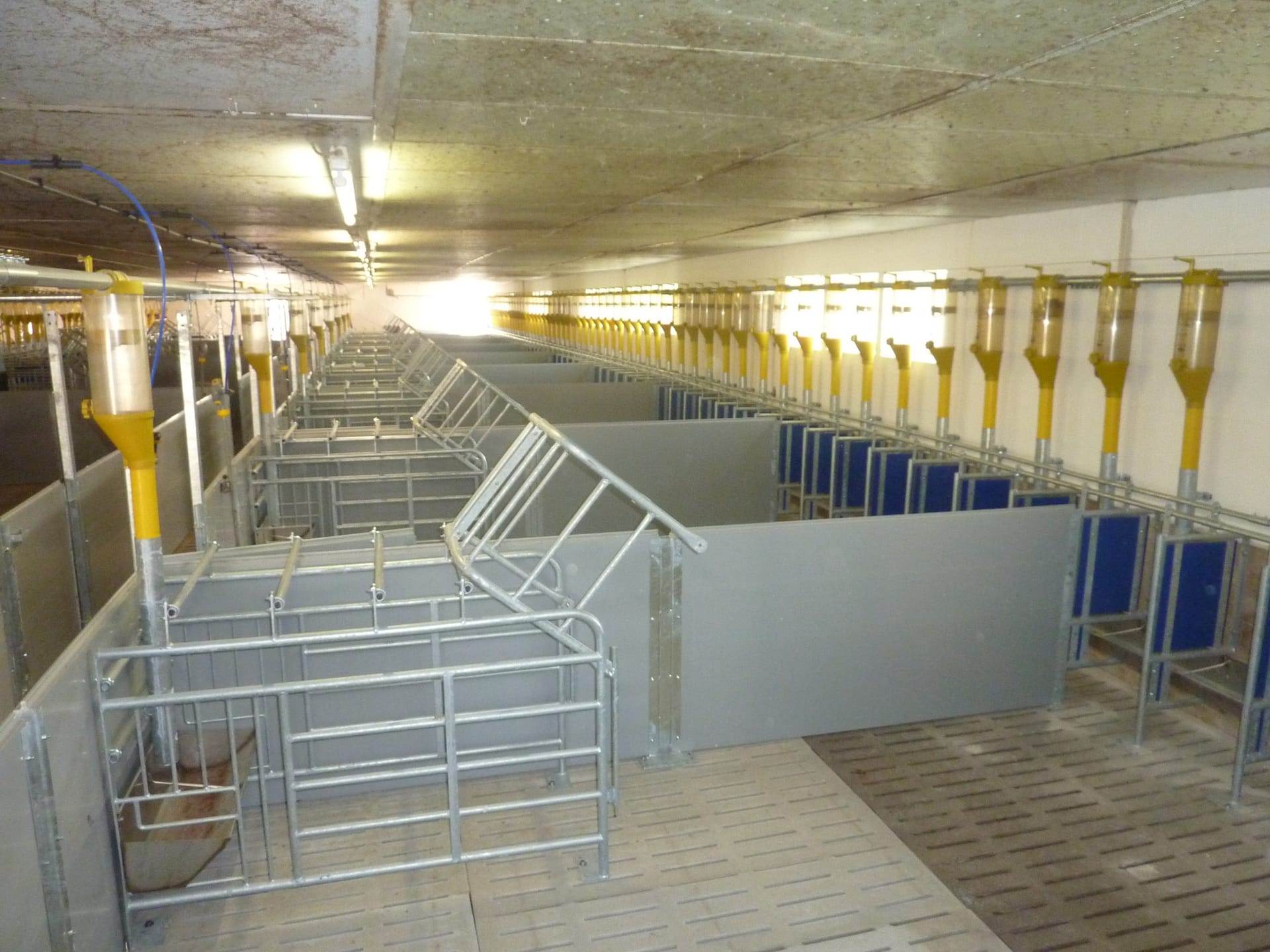
When fitting out free farrowing pens, we recommend choosing materials according to the load on each individual component. As a manufacturer and specialist in bespoke pig housing systems, Van Osch B.V. supplies complete solutions, from design through to installation. Stainless steel is increasingly the default choice because a loose sow puts far greater mechanical pressure on walls and partitions as she turns, pushes and rubs against them. Its smooth surface also remains easy to clean after years of washing. Plastic remains a sensible option where thermal insulation, noise reduction and low weight matter most, such as partitions in the piglet nest. This mix of materials reflects the changing requirements for free farrowing pens.
Key takeaways
- For participants in the Better Life certification scheme, free farrowing pens will become mandatory by 2035 at the latest, according to Nieuwe Oogst (2026), with a minimum pen size of 7.5 square metres.
- According to the Flemish government, new farrowing pens in Germany must provide at least 6.5 m² per sow and permit confinement for no more than 5 days, with a 15 year transition period.
- According to ThyssenKrupp Materials Netherlands, stainless steel 316 contains around 2% more molybdenum than stainless steel 304, improving its resistance to pitting corrosion.
- Larger pens generally mean fewer pens per unit. Producers looking to keep the same number of sows will need to build additional farrowing pens, according to the same Nieuwe Oogst publication.
- Material choices should be made by component, not by the pen as a whole. Hinges and the sow side of the pen are often best in stainless steel, while piglet nests and dividing walls are more often suited to plastic.
Why does pen equipment wear out faster in a free farrowing system?
Van Osch B.V. regularly sees the same pattern among sow producers opening their first free farrowing unit. Components that lasted ten years in a conventional farrowing pen can develop play or wear marks within just a few years in a free farrowing pen. It is not necessarily a question of inferior materials, but of a completely different load pattern.
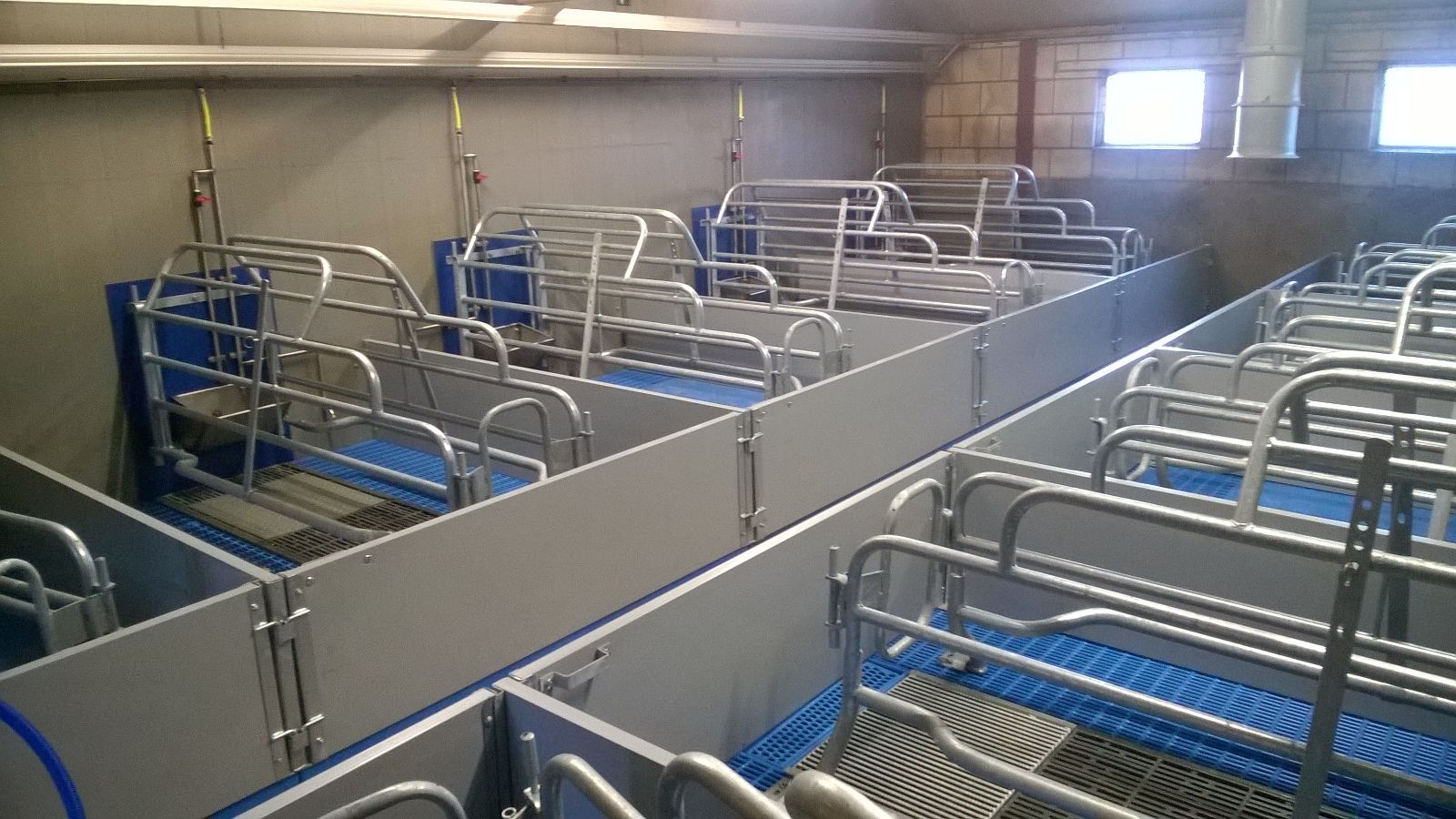
In a conventional crate, the sow stays largely in one place. The loads are predictable and distributed across fixed support points. Give that same sow 6.5 to 7.5 square metres of room, and you have an animal weighing more than 200 kilos turning around, leaning on pen dividers and rubbing her shoulder along edges. Every turn puts force on hinges, latches and the bottom 40 to 60 centimetres of the pen wall.
Cleaning is the second factor. A larger pen means more surface area to wash between batches, often using high pressure equipment and cleaning chemicals. Materials that need to withstand this year after year vary greatly in how smooth they remain. Once a surface becomes rougher, it retains manure and biofilm, making every subsequent cleaning cycle more time consuming.
A third factor is often overlooked: stockpeople move around inside the pen more often. Whether moving piglets, fitting a temporary divider or treating an animal, they have to enter the pen. Hinges and handles are therefore used more frequently than in a fixed system. This is exactly where a well considered design for durable bespoke pig housing makes the difference between a pen that still closes neatly after eight years and one that starts to rattle.
Stainless steel for free farrowing pens: what can stainless steel and plastic do in the farrowing unit?
Stainless steel is a chromium containing steel alloy that forms a passive oxide layer, keeping the surface hard, impact resistant and smooth even after years of cleaning. In a free farrowing pen, that lasting smoothness is often the deciding factor, rather than corrosion resistance alone.
When stainless steel 304 is sufficient and when 316 makes sense
There is an important distinction between stainless steel grades. According to ThyssenKrupp Materials Netherlands, stainless steel 316 contains chromium, nickel and around 2% molybdenum, which improves resistance to pitting and stress corrosion. In a farrowing unit subject to intensive cleaning and chemically demanding products, this can matter for components that remain permanently damp. Standard grade stainless steel is generally sufficient for structural parts exposed to drier conditions. Technical supply requirements for these grades are set out in the NEN EN 10088 standards series, allowing buyers to specify a documented material grade rather than simply asking for stainless steel.
Where plastic comes out ahead
Plastic pen dividers offer benefits that stainless steel cannot. They feel warmer to the touch, reduce noise and are lighter to install or remove. Those properties matter in the piglet nest and in partitions between pens. Weight can also be a major consideration when refurbishing an existing unit with limited load bearing capacity.
The weakness lies at the edges and fixing points. Where a sow repeatedly pushes against a panel, it can deform or crack around the bolt holes. In a free farrowing pen, these are exactly the areas subject to the greatest loads.
The issue most quote comparisons overlook
The conversation almost always focuses on the panel material. Yet walls are rarely the first parts to fail. Hinges, latches and the wall to floor fixings usually give way first. A plastic wall with a stainless steel frame and stainless steel pivot points will often outperform an all stainless steel pen fitted with undersized latches. When reviewing a quote, look at the connections before comparing square metres of panel.
Checklist:
- Ask for the material specification for every component, not simply “stainless steel or plastic” for the whole pen.
- Check that pivot points and latches are made from stainless steel, including where plastic walls are used.
- Ask about panel thickness and the centre to centre spacing of fixing points.
- Confirm which components will remain available as separate replacement parts.
- Check whether the bottom 40 to 60 centimetres of the pen wall have additional reinforcement.
Stainless steel or plastic by component: which material works best where?
The honest comparison is not one material against another, but one component at a time. The table below reflects the trade offs typically discussed when designing free farrowing pens.
| Component in the free farrowing pen | Stainless steel | Plastic |
|---|---|---|
| Pen wall on the sow side, bottom 40 to 60 cm | ✅ Withstands turning and pushing forces | ⚠️ Risk of deformation around bolt holes |
| Piglet nest partition | ⚠️ Cooler surface | ✅ Thermally insulating and noise reducing |
| Pivot points and latches | ✅ Preferred for daily operation | ❌ Generally not suitable |
| Surface after years of cleaning | ✅ Usually remains smooth | ⚠️ May discolour or become rougher |
| Weight during refurbishment installation | ⚠️ Heavier, requiring more support points | ✅ Lighter and quicker to install |
| Replacing individual parts | ✅ Individual parts can often be replaced | ⚠️ The full panel often needs replacing |
There are two important qualifications to this table. Plastic has the advantage on purchase price per square metre, but in a free farrowing pen, the lifespan of heavily loaded areas determines total lifetime cost, not the initial cost per panel. The table is also a rule of thumb rather than a prescription. Different dimensions or an existing floor structure can change the best choice for a particular unit.
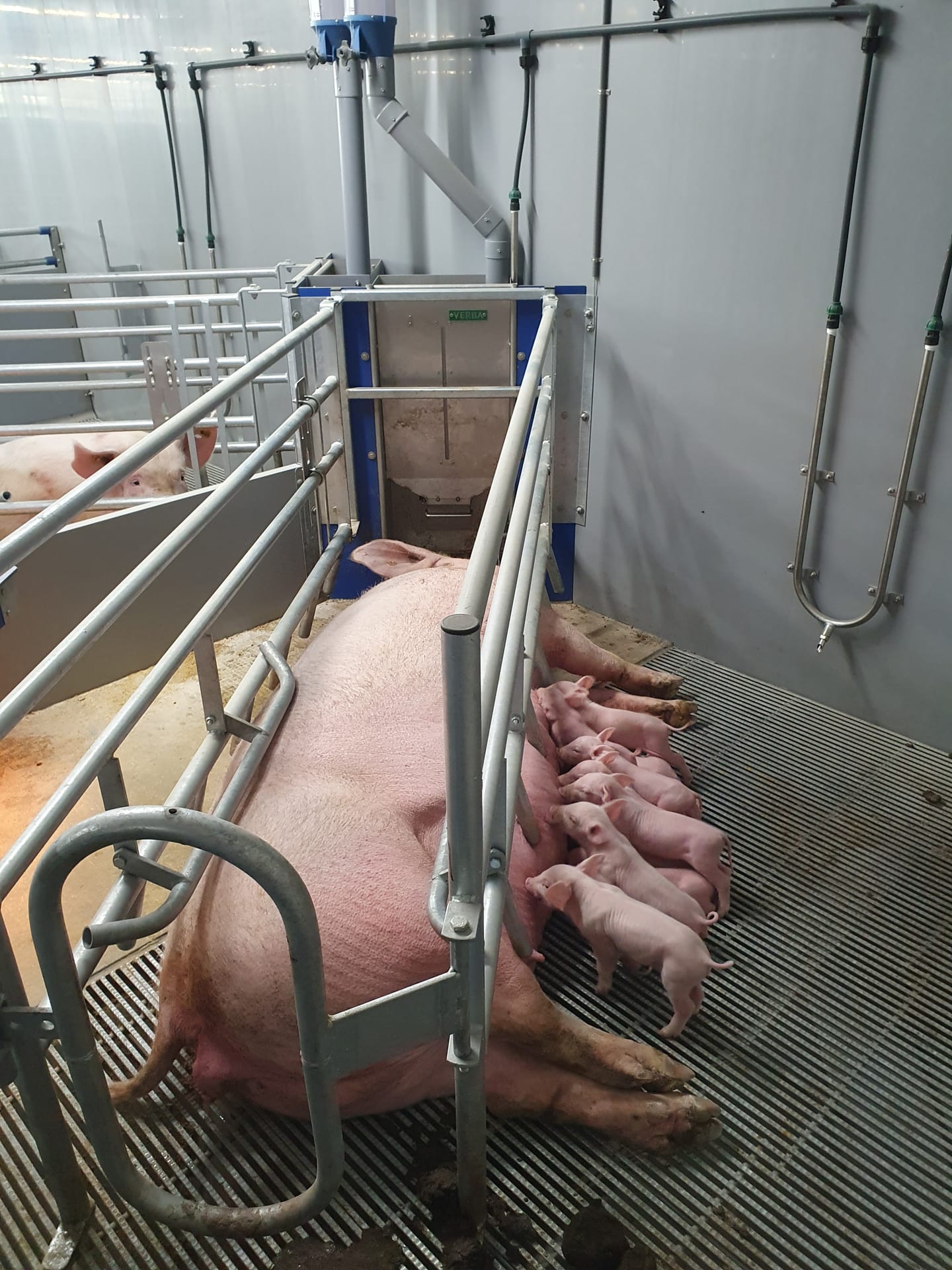
A second practical consideration is that the European Food Safety Authority already advised in 2007 that free farrowing pens should only be introduced if piglet mortality did not exceed that of farrowing crates, according to the Flemish government. This makes pen layout just as important as material selection. The lying area, piglet corner and sow movement route together determine whether the system works. At the free farrowing project in Wolferstedt, pen geometry and material allocation were developed in the same design phase because each directly affects the other.
Which material mix suits new builds and which suits refurbishments?
Consider a sow producer with around 400 sows reviewing their farrowing units ahead of the 2035 requirements. Their existing pens measure around 4 square metres. With a minimum pen size of 7.5 square metres for Better Life scheme participants, the same building would hold roughly half as many pens per unit. The choice is therefore clear: refurbish within the existing building footprint and reduce sow numbers, or extend the building.
For a new build
If you have freedom over dimensions, the logical approach is to use stainless steel in heavily loaded areas and deploy plastic selectively in the piglet nest. The extra cost of stainless steel on the sow side is modest in relation to the overall construction budget, while helping avoid replacement cycles over the next fifteen to twenty years.
When refurbishing an existing unit
Here, weight and the existing support structure become decisive. Plastic panels with stainless steel frames and stainless steel pivot points are often the practical middle ground. One key issue is that the new pen size will rarely fit the existing layout exactly. Standard catalogue dimensions may not align with existing manure channels and slatted floor sections. This is why bespoke pig housing solutions matter more in refurbishment projects than in new builds. A one centimetre difference per pen quickly adds up across a row of ten pens.
When converting in phases
Many farms do not convert everything at once. In that case, it makes sense to define the material standard now that you will want for the next unit in five years’ time, ensuring replacement parts remain interchangeable between units. Producers choosing free farrowing pens with the requirements from 2028 in mind should build that interchangeability into the design from the start.
Checklist:
- Measure existing pen widths and manure channel locations before requesting a quote.
- Calculate how many pens will fit within the current building footprint at 6.5 m² and at 7.5 m².
- Decide which material you want in each zone: sow side, piglet nest and dividing wall.
- Identify which parts must still be available to order in five years’ time.
- Request one complete quote covering pen equipment, slatted flooring and finishing profiles.
Frequently asked questions
What exactly is a free farrowing pen?
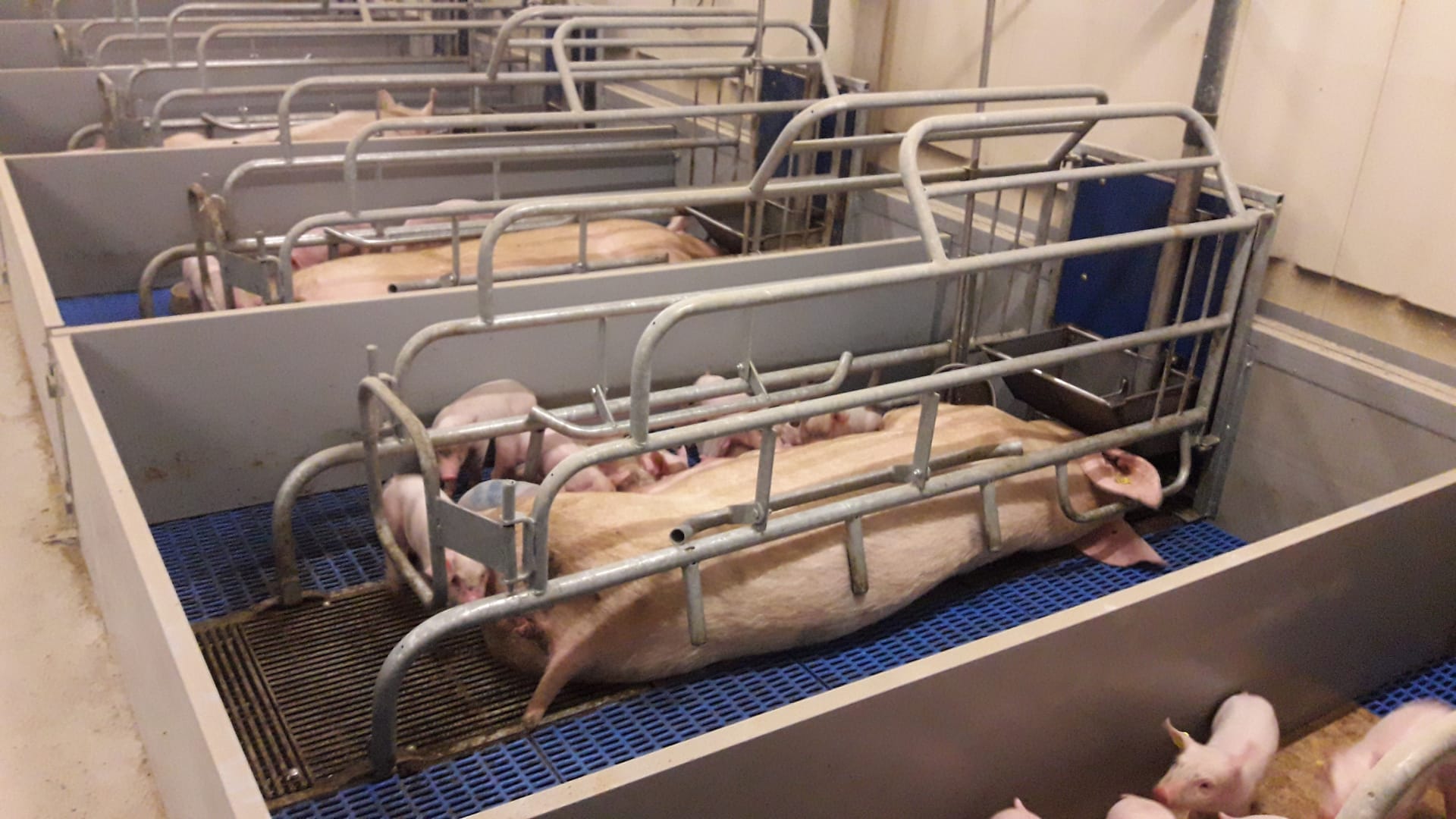
A free farrowing pen is a farrowing pen in which the sow is not permanently confined and can move freely around the time of farrowing. Under the German rules described by the Flemish government, a sow may be confined for no more than 5 days. These pens therefore need more space than conventional farrowing pens, which affects the number of pens that can be accommodated in each unit.
How many square metres does a free farrowing pen need?
The required area depends on the applicable scheme or regulation. According to Nieuwe Oogst (2026), Better Life scheme participants will require at least 7.5 square metres, in line with organic standards. New farrowing pens in Germany must provide at least 6.5 m² per sow. When planning, work from the strictest standard that applies to your route to market.
Is stainless steel always more expensive than plastic in a farrowing unit?
Usually per square metre at the point of purchase, but often not over the full service life. Stainless steel is typically used only in the most heavily loaded areas, rather than throughout the whole pen, which limits the additional cost. Assess costs by zone and expected replacement cycle, not by panel alone.
Will plastic pen equipment fail with a loose sow?
Not necessarily, but the load is concentrated at the fixing points. In a free farrowing system, the sow pushes and turns against the lower half of the wall, where bolt holes and edges are at their weakest. A plastic panel in a stainless steel frame with a reinforced lower edge will generally perform far better than a panel fixed directly in place.
Which stainless steel grade is suitable for a farrowing unit?
That depends on moisture exposure and the cleaning products used. According to ThyssenKrupp Materials Netherlands, stainless steel 316 contains around 2% more molybdenum and therefore has better pitting corrosion resistance than stainless steel 304. Ask your manufacturer for the material specification under the NEN EN 10088 standards series, rather than accepting the term stainless steel on its own.
Conclusion
There is no one size fits all answer to whether free farrowing pens should use stainless steel or plastic. There is, however, a clear method: select materials by zone and give more weight to the connections than to the panels themselves. The sow side, pivot points and latches need the toughest construction, while the piglet nest benefits from warmth and noise reduction.
Take three practical steps over the coming months. First, measure your existing unit and calculate how many pens will fit at 6.5 and 7.5 square metres. Next, choose the material for each zone and establish this as the standard for every unit you convert in phases. Finally, request one integrated quote that includes pen equipment, slatted flooring and finishing profiles, so you are not left coordinating four separate suppliers.
Van Osch B.V.’s experience with free farrowing units in the Netherlands and Germany shows that farms that follow this sequence, starting with design and then selecting materials, face fewer surprises at handover.
About Van Osch B.V.
Van Osch B.V. is a Dutch family business based in Uden, founded in 1939. The company designs, manufactures and supplies complete bespoke pig housing systems for sows, farrowing sows, piglets and finishing pigs, using stainless steel, plastic and steel. It serves pig producers and dealers across Europe and beyond, both directly and through an international dealer network.
Sources
- Nieuwe Oogst — Nieuweoogst
- ThyssenKrupp Materials Nederland — Thyssenkrupp-materials
- NEN-EN 10088 — Nen
- Varkenscriteria Beter Leven-keurmerk worden aangescherpt — Nieuwe Oogst
- Normen voor (vrijloop)kraamhokken — Vlaamse overheid, Departement Landbouw en Zeevisserij
- Prijsverschil, eigenschappen en verschillen tussen RVS 316/304 en RVS 316L/304L — ThyssenKrupp Materials Nederland
- NEN-EN 10088-2:1995 nl — NEN (Nederlands Normalisatie-instituut)