


Quick summary
Van Osch Uden designs and installs custom pig housing equipment built to withstand twenty years of wear in demanding barn conditions, while remaining flexible enough to meet changing regulations. That is why we look beyond material selection. Construction, fixings and adaptability together determine a system’s true service life.
- Six choices make the difference: materials for each animal group, slatted flooring, fixing methods, cleanability, modularity and service support
- Stainless steel performs best under heavy mechanical loads and in harsh environments, while plastic offers a warmer feel and lower weight
- Legal slat width requirements should shape the design from the outset, not be treated as an afterthought
- Farms are getting larger: an average of five thousand pigs per pig farming business in 2025 (CBS)
- The ability to replace individual parts matters more than the purchase price per pen
Why does one pen system last twenty years while another lasts eight?
This is something Van Osch Uden regularly sees in renovation projects: custom pig housing equipment rarely reaches the end of its life because the material itself has failed. More often, the fixings have come loose, the dimensions no longer suit the new group size, or replacement parts are no longer available. The steel is still in excellent condition. The system around it is not.
That distinction between physical wear and functional obsolescence is central to this topic. A pig farmer investing in custom pig housing equipment will usually plan for a depreciation period of fifteen to twenty years. A lot can change during that time. Group sizes shift, housing systems evolve, and daily routines change as the operation grows.
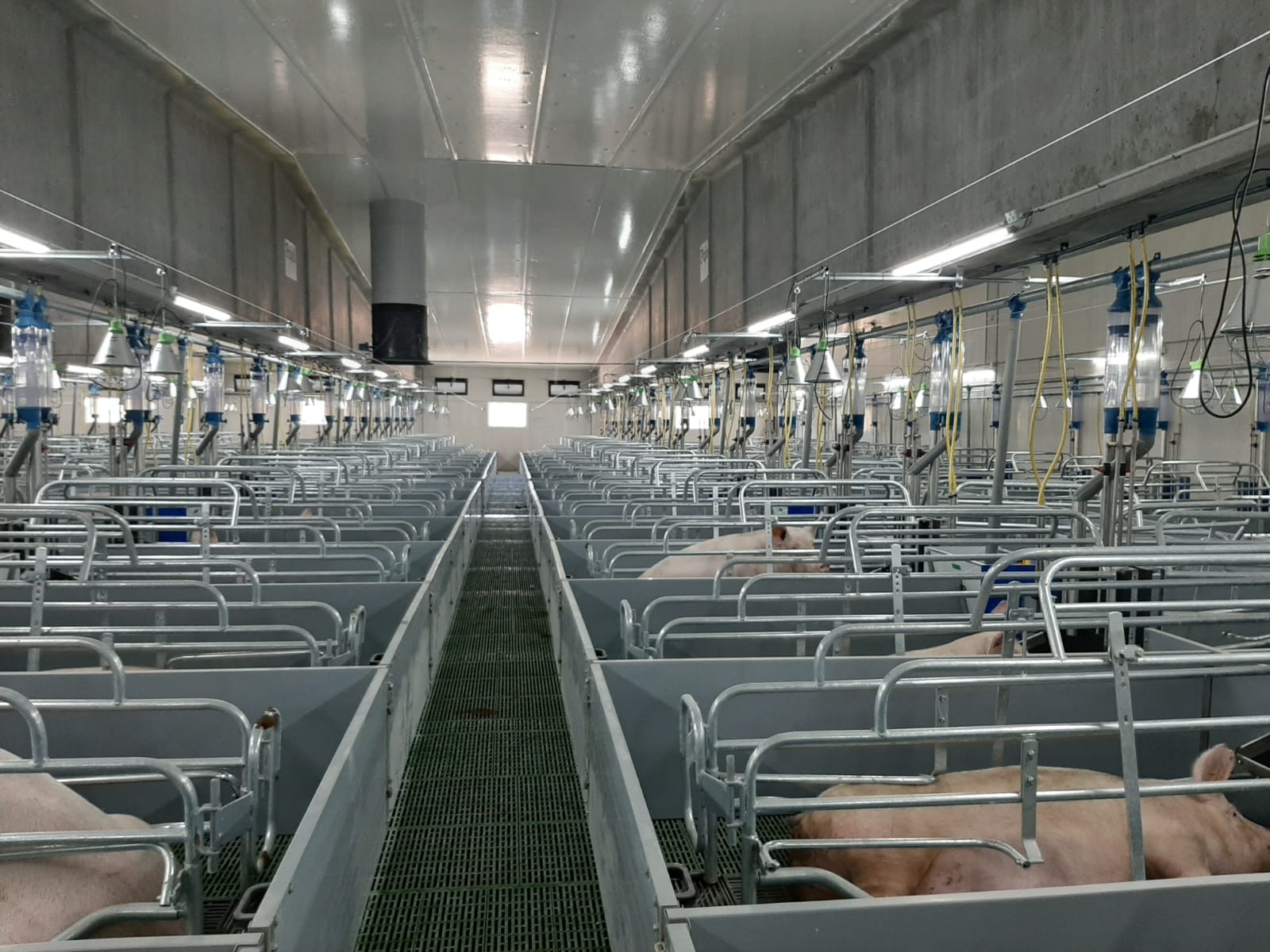
The figures support this trend. According to CBS, the Netherlands had fewer than 10 million pigs on 1 April 2025 for the first time since 1979, while the average number of pigs per pig farming business rose to five thousand, almost 50% more than ten years earlier. Fewer farms, larger units. Equipment that works in a section with forty pens must therefore also work in one with one hundred and twenty, using the same operating methods and available parts.
The six choices below determine whether your installation goes the distance.
Choices 1 to 3: custom pig housing equipment for each animal group and load
The question is not simply, “stainless steel or plastic?” The better question is: what load will this component face, which animals will use it, how often, and in what barn environment?
Choice 1: match materials to mechanical load
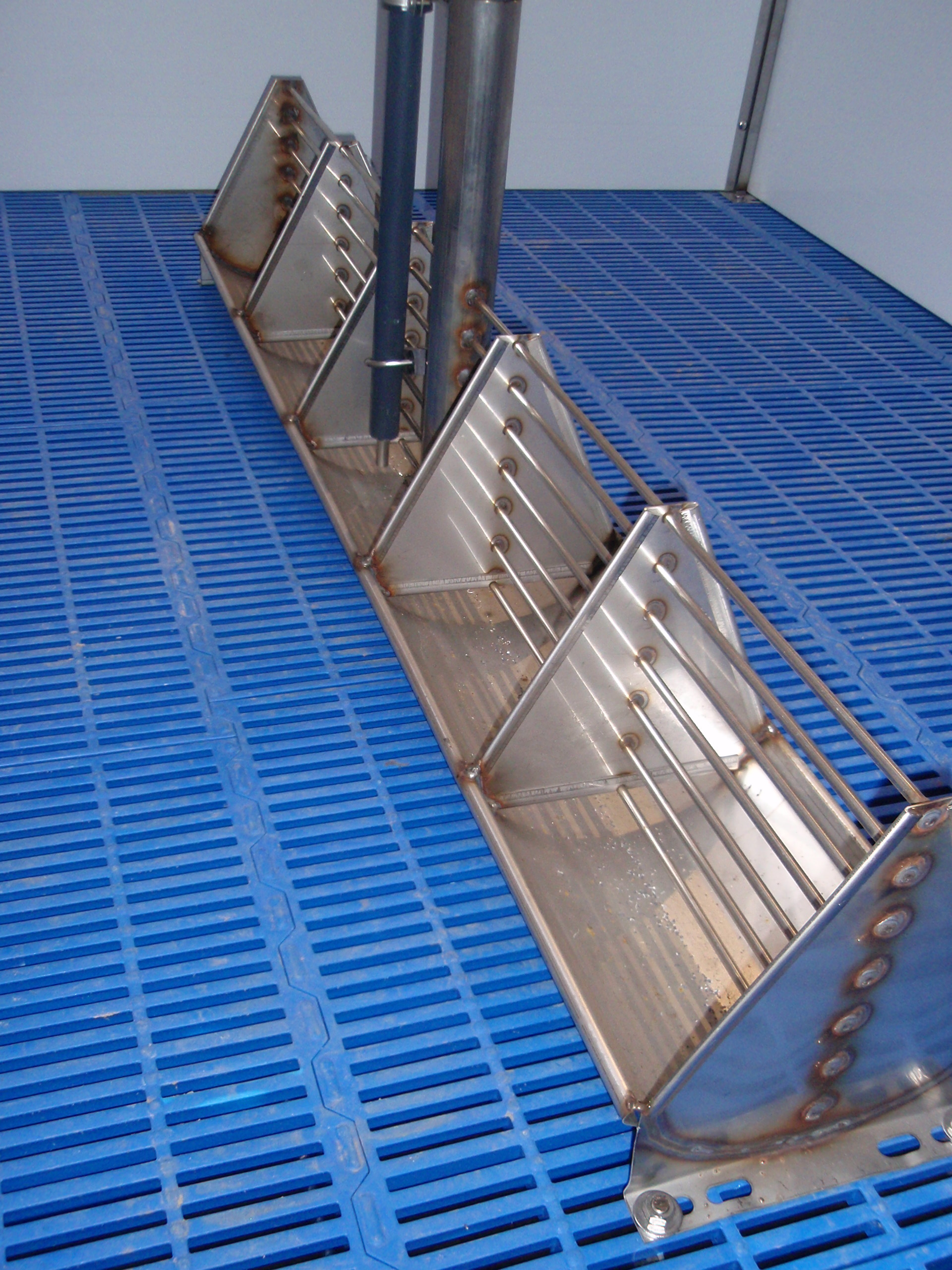
A feeding stall in a service area takes daily impacts from adult sows. A piglet partition does not. Stainless steel and galvanised steel make sense where animals push, lean and bite. Plastic performs well where the main exposure is contact, urine and wash water. During the design stage, Van Osch Uden assesses this component by component rather than fitting an entire section in one material. This reduces the upfront cost without compromising the areas exposed to the heaviest loads.
Choice 2: account for conditions in each section
Ammonia, moisture and cleaning chemicals all speed up corrosion. In sections that are frequently cleaned with high pressure equipment and detergents, stainless steel generally performs better over the full depreciation period, even though the initial cost is higher. Galvanised steel can be a sensible middle ground in drier sections and for structural components that are not constantly wet.
Choice 3: warmth and weight
For piglets and farrowing pens, the material’s perceived warmth matters. For removable partitions, so does the weight a worker has to lift several times a week. Plastic has the advantage in both cases. For a more detailed comparison by component, see stainless steel and plastic pen equipment for finishing pigs.
| Criterion | Stainless steel | Plastic | Galvanised steel |
|---|---|---|---|
| Purchase cost per pen, indicative | highest of the three | typically 30 to 50% lower than stainless steel | between the two |
| Resistance to impacts from sows | very good | moderate under heavy load | good |
| Perceived warmth for the animal | feels cold | feels warm | feels cold |
| Performance under intensive cleaning | stable, even after years of use | stable, but susceptible to scratches | depends on the zinc coating |
| Expected service life under intensive use | generally the longest | depends on the load | intermediate |
| Individual parts replaceable | yes, by component | yes, by sheet or panel | yes, provided dimensions remain accurate |
Putting this into practice:
- Walk through the section and classify each component by load: impact, contact or structural
- Use stainless steel wherever adult animals apply force every day
- Always ask for material thickness and stainless steel grade in quotations, not just “stainless steel”
- Calculate the investment per pen per year over fifteen years, not simply per unit at purchase
Choice 4: how do you choose slatted flooring that still complies after ten years?
Slatted flooring is the least visible part of a pen system, yet it causes some of the biggest problems. This is where the difference between physical wear and functional obsolescence becomes most apparent, even in custom pig housing equipment.
Start with the requirements. According to RVO, slatted floors must have a minimum slat width of 50 millimetres in housing for piglets and weaned pigs, and at least 80 millimetres for production pigs, gilts after service and sows, excluding composite and cast iron slats. The same rules require pregnant sows and gilts in group housing to have at least 2.25 m² of available space per animal, including 1.3 m² of continuous solid flooring.
These figures are not boxes to tick at the end of the design process. They determine the pen dimensions, and those dimensions determine whether the section will still be usable in ten years with a different group layout. Designing around the minimum space allowance leaves no room to adapt when farm management changes.
The floor material should then be selected according to the animal group and manure behaviour. Cast iron and composite are suitable in farrowing and piglet areas, where heat transfer and gap width matter. Concrete and plastic are often chosen where load capacity and cost are the main considerations. One detail is often overlooked in practice: the connection between the slatted floor and the pen partition. This transition point sees the most wear. A dimensionally accurate solution made in house can be the difference between a floor that lasts twenty years and one that starts rattling after eight.
Choice 5: why fixings and cleanability determine service life
Most housing systems do not fail in the middle of a panel. They fail at the fixing points.
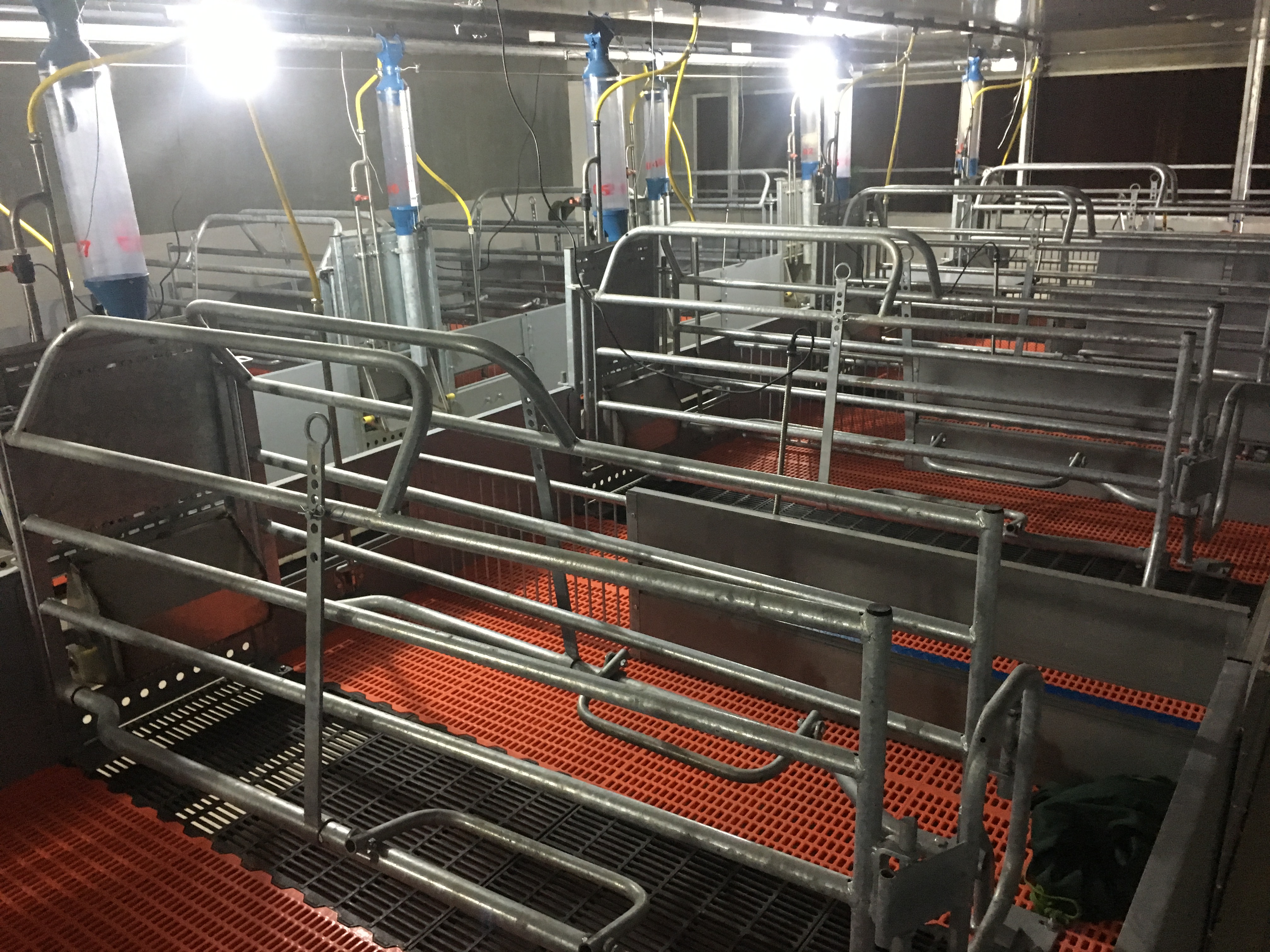
Stainless steel bolts in a galvanised structure, fixing points positioned directly in the manure channel, or profiles that hold standing water: these are the places where corrosion begins. A high quality stainless steel drinker fitted to a wall with the wrong fixings will fail sooner than the drinker itself. For custom pig housing equipment, fixings must therefore be part of the design.
Cleanability follows the same principle. Every seam, cavity and profile that cannot be cleaned in one pass with a pressure washer adds labour time every cycle and creates a place where materials can deteriorate. A section that takes ten minutes less to clean per cycle saves more than twenty working hours a year across twenty sections and seven cycles.
Choice 6: how do you avoid a barn that cannot be adapted in five years?
Modularity is the most cost effective form of future proofing available. Custom pig housing equipment made up of separate, replaceable and movable components can adapt to a new layout. A fully welded fixed unit cannot.
Consider a pig farmer with an existing farrowing house who is considering a move to loose housing farrowing pens. With a modular system, the job involves replacing partitions and reconfiguring the section. With a fixed, fully integrated structure, it means demolition and starting again. In practice, the cost difference between these two scenarios can be substantial. The decision is made during construction, not during the renovation.
This also affects the investment case. According to RVO, a sustainable pig barn that qualifies for environmental investment tax relief must meet the requirements of the Maatlat Duurzame Veehouderij. The housing equipment, climate control systems, feeding systems and ammonia emission reduction systems are all explicitly considered part of the barn. The equipment is therefore part of the assessment, not a separate add on.
A sensible note of caution about technical performance claims: research published via open.overheid.nl indicates that low emission pig housing achieves, on average, around 60% less emission reduction than expected based on Rav emission factors. There is less data available for pigs than for dairy cattle and poultry. This is a strong argument for equipment that can be adapted as knowledge and requirements change, rather than building everything around one fixed technology.
Putting this into practice:
- Ask with every quotation: which components can be replaced individually in ten years without dismantling the rest?
- Record which parts are custom made and which use standard dimensions, as standard sizes are easier to replace later
- Test your design against more than the minimum space requirement, allowing room for a different group layout
- Check whether the manufacturer will still be able to supply the same parts in ten years
What commonly goes wrong when comparing quotations?
Three mistakes come up time and again.
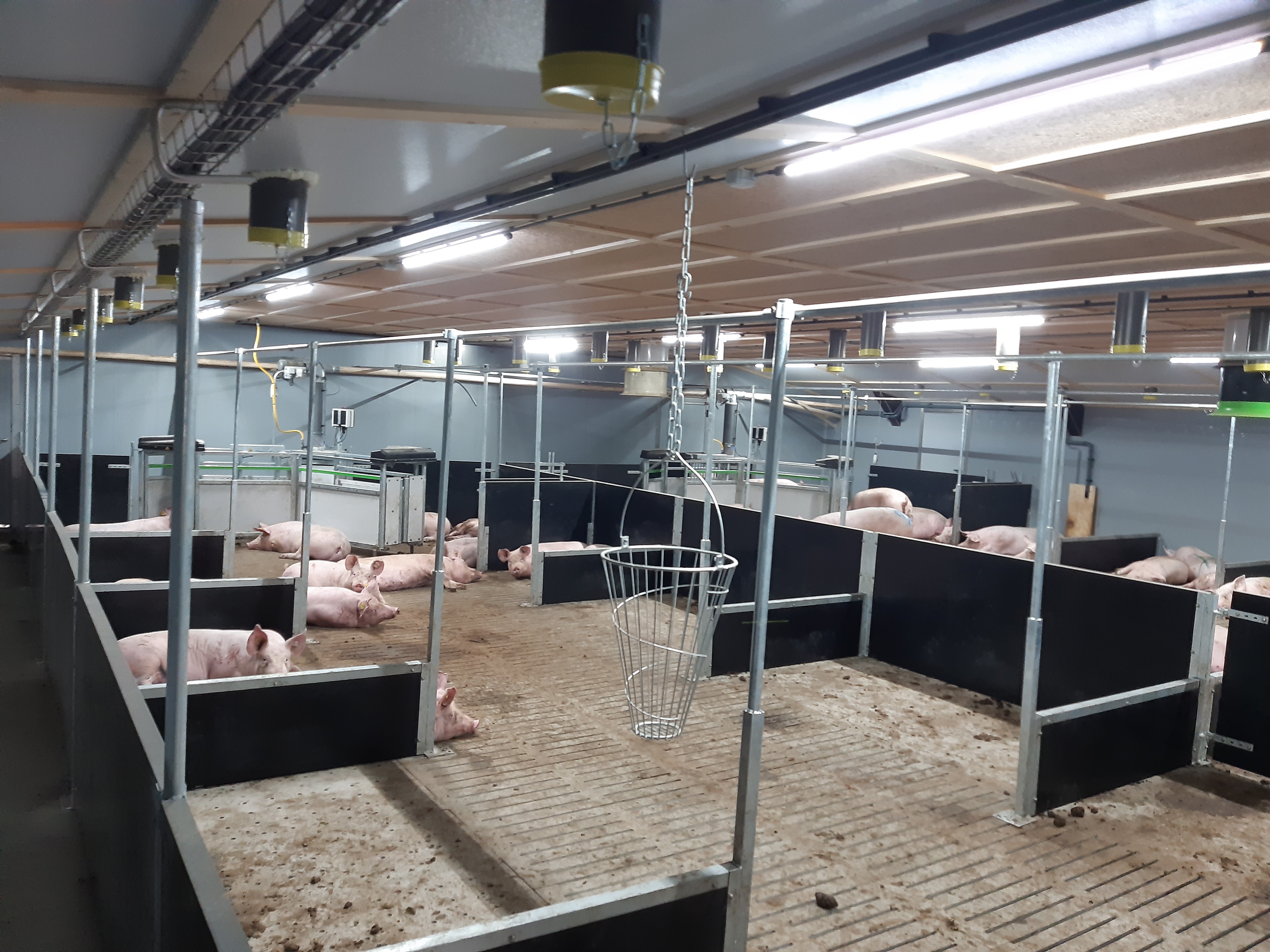
Comparing only the total price per pen. A quotation with thinner sheet metal and lighter profiles may look attractive. The comparison only becomes fair when you place material thickness, stainless steel grade and fixing methods side by side. Ask for these details before you sign.
Using multiple suppliers for one section. Slats from one supplier, troughs from another and drinkers from a third: every interface between suppliers is a potential dimensional mismatch, and nobody takes responsibility when something does not fit. When one manufacturer handles design, engineering and production under one roof, as it does at the production facility in Uden, responsibility sits in one place.
Leaving service arrangements vague. “We will sort that out” is not an agreement. Van Osch Uden has set out its approach in the Five O’s: Solution oriented, Supportive, Open, Organised and Sincere, including a clear promise to return calls within one working day. It is measurable, which is the point. Ask every supplier for a service commitment you can verify.
A fourth, less visible mistake is designing around today’s regulations alone. If you are building now and will not invest again for fifteen years, it makes sense to also consider the scenarios described in custom pig barns in Brabant.
Putting this into practice:
- Compare quotations on four points: material type, sheet thickness, fixings and parts availability
- Ask for reference projects that are at least five years old, then call the pig farmer
- Have service response times and parts availability confirmed in writing
- Check whether the supplier manufactures in house or simply resells products
Frequently asked questions
What exactly is durable pig housing equipment?
Durable custom pig housing equipment is equipment that can withstand the mechanical and chemical demands of years of barn use while remaining adaptable to changing farm management and regulations. It is about the combination of materials, construction, fixings and modularity. In practice, a high quality stainless steel component with poor fixings may have a shorter life than a properly installed plastic panel.
Does stainless steel always last longer than plastic in a pig barn?
Not necessarily. Stainless steel generally performs better under heavy mechanical loads and intensive cleaning, for example in feeding stalls and troughs. Plastic performs well in areas mainly exposed to contact, urine and water, and offers a warmer feel at a lower weight. The best choice can differ for each component in the same section.
What legal requirements apply to slatted floors for pigs?
Slat width and floor area are the two key requirements. RVO requires a minimum slat width of 50 millimetres for piglets and weaned pigs, and 80 millimetres for production pigs, gilts after service and sows, excluding composite and cast iron slats. Pregnant sows in group housing require at least 2.25 m² per animal, including 1.3 m² of solid flooring. Design with a margin above these minimums.
How does Van Osch Uden help select durable pig housing equipment?
As both manufacturer and specialist, Van Osch Uden works from Uden with in house engineering, welding robots and modern sheet and tube processing. This makes it possible to select materials for each component rather than applying one solution across an entire section. During the design phase, every component is assigned a load class and matched with the appropriate fixing method. Because production takes place in house, replacement parts can also be supplied years later. Read more about durable quality and material selection and the company’s approach.
Is it worth keeping the existing slatted floor during a renovation?
Sometimes, but often not. The floor itself may still be technically sound, but if the slat width or pen dimensions no longer suit the desired layout, the existing floor will limit the entire design. During a renovation, first measure the existing dimensions and then assess whether adjusting the partitions is enough. A custom approach for each section helps prevent a new pen system from being installed on an outdated floor layout.
Conclusion
Six choices determine whether custom pig housing equipment will last twenty years: materials matched to load class, resistance to barn conditions, perceived warmth and weight, slatted flooring and its dimensions, fixings and cleanability, and the modularity of the overall system. Five of these decisions are made at the drawing board, not during construction.
The key point is simple: do not focus on the price per pen. Look at the annual cost per pen and assess every component for replaceability. Farms are getting larger, and sections are being reconfigured more extensively than was common ten years ago. Equipment that can be adapted component by component can keep pace with that change.
Start by identifying the areas subject to the greatest loads and request the material specifications for those points. Taking that step seriously before the first quotation arrives will lead to a very different conversation with your manufacturer.
Sources
- CBS — Cbs
- RVO — Rvo
- Varkensstapel voor het eerst in ruim 45 jaar onder de 10 miljoen — CBS
- Welzijnseisen voor varkens — RVO (Rijksdienst voor Ondernemend Nederland)
- Duurzame varkensstal — RVO (Rijksdienst voor Ondernemend Nederland)