


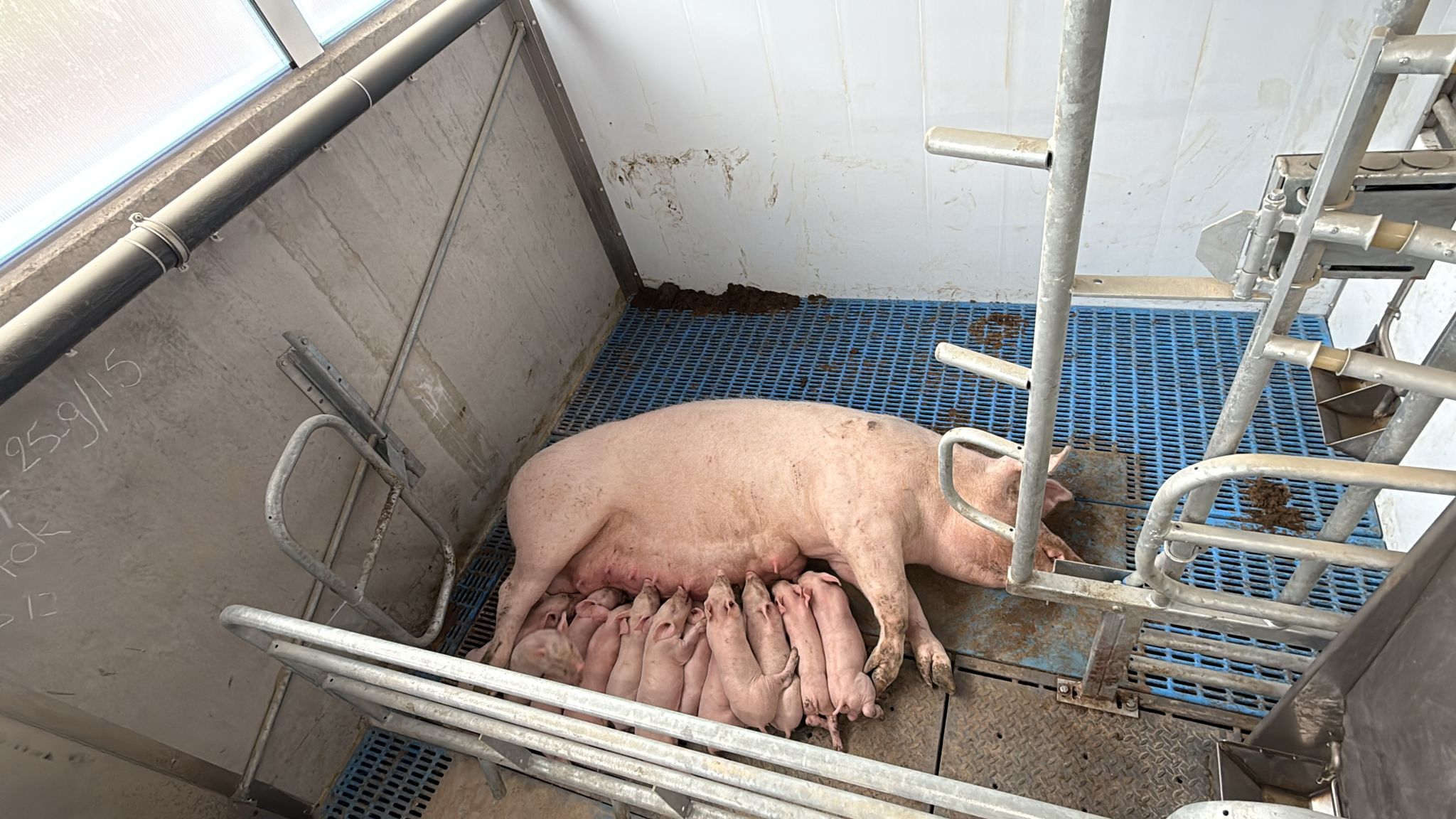
A Beter Leven loose farrowing pen must be at least 7.5 square metres under the quality mark’s standards. The sow must be able to turn around freely, while piglets need their own separate, bedded nest. This is one square metre more than the 6.5 square metres proposed in the government’s draft rules. If you want your loose farrowing pens to remain viable as standards evolve, design your farrowing unit around the strictest requirement that could apply to your sales channel. Keep the pen layout, piglet nest and farrowing confinement system as adaptable as possible. That way, you are less likely to face another costly refurbishment before the investment has paid for itself.
What does the Beter Leven quality mark require for a loose farrowing pen?
A Beter Leven loose farrowing pen is a farrowing pen of at least 7.5 square metres where the sow can move freely and turn around, with a separate bedded nest for piglets. According to Nieuwe Oogst (2024), at least 4.5 square metres must be available to the sow. The quality mark also requires a turning circle of at least 2 metres and a bedded piglet nest of at least 1 square metre.
These standards no longer apply solely to the higher star ratings. The Dutch Society for the Protection of Animals has tightened its criteria. According to Nieuwe Oogst (2026), loose farrowing pens will become the standard for the 1 star rating too, as they already are for 2 and 3 stars. They will be mandatory for all quality mark participants by 2035 at the latest.
What does that mean for your floor plan? A pen measuring 2.5 by 3.0 metres comes to exactly 7.5 square metres. In an existing unit with a fixed width, every extra centimetre of pen width has to come from somewhere else, often resulting in fewer pens per section. The piglet nest and piglet feeding area may also compete for the same corner of the pen. Our article on choosing and positioning piglet feeders in loose farrowing pens explains how to make this layout work in practice.
Why is 6.5 square metres not enough if you want to supply Beter Leven?
First, check whether a proven pen design will suit your building and compare its cost with a bespoke solution.
Two different standards apply, and they do not ask for the same thing. The government is working on a legal minimum, while the quality mark sets a higher bar. If you only design around the draft legislation, you could end up with a pen that is legally compliant but unsuitable for Beter Leven.
| Framework | Minimum pen size | Other key requirements | Transition period for existing pens |
|---|---|---|---|
| Draft Order in Council on Welfare Friendly Livestock Farming | 6.5 m² | Sow confinement prohibited from four days after farrowing | Existing farrowing crates with sow confinement permitted until 2040 |
| Beter Leven quality mark, 1, 2 and 3 stars | 7.5 m², including at least 4.5 m² for the sow | A 2 m turning circle and a 1 m² bedded piglet nest | Until 2045 for already installed loose farrowing pens below 7.5 m² |
The legal requirements are described in the draft Order in Council on Welfare Friendly Livestock Farming. The draft legislation was submitted to the Dutch House of Representatives in September 2026. According to Nieuwe Oogst (2026), farrowing sows must generally be able to move freely from 1 January 2030. Confinement will only be allowed for a short period around farrowing. This remains draft legislation, so the final wording may still change.
For dealers and businesses with sites across the border, there is a third benchmark to consider. For a long time, it was expected that the Netherlands would adopt the German standard of 6.5 square metres, reported varkens.nl (2024). A pen model designed for the German market is therefore not automatically suitable for Beter Leven.
One point that is easily overlooked is the transition period. The deadline of 2045 is intended for pig farmers who have already invested in a smaller loose farrowing pen. If you deliberately build to 6.5 square metres now but want to switch to Beter Leven later, you may need to adapt the system before it has been fully depreciated. Before signing a quotation, check with the Dutch Society for the Protection of Animals which qualifying date applies to your farm.
How can you make loose farrowing pen designs ready for future changes?
Separate the elements that are permanent from those you may want to alter later. The building, slurry pit and pen dimensions are long term decisions. The confinement system, nest protection and removable components are easier to replace, provided the original design allows for it.
Building dimensions and pen layout
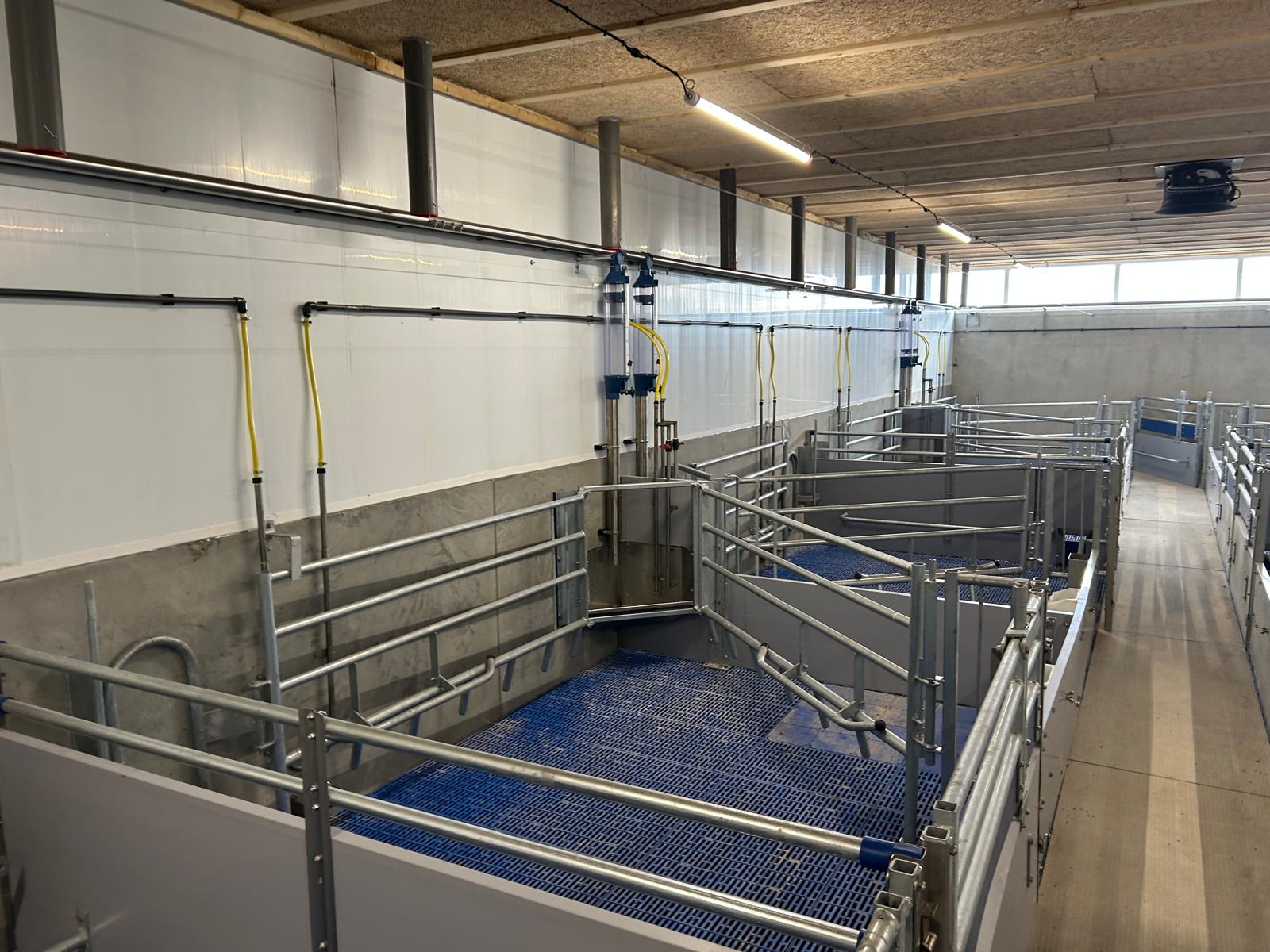
The width of the building and the layout of the slurry pit determine how many pens can fit in each section. These are difficult to change later. For example, in a section with 20 pens, moving from 6.5 to 7.5 square metres adds up to 20 square metres of floor space. If you build to 7.5 square metres from the outset, you keep the Beter Leven option open, even if you do not need it today. For a refurbishment, it is sensible to calculate both options for each section, so you can see what each one means for your total number of sow places.
Confinement around farrowing
Both the draft Order in Council and the quality mark assume that the sow can move freely, with confinement limited to a short period around farrowing. This makes the operation of the confinement mechanism more important. One member of staff should be able to confine and release the sow quickly and safely, even in a full section. Every extra action adds time across each round and every pen.
The design has a major influence on how a loose farrowing pen performs in daily use. Following a grant from the Dutch Ministry of Agriculture, Wageningen University & Research carried out a public private partnership study into the success factors of loose farrowing pens (Nieuwe Oogst, 2020). The aim was to reduce disadvantages such as higher piglet mortality while making the most of benefits such as greater colostrum intake. Earlier research showed that piglets can weigh up to 500 grams more at weaning. Read more about farrowing area layouts in our article on designing a farrowing unit for calmer sows and stronger piglets.
Piglet nest, bedding and slatted flooring
A bedded piglet nest of at least 1 square metre needs clear separation and suitable flooring underneath. Bedding and slatted flooring need to work together. Ask what flooring is used below the nest and how bedding is kept out of the manure system. Also ask how much time it takes to clean the nest between batches. These may sound like practical details, but they will determine your labour requirement for years to come. When choosing farrowing pen equipment for sows, always assess the nest and flooring as one system.
What is the best order for planning a Beter Leven farrowing unit?
Take the example of a pig farmer who plans to replace one farrowing section next year and the remainder later on. If the first section does not use the same dimensions as the next, the farm could be dealing with two types of pens, spare parts and working routines for years. A clear sequence helps prevent that:
- Define your sales route. If you may supply Beter Leven now or in the future, start with 7.5 square metres, not the legal minimum of 6.5.
- Have the existing building measured. Calculate how many pens remain per section at both sizes, and what this means for your number of sow places.
- Start with proven designs. Bespoke work can cost more and may make future replacement more difficult than a proven solution. Only use it where the existing building requires it.
- Ask for photos and references. Look at pens that have already been used through several batches. Ideally, visit one and ask the farmer how they find the operation and cleaning.
- Schedule delivery and installation around your farrowing batches. Refurbish one section at a time to keep production running. Allow for lead times. Our article from EuroTier to your farm explains how this process usually works.
Also make sure the quotation states exactly which components are included: pen partitions, confinement equipment, nest protection, slatted flooring, troughs and drinkers. An incomplete quotation may look cheaper at first, but often leads to additional work and coordination costs during installation.
Frequently asked questions
When will loose farrowing pens become mandatory for Beter Leven 1 star?
By 2035 at the latest, loose farrowing pens will be mandatory for all participants in the Beter Leven quality mark, including those with a 1 star rating. If you have long term contracts with a buyer, check whether they already include earlier requirements for farrowing accommodation.
Can an existing loose farrowing pen smaller than 7.5 square metres remain in use?
The transition period runs until 2045 for pig farmers who have already invested in a loose farrowing pen that does not meet the 7.5 square metre requirement. Keep invoices and drawings from the investment. They can help demonstrate when the pen was installed and what was built.
Can a conventional farrowing pen be converted into a Beter Leven loose farrowing pen?
Conversion is only possible if the section provides enough room for 7.5 square metres per pen. In practice, this often means fewer pens in the section and a new layout for the slatted flooring and piglet nest. Have a floor plan calculated first before deciding between conversion and complete replacement.
Where does the cost difference between 6.5 and 7.5 square metres come from?
The biggest cost factor is often not the pen itself, but the extra floor space per sow place. In a new build, that means a larger building. In a refurbishment, it means fewer sow places in the same space. Compare quotations per sow place, rather than per pen.
What materials are suitable for a loose farrowing pen?
Steel, galvanised steel, stainless steel and plastic are all used, often in combination for different components. For partitions and confinement systems, the key considerations are strength and ease of cleaning. For slatted flooring, grip and manure drainage are most important. Ask which material has been selected for each component and why.
Build with extra space now or refurbish later: what suits your sales route?
The key decision is whether to invest in more space per sow now or accept the risk of having to adapt your farrowing unit again before the investment has paid for itself. If you want to keep Beter Leven as an option, plan around 7.5 square metres and choose a confinement system and nest design that can be adapted as requirements change.
Have your farrowing pens designed to suit the dimensions of your building and check the layout against the requirements for your intended sales route. Share your floor plan and plans with us and request a quotation for a bespoke farrowing unit.
Sources
- Nieuwe Oogst — Nieuweoogst
- meldde varkens.nl — Varkens
- Varkenscriteria Beter Leven-keurmerk worden aangescherpt — Nieuwe Oogst
- Dierenbescherming kiest voor vrijloopkraamhok van 7,5 vierkante meter — Nieuwe Oogst
- Dierenbescherming verplicht vrijloopkraamhok van 7,5 vierkante meter — Nieuwe Oogst (varkens.nl)
- Van stalvloer tot daglicht: dit verandert er voor veehouders — Nieuwe Oogst