


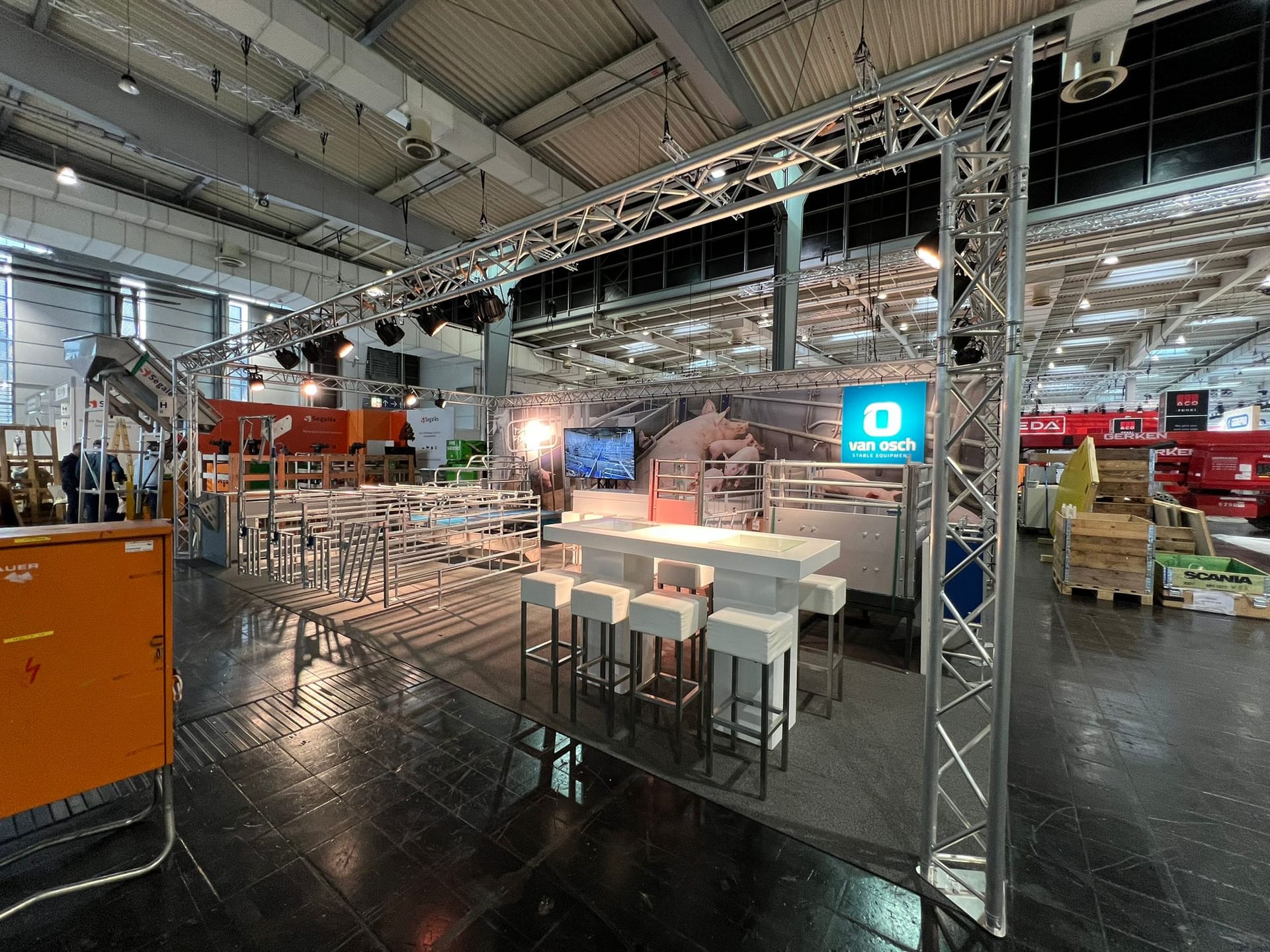
Find Van Osch at EuroTier in hall 14/15, stand 15J26. On a technical drawing, a farrowing crate can still feel abstract. A working setup lets you see how the sow restraint opens and closes, how the piglet nest and slatted flooring are constructed, and which materials are used in each component. Planning to build, renovate or convert a farrowing house in the coming years? It pays to find out early whether a system suits your day-to-day work, before a quotation lands on the table.
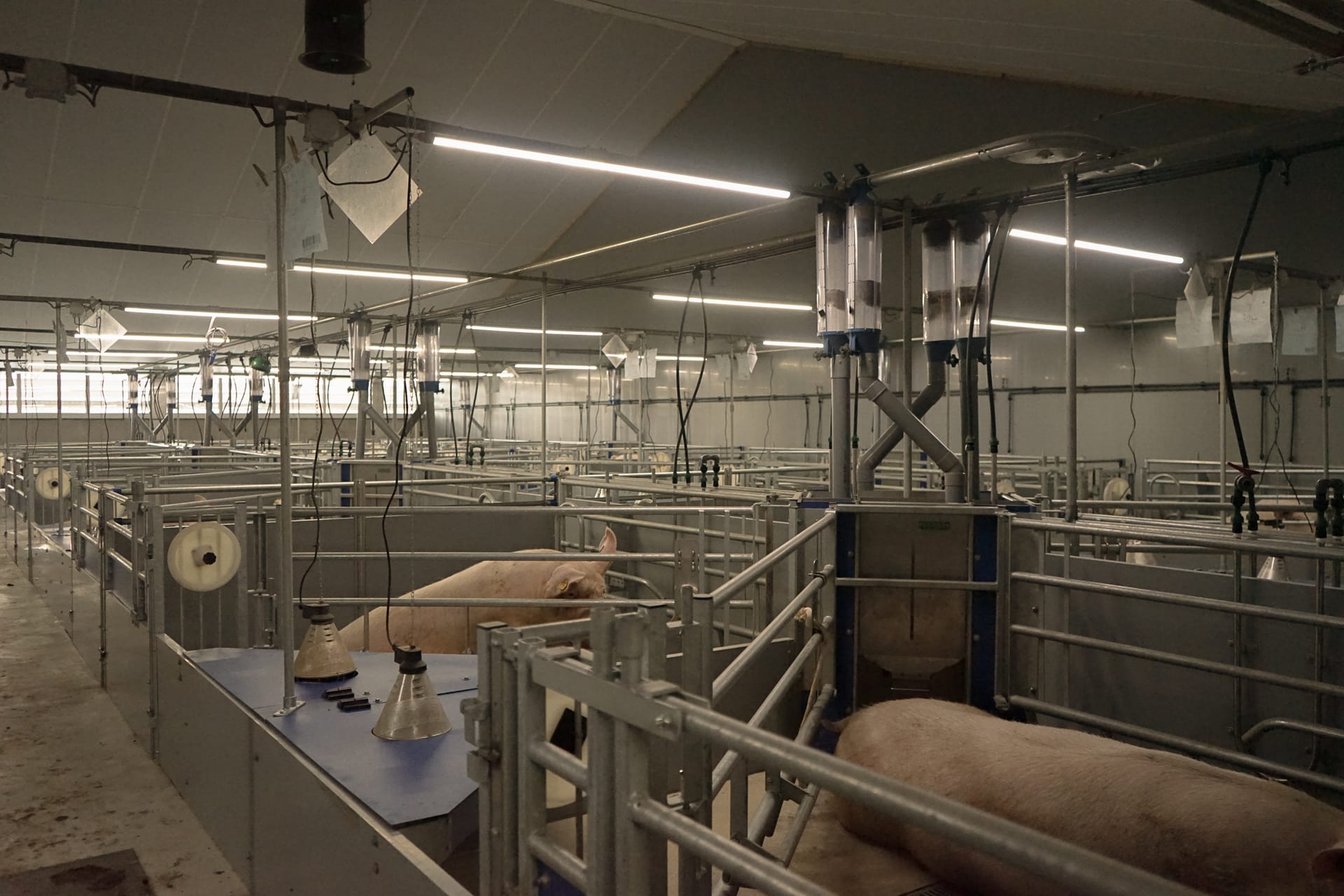
How do you choose a loose farrowing crate when you have only seen it on a drawing?
Many pig farmers choose a farrowing crate based on a layout, product sheet and price per place. That worked reasonably well with conventional crates, where the design was largely fixed and the differences between models were limited. Loose farrowing crates are different. The crate has two positions: the sow is restrained during the first days after farrowing, then given freedom to move. Every step involved in changing between those positions takes time for your staff, in every batch and every room.
You cannot judge that operation from a drawing. How smoothly does the gate move? Can it be operated with one hand from the aisle? Is the piglet nest still easy to access when the sow is loose? Questions like these determine whether a system remains pleasant to use after five years or whether staff start finding ways around it.
A trade show is one of the few places where you can operate and compare different designs side by side. You do not need to arrange a visit to another farmer’s existing unit.
What are the key challenges when choosing a loose farrowing crate?
“You can meet and talk to so many people in a single day.”
Bas van den Heuvel
The questions pig farmers and dealers ask when planning a farrowing house are remarkably similar. Four issues come up time and again:
- Uncertainty around regulations. Requirements for farrowing accommodation are evolving across European countries. You do not want to install a farrowing crate that needs modifying again in a few years. Read more about how to turn requirements into one cohesive housing plan.
- An existing building with fixed dimensions. During a renovation, the width of the room, slurry pit and aisles are already set. A catalogue crate that is a few centimetres too wide can cost you one farrowing place in every row.
- Labour for every task. According to Statistics Netherlands, via varkens.nl (2025), the average number of pigs per farm has risen by almost 50 percent over ten years. Larger farms mean more farrowing crates for each employee to manage. That makes every second spent on a task matter.
- Materials and cleaning. Stainless steel, galvanised steel and plastic all react differently to manure, water and cleaning products. You notice the difference in cleaning time between batches and in the lifespan of the equipment.
There are also basic requirements that do not change. The Netherlands Enterprise Agency specifies, among other things, that materials must not harm the animals and that housing must allow animals to be properly inspected at any time of day. In a loose farrowing crate, that also means having a clear view of the sow and piglets from the aisle.
Why do a brochure or quotation tell you so little about a farrowing crate?
A quotation compares prices per farrowing place, but not the labour the crate requires. Two farrowing crates with the same external dimensions can perform very differently in practice. The difference can come down to the position of the hinges, the height of the latch or the way the piglet nest is enclosed.
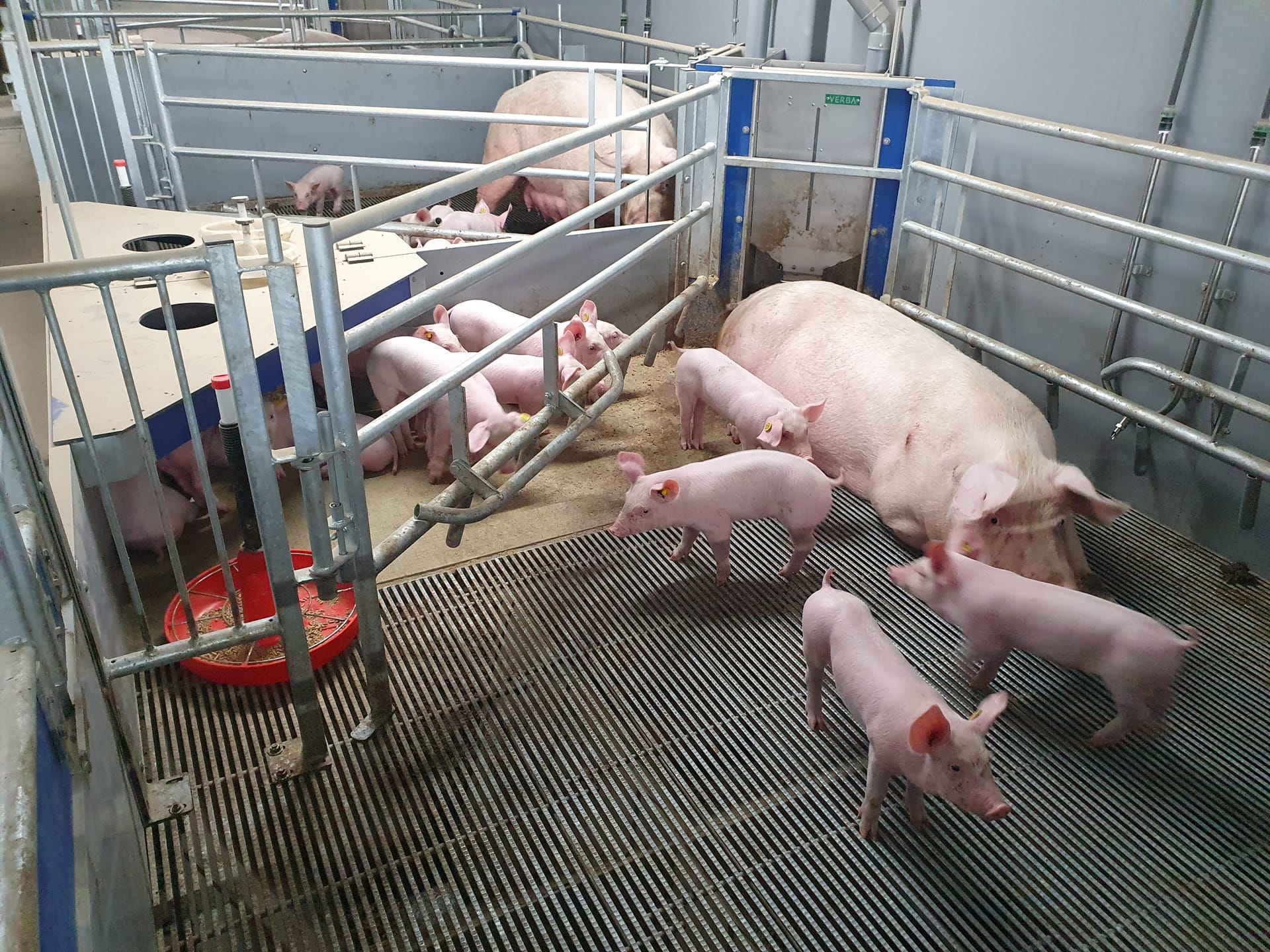
Photos have their limits too. A carefully styled product photo does not show how seams and corners are finished, even though these are exactly the places where dirt builds up. It also does not reveal whether the slatted floor behind the sow fits tightly against the pen wall, or whether the feed trough is positioned so you can reach it properly during cleaning.
Timing is a third limitation. Brochures and quotations usually arrive when your decision is already half made. At that stage, any adjustment to dimensions or specifications can feel like a delay. Farmers who have operated a working setup early in the process ask better questions during the first design meeting and are less likely to revisit the drawing later.
The common mistake is to compare loose farrowing crates mainly by the number of square metres per farrowing place. That figure matters when planning the building, but it says nothing about how often and how much effort your staff need to put into operating the crate in each batch.
What loose farrowing crates will Van Osch demonstrate at EuroTier 2026?
At a trade show with such a broad range of exhibitors, focus is essential. Nieuwe Oogst reports that EuroTier 2026 will take place in Hannover from 10 to 13 November, under the main theme, ‘Intelligence in Animal Farming’. This year, 176 innovations were recognised for the DLG Innovation Award. A stand with fully assembled loose farrowing crates is most valuable when you use it to test the equipment, rather than simply look at it.
A working setup provides a practical answer to each of the four key issues:
- Regulations: see how a farrowing crate changes from the restrained position to the loose position, and how much space the sow has afterwards. Then discuss how that design relates to the requirements in your country.
- Dimensions: use your own room measurements to determine whether a custom width, length or layout is needed.
- Labour: where possible, test the gates and partitions to assess how many actions are needed to change the crate’s position.
- Materials: inspect the materials used in each component and see how the seams are finished.
The setup shows what works in real-world conditions. The completed loose farrowing house in Wolferstedt in Germany began with the same questions about operation and regulations. Want to know why it makes sense to take a look now? Read why pig farmers are advised to come and see loose farrowing crates now.
How can you make the most of your visit to the stand in Hannover?
Half an hour at a stand is far more productive when you arrive prepared. This approach usually works well for both pig farmers and dealers:
- Bring your building dimensions. Include the width and length of the room, the location of the slurry pit and aisles, and the number of farrowing crates per room. A photo of the current situation is useful too.
- Know what stage your project is at. A new build, renovation of an existing building and a phased conversion by room each require a different conversation.
- Bring a member of staff. The person who works in the farrowing house every day will quickly know whether a gate is comfortable to operate, unlike someone focused mainly on the budget.
- Test the changeover yourself. Move the crate from the restrained position to the loose position and back again. Note how many actions it takes and whether you can do it from the aisle.
- Look at cleaning. Ask where dirt might collect and whether the piglet nest and feed trough can be reached easily during cleaning.
- Ask about service and spare parts. How quickly can replacement parts be supplied? And who will be your point of contact after installation, even if you buy through a dealer?
Write down your findings straight after your visit. After three days at the show, impressions from different stands can easily blur together. For practical advice on parking, opening hours and planning your route, read the article on what to consider before visiting the stand.
Frequently asked questions
What is the difference between a loose farrowing crate and a conventional farrowing crate?
A loose farrowing crate allows the sow to move freely after the first days around farrowing, rather than keeping her restrained throughout the entire nursing period. It usually requires more space and includes a mechanism that switches between the restrained and loose positions.
Can you convert an existing farrowing house to loose farrowing crates?
Renovation is possible in many cases, but the existing dimensions of the room, slurry pit and aisles determine how many farrowing places will remain. Custom widths or layouts are often needed to minimise the loss of places.
Which materials are suitable for a loose farrowing crate?
Material selection depends on the component. Parts frequently exposed to manure and water are often made from stainless steel or plastic, while load-bearing frames are commonly galvanised steel. Consider cleaning time and expected lifespan alongside the purchase price.
Do you need to make a final decision at EuroTier?
Researching your options is the purpose of a trade show visit, not signing on the dotted line. Use the event to assess different designs and sharpen your questions, then work through your own situation in a design meeting afterwards.
Is visiting the stand useful for dealers too?
Dealers can use a trade show visit to assess how easily a system can be explained and installed for their end customers. It is also a good opportunity to discuss design support, delivery and service arrangements.
Where should you start with your farrowing house plan?
Start with your own building dimensions and ask how many tasks your staff can realistically handle in each batch. Then use the trade show to assess which design fits those needs. Armed with that information, you can compare loose farrowing crates and ask focused questions about custom solutions for your room. Van Osch designs and manufactures its farrowing crates in Uden and develops every project together with the pig farmer or dealer, backed by the Five O’s service promise. Cannot make it to Hannover? Request advice for your own project through the page on housing equipment for farrowing sows.
Sources
- CBS via varkens.nl — Varkens
- RVO — Rvo
- Nieuwe Oogst — Nieuweoogst
- Innovation Award van de DLG — Eurotier
- Vier gouden EuroTier-innovaties zetten in op slimmer werken in de stal — Nieuwe Oogst
- Innovation Award EuroTier: Winners 2026 — DLG (Deutsche Landwirtschafts-Gesellschaft)
- Aantal varkens in Nederland duikt onder de 10 miljoen — CBS / varkens.nl
- Regels voor huisvesting en verzorging van dieren — Rijksdienst voor Ondernemend Nederland (RVO)