


The short answer
The 2026 requirements for free farrowing pens come down to two numbers and one date. The draft Order in Council on Welfare-Friendly Livestock Farming includes a minimum pen size of 6.5 square metres, with the sow able to move freely for most of the farrowing period. The Better Life quality mark is moving towards 7.5 square metres. If you are building now, it makes sense to design for the larger footprint.
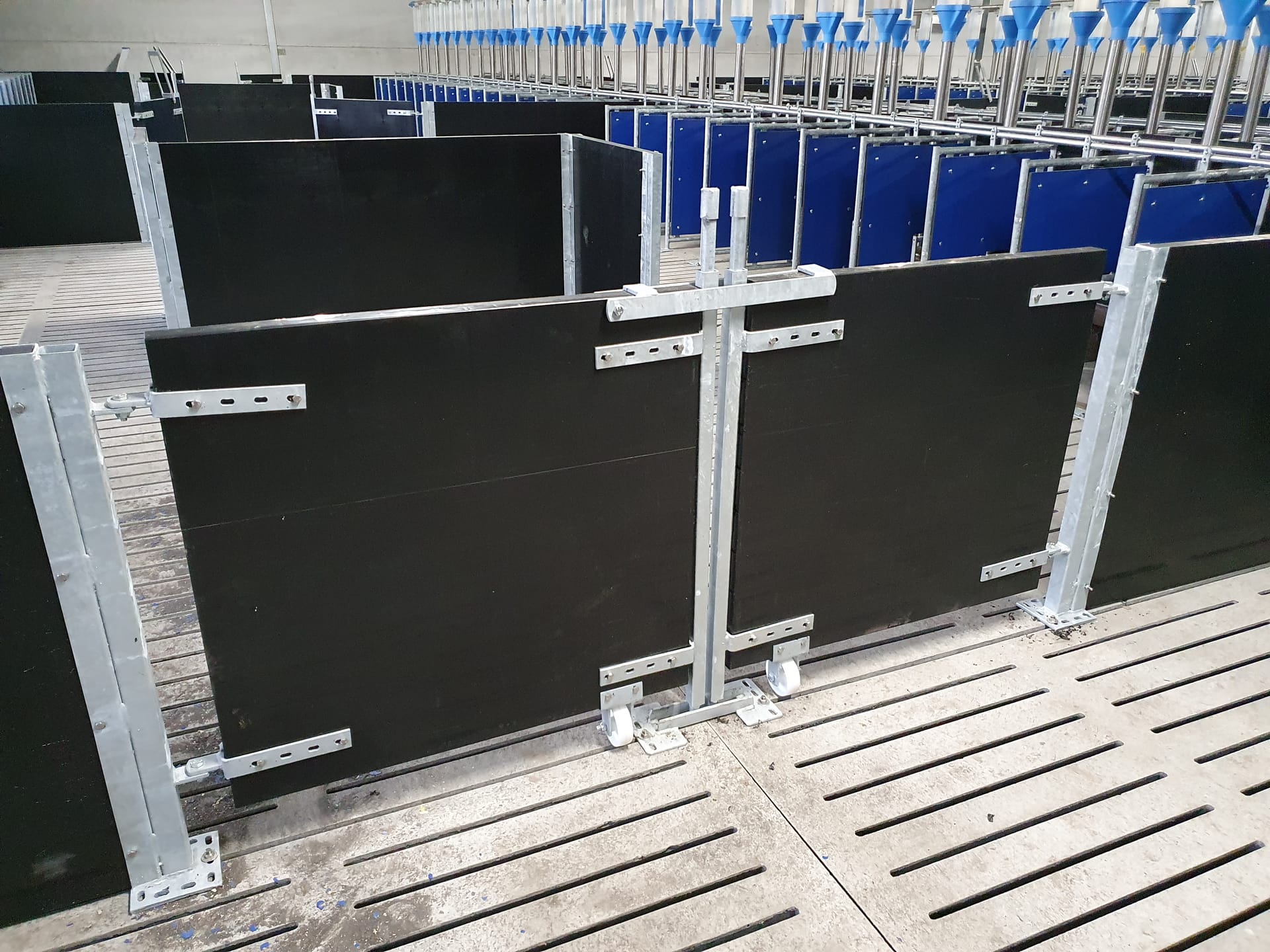
- Draft Order in Council: at least 6.5 square metres per free farrowing pen
- Better Life quality mark: 7.5 square metres, mandatory for participants by 2035 at the latest
- A permit application submitted before 2 May 2026 provides an exemption under the Better Life criteria until 2050
- Two main systems: pens without a farrowing crate and pens with a crate that can be closed temporarily
- European Directive 2008/120/EC requires piglet protection, such as a sow rail
Why are farmers hesitant to build a farrowing house right now?
Van Osch Uden regularly hears the same concern from sow farmers planning a new build: “I do not know which farrowing system will still be permitted in a few years, and I do not want to invest in a building that soon falls short.” That hesitation is understandable. A farrowing house is designed to last around twenty years, while rules for farrowing sows may change several times over that period.
The result is that projects are put on hold. But waiting also costs money: outdated pens, rising maintenance bills and, eventually, building under pressure rather than working from a well-considered design.
The real issue is not uncertainty itself. It is the way many layouts are fixed too early. Designing a farrowing unit exactly to today’s minimum standard can create a costly problem later. Designing for the most demanding requirement that is reasonably foreseeable keeps your options open. This is far from theoretical: the difference between 6.5 and 7.5 square metres per pen directly affects how many farrowing pens fit within an existing unit. This article sets out the requirements, the available systems and the design choices involved.
What exactly are the 2026 requirements for free farrowing pens?
A free farrowing pen is a farrowing pen where the sow can move freely for most of the farrowing period, with a separate protected area for the piglets. This is the functional definition underpinning current standards.
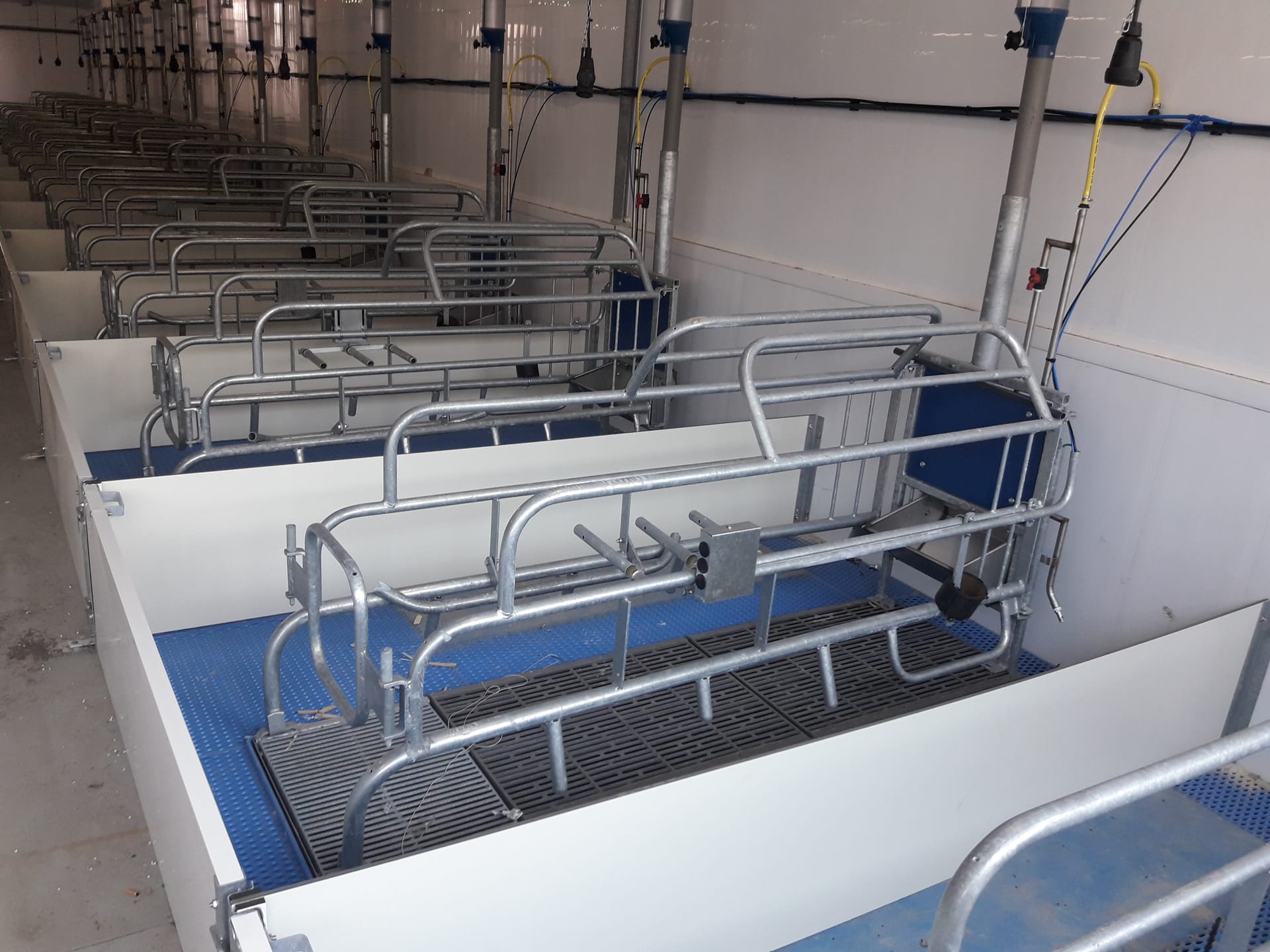
Comparing the space requirements
The key question for a new build is simple: what size should you design for? The draft Order in Council on Welfare-Friendly Livestock Farming specifies 6.5 square metres as the minimum. According to Nieuwe Oogst, free farrowing pens will become mandatory for all participants in the Better Life quality mark by 2035 at the latest, with a minimum pen size of 7.5 square metres. This brings the scheme in line with standards used in organic pig production.
The date many farmers miss
The permit application date matters alongside the floor area. DLV Advies explains that the new Better Life criteria include an exemption for free farrowing pens until 2050, but only for farms that submitted their permit application before 2 May 2026. That exemption does not apply to permit applications for conventional farrowing pens.
Requirements that already apply
Regardless of these developments, the minimum standards in European Directive 2008/120/EC remain in force. The Department of Agriculture and Fisheries sums up one of them clearly: farrowing pens where sows can move freely must include protection for piglets, such as a sow rail. There must also be enough clear space behind the sow to make farrowing easier.
This requirement is often underestimated during the design stage. A rail is not an accessory that can simply be fitted later. Its position determines the sow’s movement path, the location of the piglet nest and access to the feeder. When rails are added only after pen dimensions have been set, the result is almost always a compromise the farmer has to live with for twenty years. As a rule of thumb, determine the rail position and piglet nest in the same drawing round as the pen dimensions, never afterwards.
Checklist:
- Check whether your permit application was submitted before 2 May 2026 and retain the confirmation of receipt
- Calculate your unit layout at both 6.5 and 7.5 square metres per pen: how many pens would you lose?
- Ask whether your buyer or quality scheme applies stricter requirements than the legal minimum
- Set the rail position, piglet nest and feeder location during the first design round
What types of free farrowing pens are available?
There are two main types, and the difference is greater than it may appear on a drawing. Varkensloket distinguishes between pens without a farrowing crate, where the sow cannot be confined, and pens with a farrowing crate that can be closed temporarily during the critical period shortly after farrowing. Real-world examples exist for both systems with performance broadly comparable to conventional farrowing pens, although not at the same cost.
That last point is the nuance that often disappears from sales pitches. Comparable performance is achievable, but the cost per weaned piglet is different, partly because more floor space is required per sow.
| System | Area per pen | Sow confined temporarily | Pens per 100 m² unit area (indicative) |
|---|---|---|---|
| Conventional farrowing pen | approximately 4 to 4.5 m² | yes, throughout the period | approximately 20 to 22 |
| Free farrowing pen with a crate that can be closed temporarily | from 6.5 m² | yes, for several days | approximately 14 to 15 |
| Free farrowing pen without a crate | from 6.5 m², 7.5 m² under Better Life | no | approximately 12 to 14 |
The figures in the final column are indicative and apply to pen area only, excluding access passages and feed alleys. Actual capacity depends on unit width, aisle layout and the slurry pit.
When should you choose a system with a crate that can be closed temporarily?
In practice, the closeable option is the most common stepping stone for farms working with their existing staff. It retains the option to confine the sow briefly around farrowing and during the first days afterwards, making work in the pen more predictable. For farms with changing staff or trainees, that can be an important advantage.
When does a crate-free system make sense?
A crate-free system requires more from day-to-day management and sow selection. Farms that want to move in this direction usually do so in stages: starting with one unit and then scaling up. That was also the approach used for the completed free farrowing unit in Wolferstedt, where German rules on free farrowing housing formed the starting point.
One design choice deserves special attention here: the floor. In a free farrowing pen, the sow decides where she lies down, and that is not always where the designer intended. At a new sow unit in Egchel (2021), the farrowing pens were fitted with coated movable slats, making it almost impossible for the sow to lie on the piglets. Details like these do not come from a catalogue. They result from designing the flooring system, rail position and nest area as one integrated solution.
How should you approach a switch to free farrowing when renovating?
Practical example: an illustrative scenario from pig farming
Imagine a sow farmer with approximately 450 sows at one site who wants to renew the farrowing units. The current units contain conventional farrowing pens. The farmer wants to move towards free farrowing, without losing production capacity.
The initial calculations reveal what Nieuwe Oogst reports for many sow farmers: switching to free farrowing pens means extra pens often need to be built to maintain the same sow numbers. In this scenario, the existing unit holds noticeably fewer pens at 7.5 square metres per pen.
After revising the aisle layout, redefining slurry pit openings and removing one existing partition wall, the reduction in pen numbers is smaller than it would have been with a like-for-like conversion. The precise result varies by building, but the gain consistently comes from rethinking the layout rather than forcing larger pens into the old grid.
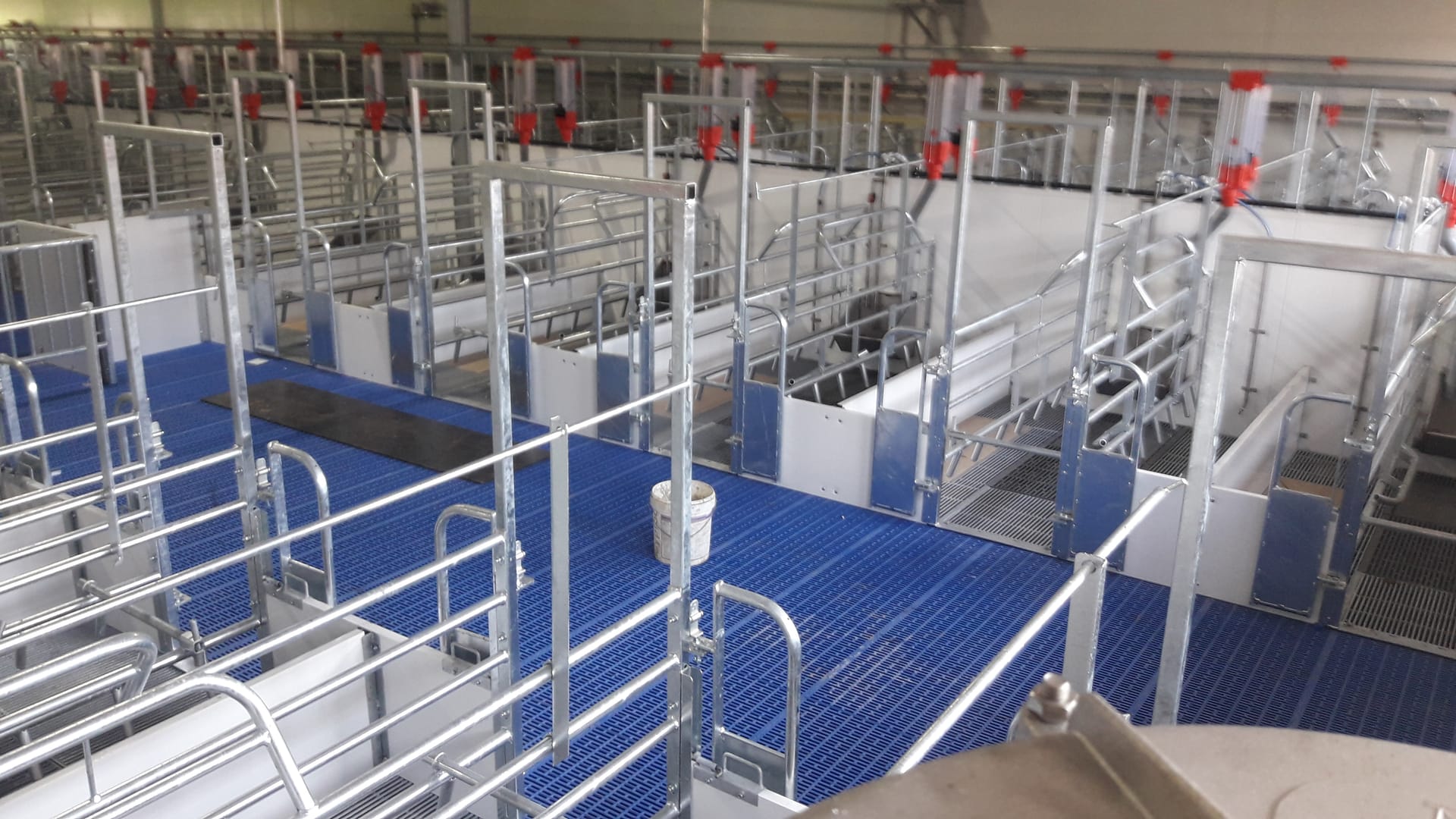
The usual steps in this type of project are:
- Measure what is actually there. Use the real dimensions, including columns and slurry pit openings, not a building drawing from twenty years ago.
- Calculate two options, one at 6.5 and one at 7.5 square metres per pen, so you understand the capacity reduction in both scenarios.
- Rethink the aisle layout. This is usually where the biggest gains are found, not within the pen itself.
- Choose the flooring system and rails at the same time, together with the piglet nest location.
- Set out the phasing plan by unit, so production can continue during the renovation.
Van Osch Uden develops projects like these through a design phase in which the sow farmer or dealer can review every detail, from custom components to finishing profiles. This is why custom livestock housing equipment matters even more in renovation than in a new build: every centimetre in an existing building is already accounted for. Read more about the choice between conversion and starting afresh in the article on renovation or new build for custom livestock housing equipment.
Checklist:
- Measure the unit again, including column positions and slurry pit openings
- Calculate the capacity reduction at both 6.5 and 7.5 square metres per pen
- Explore alternative aisle layouts before finalising pen dimensions
- Define the phasing sequence and downtime for each unit
- Ask for one supplier for slats, feeders, drinkers and partitions, so the coordination work does not fall on you
What are the day-to-day benefits of a more spacious farrowing pen?
The benefits are most apparent in the routine jobs. In a larger pen, you can reach the sow without putting yourself in an awkward position, saving time on every treatment. Among farms making the switch, the improvement mentioned most often is not a production figure but working comfort: less squeezing into tight spaces and less risk when working between sow and piglets.
Your permit position also matters. Farms that submitted their application in time have a longer planning horizon under the Better Life criteria. There is also an industry signal worth taking seriously: the Dutch Society for the Protection of Animals will assess in 2030 to what extent permits for building free farrowing pens can actually be obtained. This means the practical feasibility of construction itself will influence the pace at which requirements are introduced.
The choice of system affects the entire farrowing process, from nest hygiene to weaning. For a closer look, read the article on setting up a farrowing house for calmer sows and stronger piglets, which explains the connection between pen layout and daily routines.
What should you decide now, and what can wait?
Three elements need to be fixed now because changing them later means breaking into the building again.
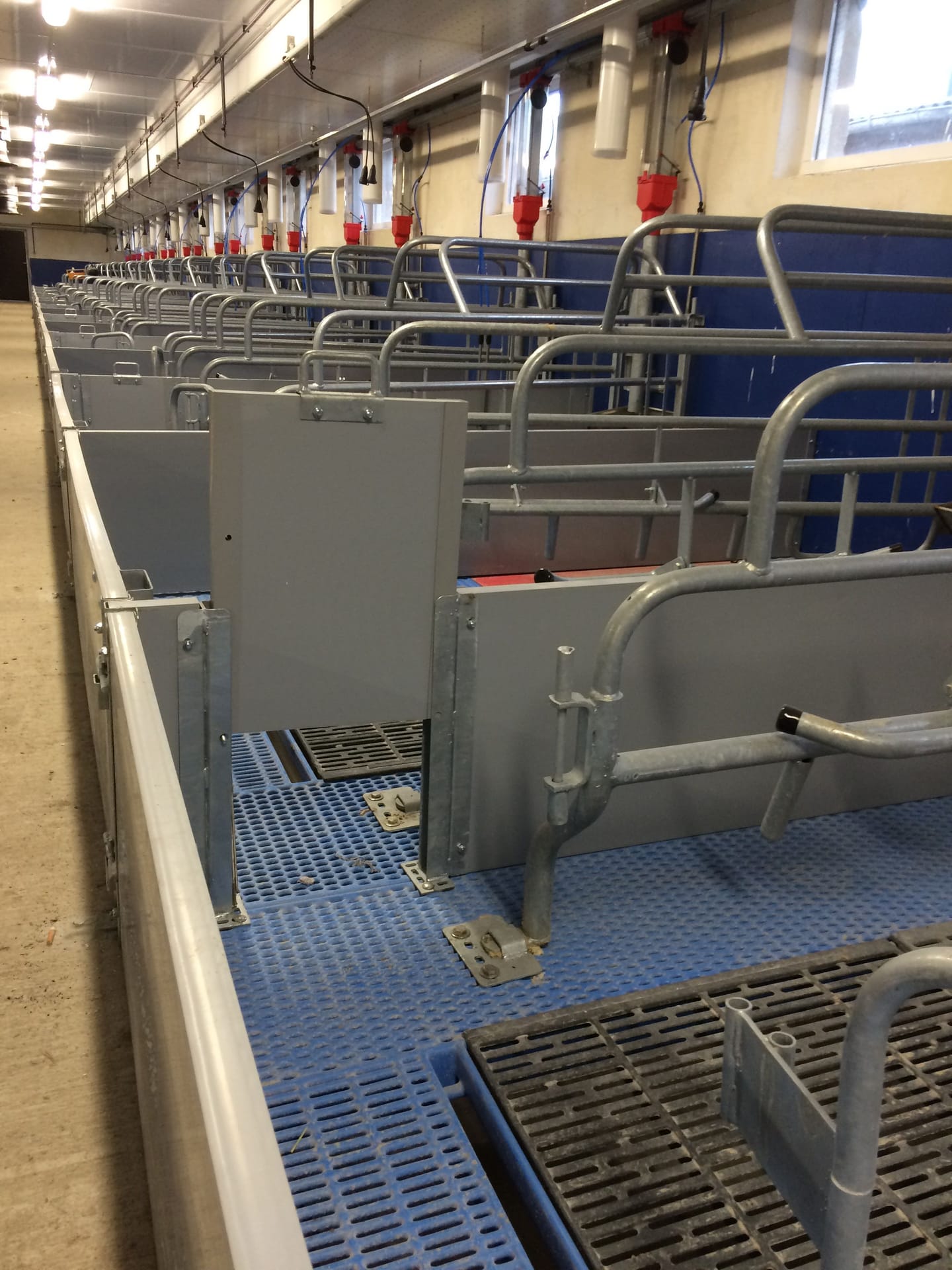
First, there is the overall unit size and aisle layout. These are tied to the concrete and load-bearing structure. Second, there is the slurry pit and its openings beneath the pens, which determine where a flooring system can be installed. Third, there is the position of the water supply and feed line.
What can be changed later is the rail configuration, feeder type, drinker and finishing profiles. With a manufacturer that has its own engineering and production facilities, these are components that can be adjusted without affecting the building structure. Van Osch Uden supplies these made-to-measure components from its own production site in Uden, so an adjustment after completion does not turn into a search across multiple suppliers.
One misconception persists: that a free farrowing system automatically meets the highest welfare requirements. It does not. The floor area you build to determines whether you meet the requirements, not the “free farrowing” label. A 6.5-square-metre pen is a free farrowing pen and meets the draft standard, but it does not meet the 7.5-square-metre requirement the Better Life quality mark is working towards for 2035.
Checklist:
- Fix the unit dimensions, aisle layout and slurry pit openings around the most demanding foreseeable standard
- Keep the rail type, feeder and drinker deliberately flexible for future changes
- Ask how quickly replacement parts can be supplied and where they are manufactured
- Check whether your supplier can deliver the complete package: slats, feeders, drinkers and partitions
Frequently asked questions
How many square metres does a free farrowing pen need to be?
The required size depends on the scheme. The draft Order in Council on Welfare-Friendly Livestock Farming specifies a minimum of 6.5 square metres, while the Better Life quality mark is setting 7.5 square metres as the minimum pen size for 2035. If you are building now, it is wise to use the larger size as your starting point, even if your buyer does not require it today. That one-square-metre difference per pen can mean losing several pens in an average unit.
When will free farrowing pens become mandatory?
For Better Life participants, the deadline is 2035 at the latest. According to Nieuwe Oogst, free farrowing pens will be mandatory for all participants in the scheme by 2035 at the latest. The legal requirements will be set through the Order in Council on Welfare-Friendly Livestock Farming, which is still in draft form. Seek advice on your specific situation from an adviser familiar with your permit file.
What is the difference between a free farrowing pen with and without a farrowing crate?
A pen with a crate allows the sow to be confined temporarily, while a crate-free pen does not. Varkensloket reports that real-world examples of both types achieve performance broadly comparable to conventional farrowing pens, although not at the same cost. The closeable system is generally the logical intermediate step for farms with changing staff, as it keeps work around farrowing more predictable.
Why is 2 May 2026 an important date?
The date determines whether you qualify for an exemption under the Better Life criteria. DLV Advies explains that free farrowing pens can qualify for an exemption until 2050, but only if the farm submitted its permit application before 2 May 2026. This exemption does not apply to applications for conventional farrowing pens. Keep the receipt confirmation for your application safely in your records.
Do I need to build extra farrowing pens when switching to free farrowing?
In many cases, yes. Nieuwe Oogst reports that many sow farmers need to build additional farrowing pens when switching, in order to maintain the same sow numbers. The exact number depends on the unit width and aisle layout. Always calculate two options before committing to a final pen count.
Conclusion
The 2026 requirements for free farrowing pens are more concrete than the uncertainty may suggest: 6.5 square metres in the draft regulation, 7.5 square metres under the Better Life quality mark by 2035, piglet protection under the European Directive, and a permit application date that may determine your position until 2050.
The practical takeaway for anyone building or renovating now is clear: design the structure for the largest foreseeable footprint, while keeping components that can be replaced later deliberately flexible. Calculate two layouts before fixing the pen count, and rethink the aisle layout before locking in pen dimensions.
For more background on the requirements and what they mean for your farrowing house, read what the requirements from 2028 mean for your farrowing house. When choosing a system, do not finalise the drawing until the floor, rail and nest area work together in one integrated design.
Sources
- Nieuwe Oogst — Nieuweoogst
- DLV Advies — Dlvadvies
- Varkensloket
- AMvB bevat weinig verrassingen, wel veel aanpassingen voor varkenshouderij — Pigbusiness.nl
- Nieuwe BLK-criteria varkens: dit komt er aan voor jouw bedrijf — DLV Advies
- Varkenscriteria Beter Leven-keurmerk worden aangescherpt — Nieuwe Oogst
- Normen voor (vrijloop)kraamhokken — Departement Landbouw en Visserij
- Vrijloopkraamstallen — Varkensloket