


The short answer
Since 1939, Van Osch B.V. has designed and manufactured custom pig housing systems in Uden. Through farrowing and piglet unit renovations, we regularly see feeders being selected at the very end of the process. As both a manufacturer and a specialist in complete custom housing systems, from design through installation, we recommend choosing a feeder based on three factors: the animal group, its position in relation to the resting area, drinking point and dunging area, and a material that suits the cleaning routine. Anyone building today should also plan for future developments in loose farrowing pens, as a more spacious farrowing pen changes where the piglet feed bowl needs to go.

Key takeaways
- A standard loose farrowing pen measures 5 to 5,2 m² per sow. Larger versions, such as a 7,96 m² research pen, provide more flexibility when positioning the piglet feed bowl (Pigbusiness, 2024).
- Under the 2024 requirements of the Better Life quality mark, a 7,5 m² loose farrowing pen will be mandatory for breeding farms from 2035, across all three star levels.
- Rule of thumb: keep the piglet feeder out of the sow’s reach, never place it in the dunging area, and avoid positioning it directly beside the drinking point.
- Stainless steel is well suited to feeders exposed to heavy daily use and wet cleaning. Plastic is a good choice for lightweight piglet bowls that need to be moved regularly.
Which pig feeders should you use in farrowing pens and piglet pens?
During the piglet stage, a feeder changes purpose at least once within a few weeks. The IKB Varken regulations (2024) require piglets to be weaned at no less than three weeks of age. Until then, piglets eat from a small bowl in the farrowing pen. Afterwards, they feed from a feeder in a group pen.
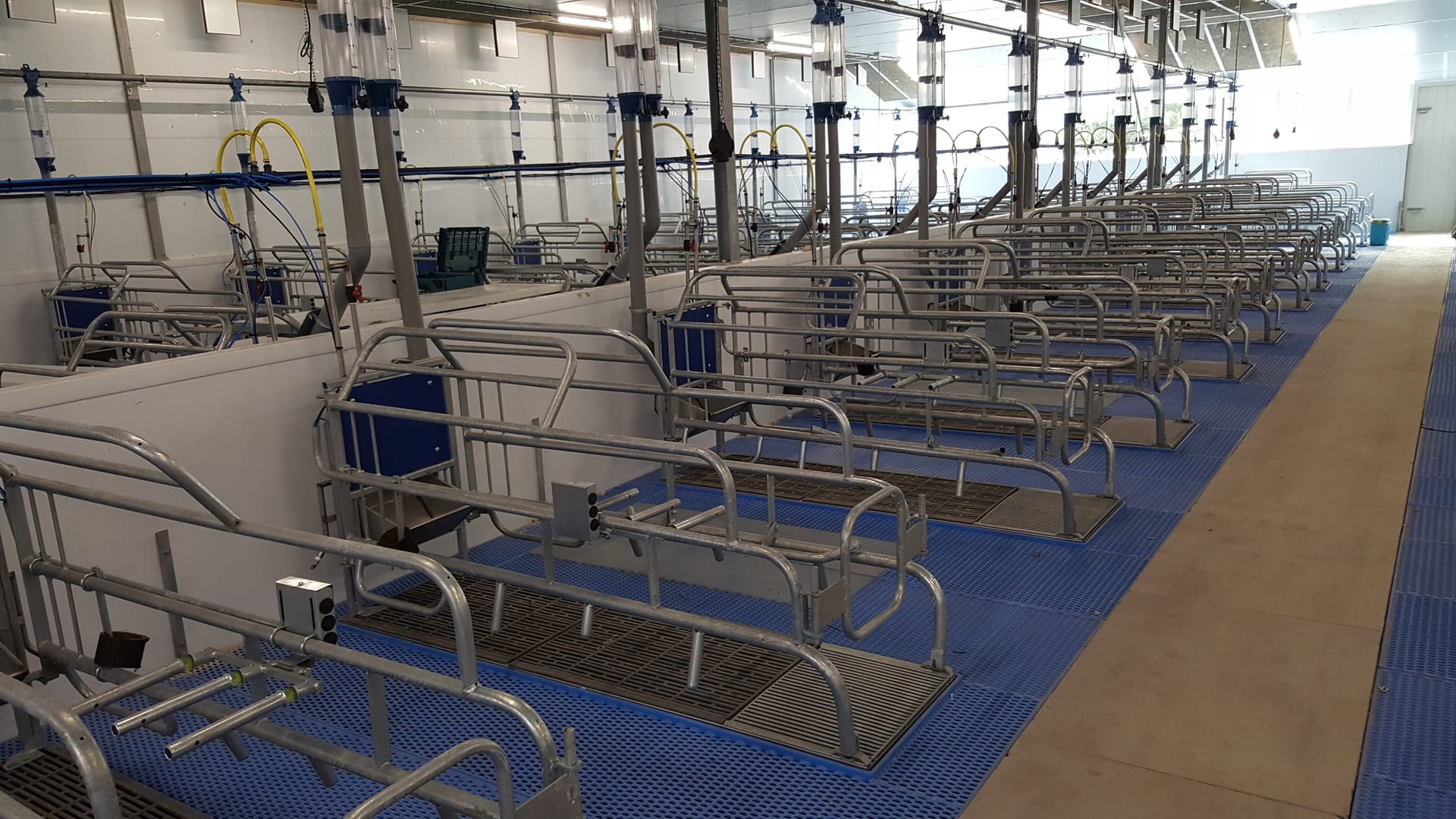
A pig feeder is a fixed or removable feeding point in the pen where animals consume dry feed, wet feed or liquid feed, selected to suit their age, group size and feeding system.
The piglet feed bowl in the farrowing pen
In a farrowing pen, the feeder is usually a shallow round or oval bowl placed on the slatted floor or clipped to the pen division. Feed quantities are small and need topping up frequently. Three things matter most: the sow must not be able to reach it, the bowl must stay out of the dunging area, and it must be easy to remove one handed for cleaning. A bowl that constantly tips over or slides around creates daily work that is easy to overlook when comparing quotations.
Feeders and troughs in piglet pens
After weaning, piglets move into a group pen with a dry feeder, a wet feeder that combines feed and water, or a longer trough. The feeding system determines the right choice. With ad lib dry feeding, not all animals eat at the same time. With restricted feeding, they do. Restricted feeding therefore requires more feeding space. The range of stainless steel troughs for different animal groups shows how feeding space can be matched to each pen size.
Checklist:
- Define the feed type for each animal group, dry, wet or liquid, before selecting a feeder.
- Measure the free floor space around the feeding point. Is there still enough room for a dry resting area next to the feeder?
- Ask the manufacturer how the feeder is removed and wet cleaned, and how many actions this requires per pen.
- Check whether the feeder can be moved to another section if you renovate later.
Why does the feeder affect daily work in the piglet unit?
The wrong feeder may add little to the quotation, but it costs time every day in the barn. If a feed bowl is too close to the dunging area, it becomes contaminated and has to be emptied daily. If it is too lightweight, piglets will push it around the pen. If feed sits too deep in the bowl, more is spilled and ends up in the slurry pit through the slatted floor.
Space is another consideration. Article 1.6 of the Dutch Decree on Animal Keepers states that animals must have sufficient space for their physiological and behavioural needs. A feeder that takes up too much floor area reduces available resting and movement space. Include the feeding point in the pen layout from the start, rather than treating it as an afterthought.
Future developments in loose farrowing pens: what do they mean for the feeder?
Where should the piglet feed bowl go when the sow can move freely? In a conventional farrowing pen, the answer is straightforward: the sow is confined, so the bowl goes on the side she cannot reach. In a loose farrowing pen, the sow moves throughout the entire pen, which changes the layout.
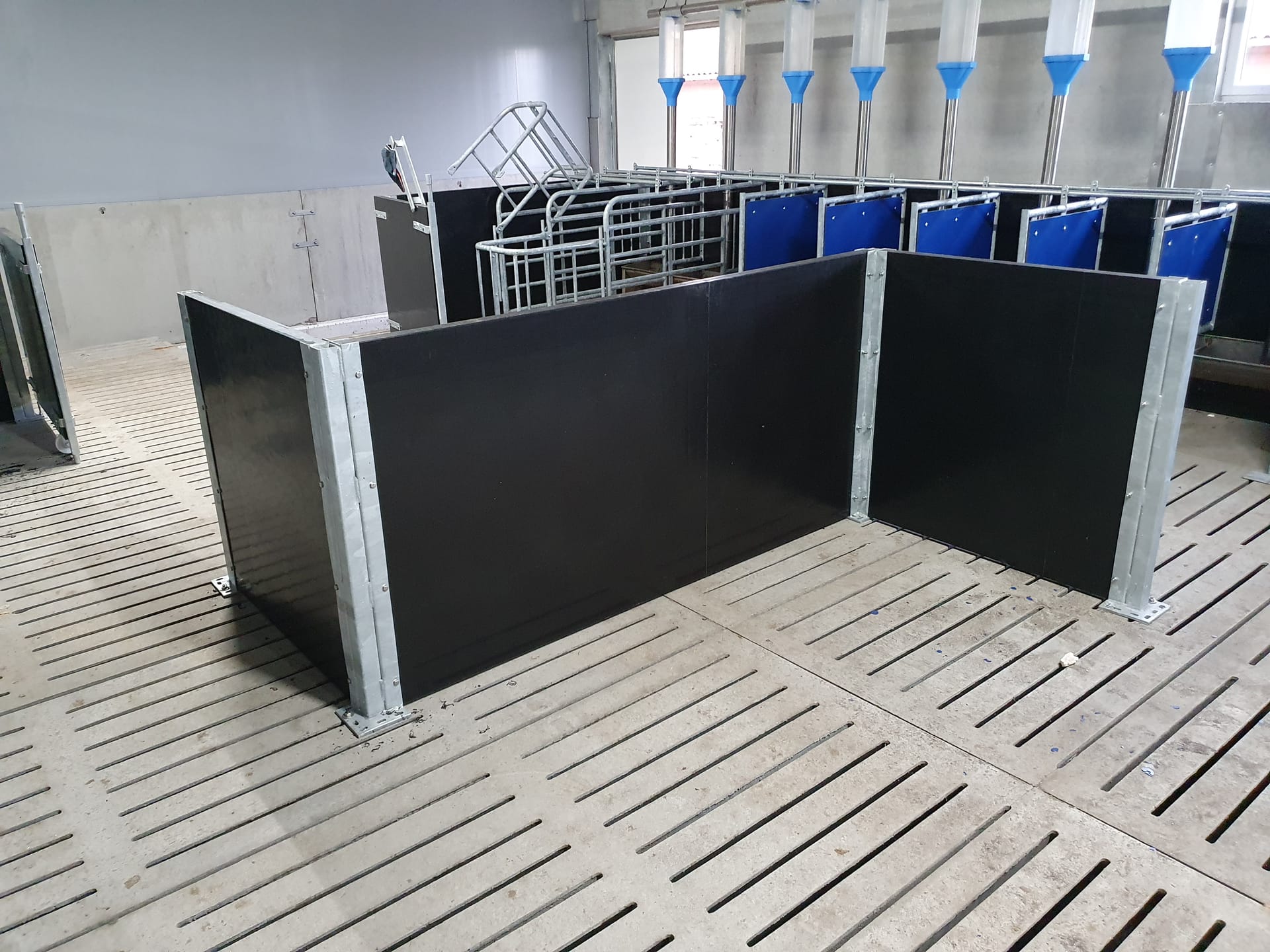
More floor space, a different location for the piglet feed bowl
Pen size makes a major difference. A standard loose farrowing pen measures 5 to 5,2 m² per sow, while the research pen described by Pigbusiness (2024) is considerably larger at 7,96 m². In the Pro Dromi concept, described in a WUR publication (2018), the loose system without a fixed crate offers around 7 m² and includes a separate piglet nest. This piglet nest is an obvious location for the bowl: the sow cannot access it, while piglets naturally visit it.
| Pen type | Area per sow | Suitable location for the piglet feed bowl | Risk of sow access | Piglet bowl material |
|---|---|---|---|---|
| Conventional farrowing pen | Usually around 4 to 4,5 m² (rule of thumb) | Along the side, out of the sow’s reach | Low, sow is confined | Plastic or stainless steel |
| Standard loose farrowing pen | 5 to 5,2 m² (Pigbusiness, 2024) | In or beside the piglet nest | High without a barrier | Stainless steel, clipped in place or protected |
| Spacious loose farrowing pen | 7 to 7,96 m² (WUR, 2018; Pigbusiness, 2024) | Separate piglet nest or dedicated feeding corner | Low with a properly protected nest | Stainless steel or movable plastic |
Will sows and piglets eventually share a feeding point?
Practical trials are underway with shared feeding areas where sows and piglets eat together. This raises a clear design question for pen layouts: how do you keep the sow away from piglet feed when feeding points are close together? In practice, a barrier with a piglet sized creep opening works well, as does reserving a separate piglet feeding corner during the design stage.
What is confirmed, and what is still uncertain?
The Better Life quality mark requirements for 2024 confirm that breeding farms must use 7,5 m² pens from 2035. Requirements for the rest of the sector have not yet been finalised. It is therefore sensible to design the pen so that the feeding point can be moved later. The RVO Sbv scheme may provide funding for housing solutions that reduce emissions and improve fire safety and animal welfare. Check whether your project meets the scheme conditions. For loose farrowing projects, such as the loose farrowing unit in Wolferstedt, Van Osch B.V. incorporates the piglet bowl location directly into the pen drawing, ensuring clips and barriers are fitted at the right height.
Checklist:
- Mark at least two possible positions for the piglet feed bowl on the pen layout.
- Check whether the sow can reach each position with her head. If she can, add a barrier.
- Choose movable fixings so the bowl can be relocated if the pen size changes later.
- Record the floor area you are building now and the size you want to achieve in a future renovation.
How do you set up a piglet pen with the right feeding points?
A piglet pen only works properly when the feeding point, drinking point and resting area do not interfere with one another. An overview of all components and options for complete piglet pens shows how pen divisions, slatted flooring, feeders and drinking points are designed as one integrated system.
Feeding, drinking and resting as three separate zones
Piglets prefer to lie on a dry, solid floor and usually dung in the wetter area near the drinking point. If the feeder sits between these two areas, traffic crosses the resting zone and the floor becomes dirty. A more practical order is the resting area, then the feeding point, followed by the drinking point and dunging area. The drinking point often receives less attention than the feeder, even though both determine where piglets dung. The same principle applies later in the production cycle: in a finishing pig barn, legal requirements and practical considerations together determine the design, and the feeding point should be part of the plan from day one.
A renovation example
Consider the manager of a sow farm with several hundred sows who is renovating two piglet sections, each with around ten to twelve pens. In the old layout, feeders sit beside the resting area, and staff remove contaminated feed from some pens every morning. After the redesign, the feeder and drinking point are aligned on the dunging side, with a solid floor along the service alley. Contaminated feed is then largely eliminated, and the daily inspection takes less time because feeders can be checked from the alley without entering each pen.
The same logic starts one stage earlier. When designing a farrowing unit for calmer sows and stronger piglets, the location of the piglet bowl influences how accustomed piglets are to solid feed when they enter the group pen. For an insight into how a farrowing pen is developed from the drawing onwards, see the seven production steps behind a custom farrowing pen. For material selection by component, which follows a similar logic in piglet pens, the article on stainless steel or plastic for each component in a finishing pig pen is a useful addition.
How do you choose and position feeders step by step?
Most problems occur when the feeder is ordered as a separate item after the pen divisions and slatted floor have already been fixed. This sequence helps avoid that:
- Confirm the feeding system. Dry feed, wet feed or liquid feed determines the feeder type and required feeding space.
- Define the zones in the pen. Draw the resting area, feeding point, drinking point and dunging area before choosing the feeder.
- Select the material for the level of use. Use stainless steel for feeders exposed to heavy use and daily wet cleaning, and plastic for lightweight bowls that are moved regularly.
- Check the sow’s reach. In a loose farrowing pen, this determines where the piglet bowl can be placed.
- Test the cleaning route. Walk through a cleaning cycle on the drawing. Can the bowl be removed, washed down and replaced without tools?
- Leave room for future changes. Choose fixings and dimensions that allow you to move the feeding point if the pen becomes larger.
With custom livestock housing systems, Van Osch B.V. works through these steps with the pig farmer or dealer during the design phase. This ensures that troughs, slatted flooring, pen divisions and drinking points are supplied as one coordinated system, reducing the need to coordinate multiple parties. Even the best feeder in the catalogue only performs well when it is positioned correctly in the barn.

Frequently asked questions
How many feeding spaces are needed in a pen with weaned piglets?
The number of feeding spaces depends on the feeding system. With restricted feeding, all piglets must be able to eat at the same time, so allow one feeding space per animal. With ad lib dry feeding, fewer spaces per group are generally sufficient. Always check the manufacturer’s specification for your pen size.
Is a stainless steel feeder better than a plastic feeder for piglets?
The choice between stainless steel and plastic should be based on use and cleaning, not on the pen as a whole. Stainless steel is a strong option for heavy use and daily wet cleaning, such as for troughs and wet feeders. Plastic is lightweight and works well for removable piglet bowls that are moved frequently. In both cases, pay close attention to the fixing, as it often wears out before the feeder itself.
Where should you place a piglet feed bowl in a loose farrowing pen?
The piglet feed bowl should be placed where the sow cannot reach it, usually in or beside the piglet nest. The nest is generally already outside the sow’s reach, and piglets naturally use it. If the sow can still reach the bowl with her head, fit a barrier with an opening at piglet height. Keep the bowl out of the dunging area and away from the drinking point.
How often should a piglet feeder be cleaned?
Feeders should be thoroughly cleaned between batches, when the pen is empty. During a batch, check the bowl daily for contaminated or damp feed and remove any leftovers. If you have to empty it every day, the bowl is probably too close to the dunging area. Moving it is often a better solution than cleaning it more frequently.
Do existing feeders need replacing when switching to loose farrowing pens?
Existing feeders can sometimes be reused, but their location and fixing method will almost always change. In a loose farrowing pen, the sow can move around the entire pen, so a bowl that was previously safe may now be within her reach. Assess whether each bowl fits in the piglet nest or requires a barrier. Loose stainless steel bowls are generally easier to relocate than fixed clip systems.
Conclusion
A feeder may seem like a small component, but it influences where piglets rest, dung and eat, and therefore how much daily work a pen creates. Choose it according to the animal group, its location in the pen and the cleaning route, then select the material. If you are building or renovating a farrowing or piglet unit today, include future loose farrowing pen developments in the design. In pens of 7,5 m² or more, the piglet feed bowl tends to move towards the nest and barriers become more important. As a next step, mark the four zones for every section, identify two potential locations for the piglet bowl and check the sow’s reach. Van Osch B.V. translates these decisions into a pen drawing during the design phase, with the trough, slatted floor and drinking point fully coordinated, supported by its Five O’s service promise.
About Van Osch B.V.
Van Osch B.V. is a Dutch family business founded in 1939. From its own production facility in Uden, it develops, manufactures and supplies custom livestock housing systems for pig farming. Its range includes pen systems for sows, farrowing sows, piglets and finishing pigs in stainless steel, plastic and steel. Van Osch B.V. supplies pig farmers directly and through an international dealer network. Find out more at van-osch-uden.nl.
Sources
- de eisen van het Beter Leven-keurmerk (2024) — de eisen van het Beter Leven-keurmerk
- de eisen van het keurmerk (2024) — de eisen van het keurmerk
- Pigbusiness, 2024 — Pigbusiness
- Regeling IKB Varken — Ikbvarken
- Besluit houders van dieren, artikel 1.6 — Maxius
- WUR-publicatie (2018) — Edepot
- Sbv — Rvo
- Betere biggen dankzij vrijloopkraamhok — Pigbusiness.nl