


Quick summary
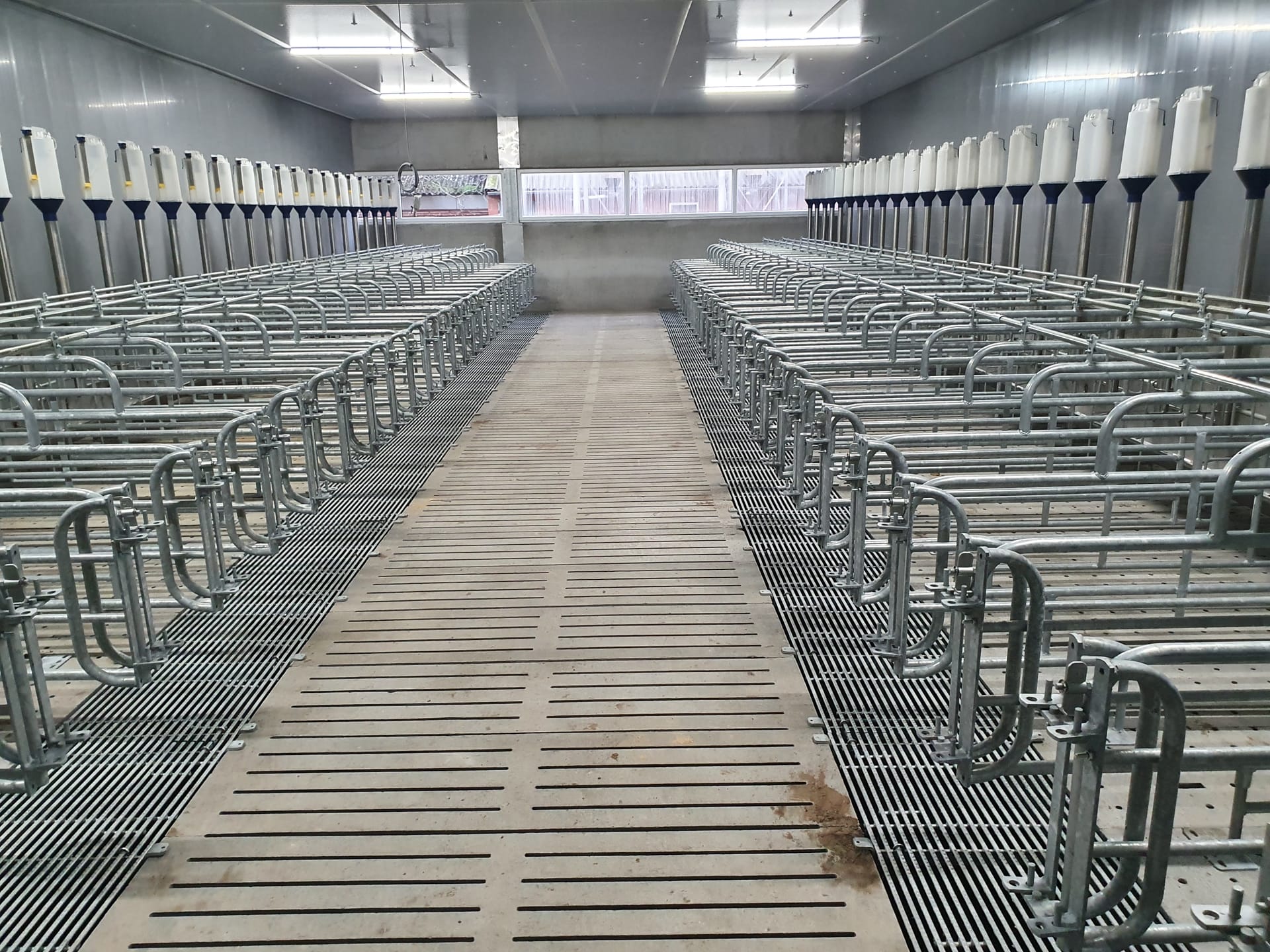
Finishing pig pen design comes down to three interdependent decisions: how the group is fed, which flooring system you install, and which materials you use for partitions, troughs and drinkers. The design principles behind loose-housing farrowing pens show why you should design for each component and animal group, rather than treating the entire barn as one unit. Van Osch B.V., a family business that has designed and manufactured custom livestock equipment in Uden since 1939, often sees producers start with the slatted floor when renovating. In reality, the feeding area determines the pen dimensions. Start with the feeding system, then check the RVO flooring requirements, and only then select the right material for each component.
Key takeaways
- According to the RVO (pig welfare requirements, 2026), finishing pigs must be kept in groups. Where partially slatted flooring is used, at least 40% of the floor area must be solid.
- For groups of more than 40 finishing pigs with an average weight above 15 kg, the RVO allows the floor area to be reduced by 10%.
- The Rav uses 0,9 m² of net pen area per finishing pig as its basis (WUR).
- Rule of thumb: draw the trough first, then position the partitions and slatted flooring.
What is included in finishing pig pen equipment?
What are you actually buying when you equip a finishing pig unit? It involves far more than gates and slatted flooring. Finishing pig pen equipment includes the partitions, gates, feeding spaces, drinking water system, flooring and finishing profiles that shape how the group lives and how you work in the unit each day.
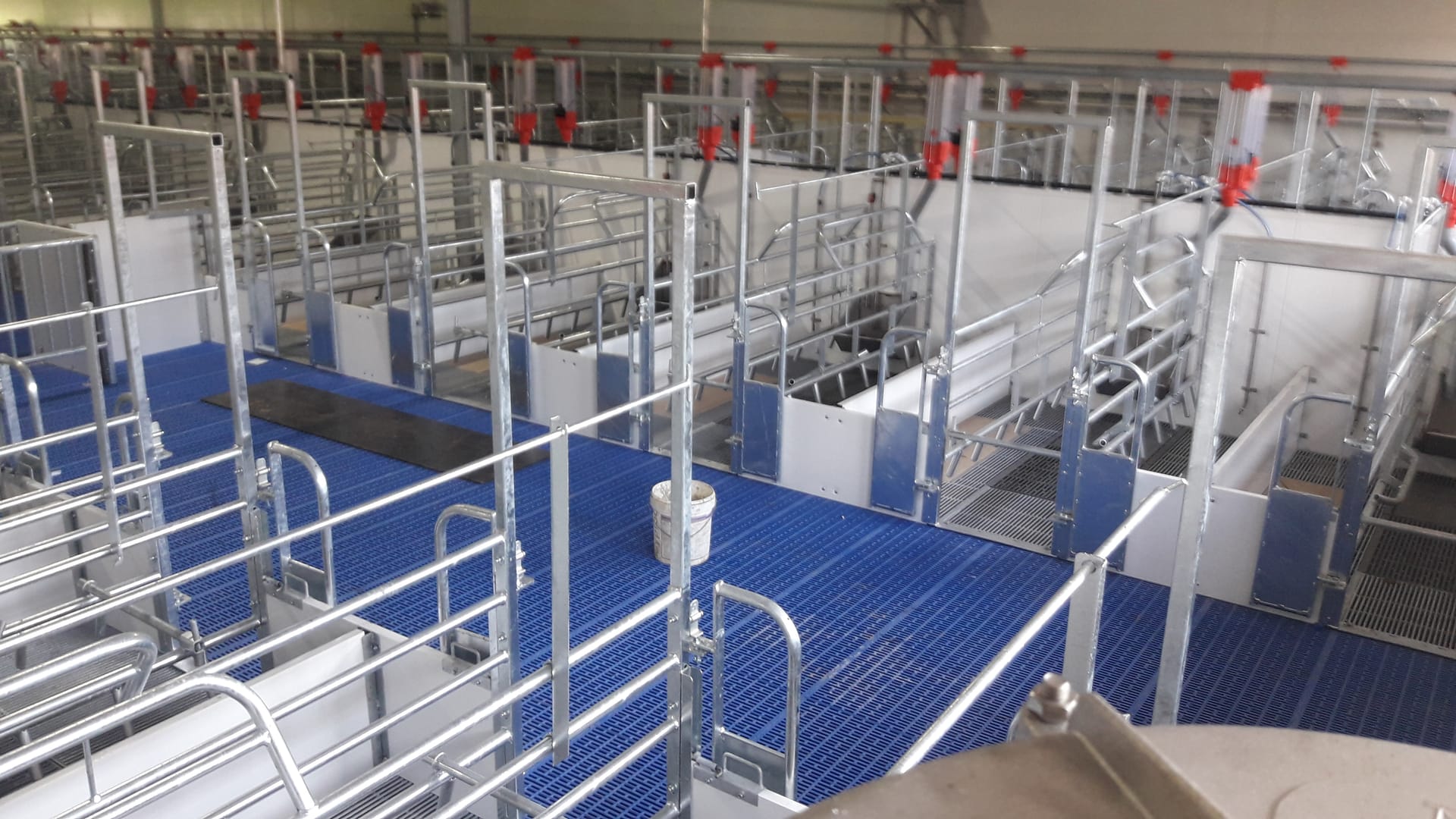
These components are closely connected. The trough determines where pigs eat. That influences where they dung, which in turn determines which part of the floor should be slatted. There is also a legal framework to consider: the RVO states that finishing pigs and weaned pigs must be housed in groups. Every layout is therefore, by definition, a group pen. Enrichment materials are also part of the basic setup. These are usually fixed to a wall or gate so they do not interfere with the floor layout.
You can find an overview of equipment for each animal group in the finishing pig housing section. For more on bringing pen dimensions, feeding and flooring together in one layout, read the article on coordinating dimensions, feeding and flooring. Below, we cover the right order for making these decisions and the points that most often go wrong in practice.
Why does a well-planned pen layout matter even more on larger farms?
Farms are getting larger. According to CBS (2025), the average number of pigs per pig farm has risen by almost 50% in ten years, to around 5.000 animals per farm. As a result, every task in every pen is repeated more often.
Imagine a poorly closing gate or a trough that is awkward to clean adds half a minute per pen each day. Across 40 pens, that is 20 minutes a day, or more than 120 hours a year. On a large farm, these small frustrations soon matter more than the initial purchase price of the equipment. A layout designed for ease of use pays back every day in saved labour.
How do you coordinate group feeding, troughs and drinkers?
Many pig producers choose the floor first and then try to find space for the trough. It works better the other way round.
The feeding system determines the trough type
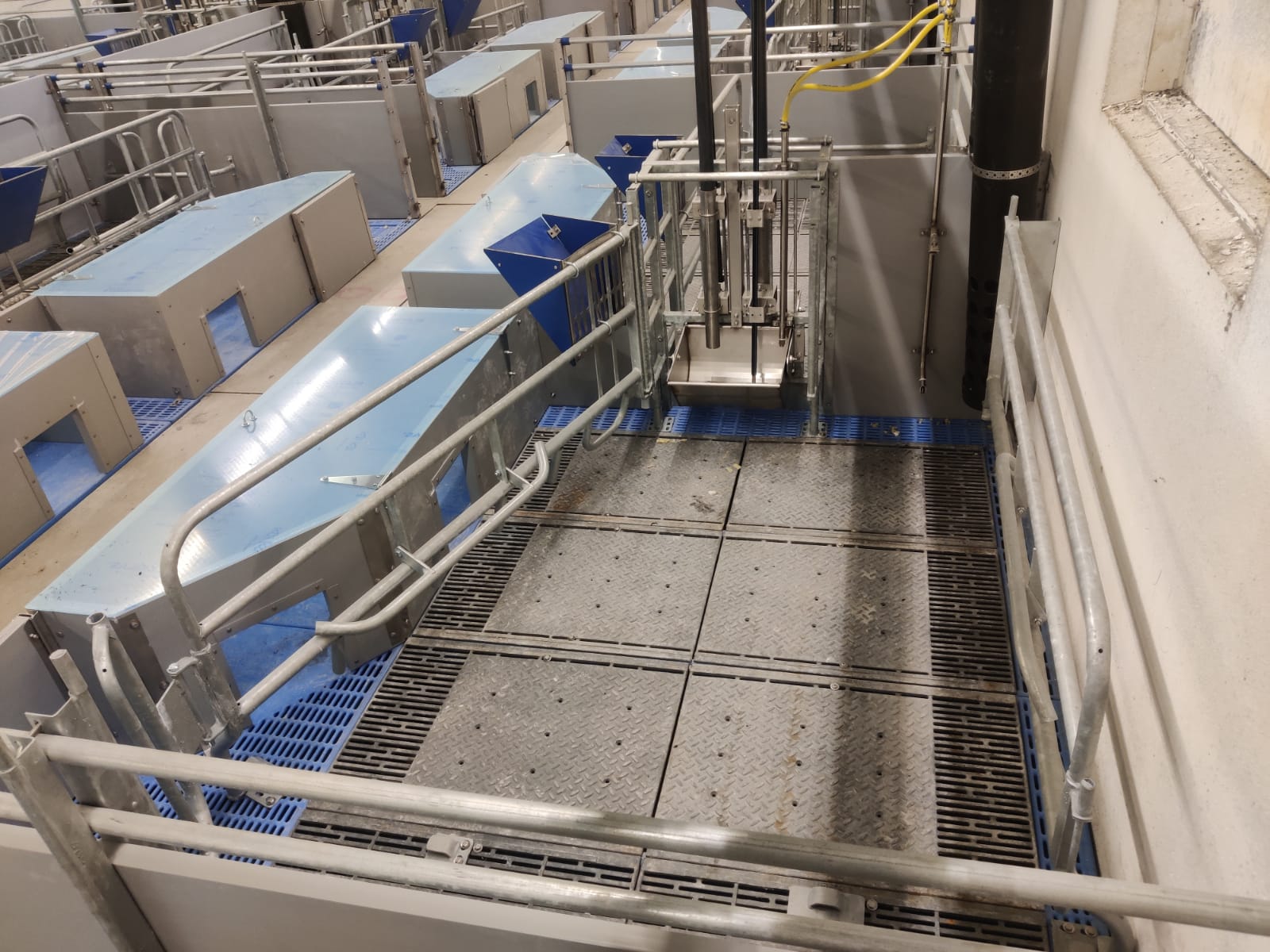
Dry feed from a feeder, wet feed or liquid feed in a long trough: each system calls for a different trough type and a different position within the pen. With restricted feeding, every pig must be able to eat at the same time, so you need a long trough with enough feeding spaces. With ad lib feeding, pigs share fewer feeding spaces and a feeder or wet-feed dispenser is often sufficient. Find out which option suits your system in this overview of troughs for different pig production systems.
The feeding area sets the pen dimensions
This is the point most often underestimated during renovations. A long trough running across the width of a pen fixes that width, and with a set floor area, it also affects the number of pigs per pen. If you start by dividing the available square metres and squeeze in the trough later, you will often end up with too few feeding spaces. Or the trough may extend halfway over the slatted area. First calculate how many feeding spaces your group needs based on the specification of your feeding system, then use that to determine the pen width.
Keep the drinking area away from the trough
Water spilled beside the trough makes the solid-floor area wet and encourages dunging in the wrong place. As a rule of thumb, place drinkers above or close to the slatted area, with some distance from the feeding area. Pipework and drinkers must also remain accessible for cleaning. Read how to keep drinkers and water lines hygienic in a pig barn.
How to apply this in practice:
- Ask your feeding system supplier how many pigs can use each feeding space, then calculate the required trough length for each pen.
- Draw the trough first on the pen plan, then add the partitions and slatted flooring.
- Check that the drinking area is positioned over the slatted section and not directly beside the trough.
- Walk through the route to the troughs and drinkers with your staff: can everything be reached without entering the pen?
Which slatted floor and pen layout suit finishing pigs?
A unit built over an existing slurry pit gives you limited freedom. Pit edges and slurry channels are fixed, so the pen layout needs to work around them.
At least 40% solid flooring
The RVO requires at least 40% of the floor area to be solid when partially slatted flooring is used. In practice, that means creating a clear division: a solid lying area and a slatted area where pigs drink and dung. The better the trough and drinking area support this layout, the cleaner the solid area will remain.
Use an approved floor layout as a reference
The approved housing description OW 2001.27 from the Informatiepunt Leefomgeving shows what this type of layout can look like. It features partially slatted flooring with a solid convex floor. At the front is a slatted floor above the water channel, while the rear has a slatted floor above the slurry channel. Your chosen housing system is decisive for your permit, so make sure the pen equipment matches the system description that applies to your barn.
Small groups or large groups?
Group size directly affects both floor area and pen design. According to the RVO, the floor area may be 10% smaller for groups of more than 40 finishing pigs with an average weight above 15 kilograms. Since the 2015 amendment, the Rav has used one emission factor for finishing pigs. According to an information document from Wageningen University & Research, this is based on 0,9 m² of net pen area per pig. The calculations below assume a unit with 400 places.
| Design choice | Small groups (10 to 12 pigs) | Large groups (50 to 60 pigs, average above 15 kg) |
|---|---|---|
| Permitted floor-area reduction (RVO) | 0% | 10% |
| Minimum solid-floor area with partially slatted flooring (RVO) | 40% | 40% |
| Net pen area per finishing pig, based on Rav (WUR) | 0,9 m² | 0,9 m² |
| Number of pens for 400 places | 34 to 40 | 7 to 8 |
| Pen gates to install, with 1 gate per pen | 34 to 40 | 7 to 8 |
For custom projects, Van Osch B.V. first overlays the pen layout on the actual dimensions of the slurry pit and channels, then decides on group size. This avoids layouts that look right on paper but are offset by half a slat width in the building.
Stainless steel, plastic or galvanized steel: what should you choose for finishing pig pens?
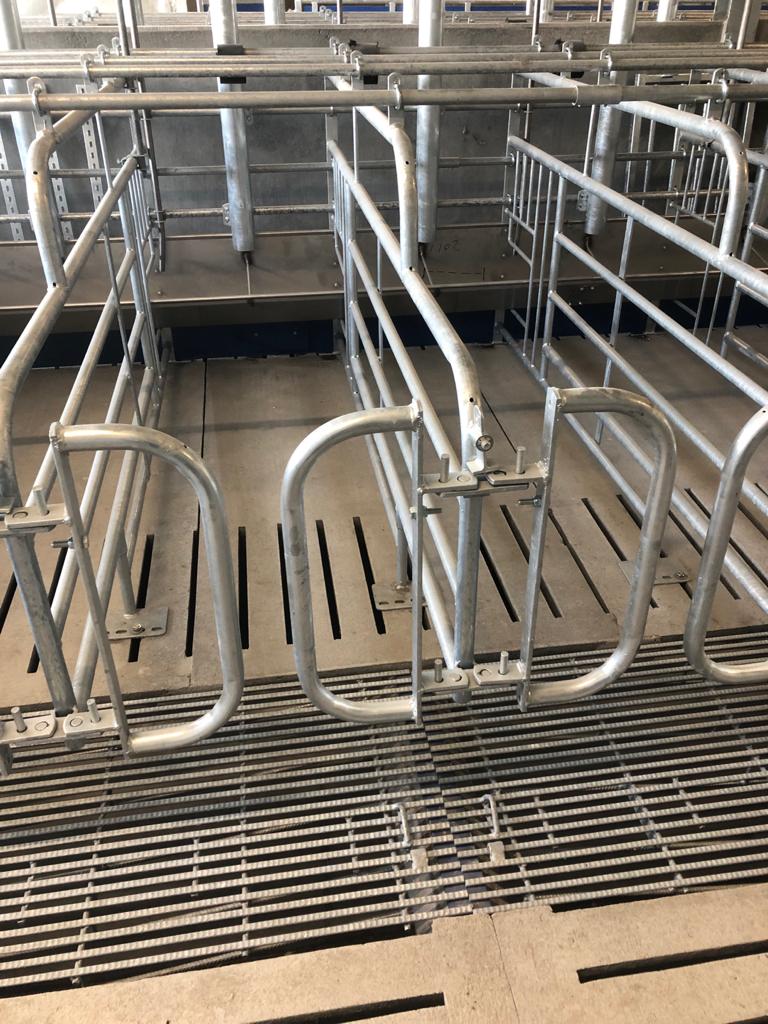
The question is rarely which material is best overall. What matters is where each component is used. Stainless steel belongs in areas exposed continuously to slurry, urine and cleaning chemicals: trough edges, drinkers and the lower sections of pen partitions. Plastic pen panels are smooth and easy to clean. Galvanized steel is often suitable for gates and railings above the splash zone. For a detailed comparison by component, see stainless steel versus plastic pen equipment for finishing pigs. You can see how this works in an existing unit in the finishing pig barn project in Panningen.
How to apply this in practice:
- Mark the splash zone around troughs and drinkers on your plan. This is where stainless steel makes sense.
- Compare materials over your own depreciation period, not just on upfront purchase price.
- Ask which components can be replaced individually without dismantling the entire partition.
What can loose-housing farrowing pens teach you about finishing pig housing?
Loose-housing farrowing pens may seem unrelated to finishing pigs. However, the design logic is the same, and it is often more fully developed in farrowing units than in finishing departments.
With loose-housing farrowing pens, the material is selected for each component. The floor under the sow has different requirements from the piglet nest or feed trough. Movable elements allow the pen to suit different stages. Every staff task, from opening a gate to checking piglets, is thought through in advance. Compare the requirements, dimensions and options for loose-housing farrowing pens in 2026 with a finishing pig pen, and it becomes clear how little of that same attention is usually given to finishing units.
You can close that gap. The lessons from loose-housing farrowing pens help you position the gate on the working route, rather than simply in the corner of the pen. Choose partitions that can be moved later if group size changes. Also consider the whole production chain: how sows are housed in groups (how much space group housing for sows requires) also affects how groups of piglets later arrive in the finishing unit. Farms that treat the whole chain as one design create pens that work together in size, operation and cleaning.
How should you approach a new build or renovation of a finishing pig unit, step by step?
Consider a pig producer with an existing unit of around 400 to 500 places. The pen partitions and troughs need replacing, but the slurry pit will remain. It is tempting to order standard catalogue pens that are approximately the right fit. But having the equipment designed around the actual pit and channel dimensions prevents discrepancies that can add days of adjustment work during installation. Just as with loose-housing farrowing pens, a well-fitting design starts with fixed dimensions and daily routines.
The sequence that works best in practice:
- Survey the existing unit: measure the slurry pit, pit edges, channels and feeding-system pipework.
- Define the feeding system: select the trough type and number of feeding spaces per group.
- Draw the pen layout: determine pen width and group size from the trough, then check the 40% solid-floor requirement.
- Choose materials by component: use stainless steel in splash zones, and plastic or galvanized steel elsewhere.
- Test daily operation: review the daily route on the drawing with the person who will work in the unit.
- Plan production and installation: coordinate delivery with the period when the unit is empty.
With custom livestock equipment, Van Osch B.V. works through these steps with the pig producer or dealer, using in-house engineering and manufacturing in Uden. What matters after delivery is set out in the Five O’s: solution-focused, supportive, open, tidy and sincere. This includes a callback guarantee within one working day.
Frequently asked questions
How much floor space does a finishing pig legally need?
Floor space is set by weight category in the RVO welfare requirements. For groups of more than 40 pigs with an average weight above 15 kg, the total area may be 10% smaller. The Rav emission factor also uses 0,9 m² net area per finishing pig as its basis.
How much solid flooring does a finishing pig pen need?
Solid flooring must account for at least 40% of the total area under RVO rules when partially slatted flooring is used. Design this solid section as a lying area, away from the drinkers. Always check the system description that applies to your barn, such as OW 2001.27.
Which trough is suitable for group feeding finishing pigs?
Trough selection depends on the feeding system. With restricted feeding, every pig must be able to eat at the same time, so choose a long trough with enough feeding spaces. With ad lib feeding, a feeder or wet-feed dispenser is often sufficient, depending on your feeding system specifications.
Is stainless steel or plastic better for a finishing pig pen?
Material selection should be made component by component, not pen by pen. Stainless steel is suitable where slurry, urine and cleaning chemicals are present, such as troughs and drinkers. Plastic or galvanized steel is often suitable for partitions and gates outside the splash zone.
How does Van Osch B.V. help with finishing pig pen equipment?
Van Osch B.V. designs, manufactures and supplies custom finishing pig pens in stainless steel, plastic and steel from its own production facility in Uden. The design starts with the real dimensions of your barn and your feeding system. After delivery, the Five O’s service promise applies, including a callback guarantee within one working day.
Conclusion
A well-designed finishing pig pen does not start with the floor. It starts with the feeding area. The feeding system determines the trough type, and the trough determines the pen width. Next, check the layout against the RVO requirement for 40% solid flooring and against your barn’s system description. Select materials by component: stainless steel where it is needed, and plastic or galvanized steel where it is suitable. This approach comes from loose-housing farrowing pens, where every component and every task has long been designed separately. That same design discipline makes finishing pig pens more practical to use.
Your next step is simple: measure your existing unit, define your feeding system and draw the trough first. Producers who follow that order and work with a manufacturer that designs and produces in-house, such as Van Osch B.V., will face fewer surprises during installation.
About Van Osch B.V.
Van Osch B.V. is a Dutch family business based in Uden, founded in 1939. The company designs, manufactures and supplies complete custom livestock equipment for sows, farrowing sows, piglets and finishing pigs in stainless steel, plastic and steel. It works with pig producers directly and through an international dealer network across Europe and beyond. More information is available at www.van-osch-uden.nl.
Sources
- volgens de RVO — Rvo
- CBS (2025) — Cbs
- OW 2001.27 bij het Informatiepunt Leefomgeving — Iplo
- informatiedocument van Wageningen University & Research — Edepot
- Welzijnseisen voor varkens — Rijksdienst voor Ondernemend Nederland (RVO)
- Informatiedocument leefoppervlaktes — Wageningen University & Research (WUR)
- OW 2001.27 – Stalbeschrijving vleesvarkens — Informatiepunt Leefomgeving (IPLO)
- Varkensstapel voor het eerst in ruim 45 jaar onder de 10 miljoen — Centraal Bureau voor de Statistiek (CBS)