


Quick summary
At Van Osch B.V., we manufacture farrowing crates in seven stages: site measurement and pig house surveying, engineering and technical drawings, material selection, tube laser cutting and sheet metal processing, robotic welding, surface finishing (galvanising or stainless steel finishing), and test assembly with logistics. The most important decisions are made in the first three stages. They determine whether the crate fits the existing building dimensions and whether it can meet requirements up to 2032. The remaining processes put those decisions into practice. Once production has started, dimensional errors cannot be corrected, so the standards below must be considered during the design stage.
Key takeaways
- According to the Animal Friendly Livestock Farming Agreement and its action plan, loose farrowing systems will become mandatory from 2032, while conventional farrowing crates will be phased out from 2035.
- For concrete slatted floors in farrowing pens, the maximum gap width is 10 millimetres. It is 14 millimetres for weaned pigs and 18 millimetres for finishing pigs (Regulation IKB Pig, interpretation document).
- The minimum slat width is 50 millimetres for piglets and weaned pigs, and 80 millimetres for sows and finishing pigs (RVO).
- According to Varkensloket, there are only two broadly worded legal provisions specifically for farrowing pens. Common dimensions are around 1.80 to 1.90 by 2.60 to 2.70 metres.
- Customisation happens during engineering, not at the welding robot. A crate that is 40 millimetres too wide on the drawing will still be 40 millimetres too wide when it leaves the factory.
Why does a standard farrowing crate rarely fit an existing farrowing house?
Van Osch sees the same issue time and again on renovation projects. A pig farmer orders a standard catalogue size, the slurry pit was poured to suit a building from thirty years ago, and installation reveals that the row of crates extends two centimetres too far per pen. Across ten pens, that adds up to twenty centimetres. The result is cutting and welding work inside the building, along with dust, noise and costly delays.
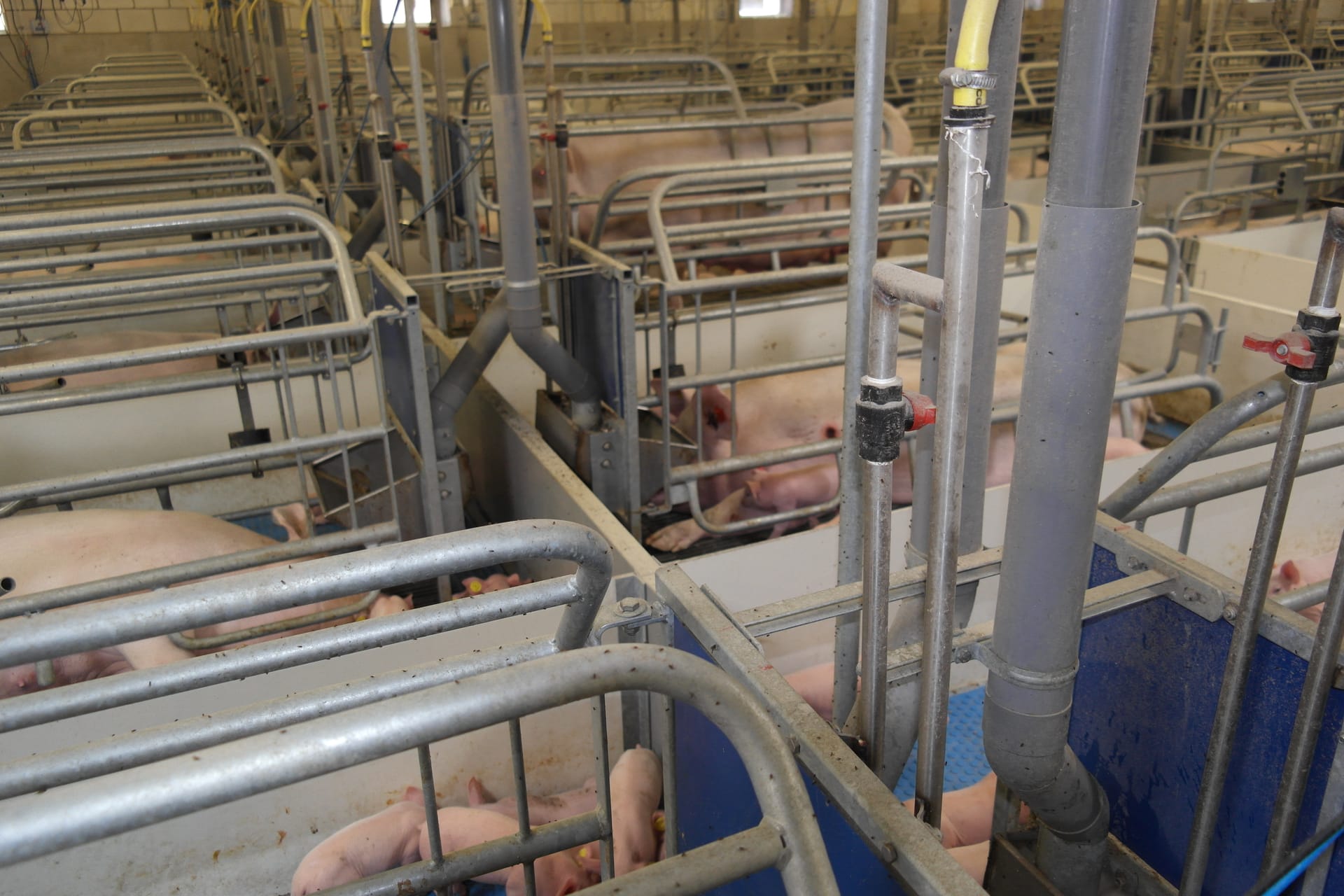
That is the heart of the problem. A farrowing house is not an empty shell. Its load-bearing structure, pit slab, pit layout and feed passage all determine the usable space down to the centimetre. Ordering farrowing crates without confirming these dimensions first simply moves the custom work from the factory to the pig house, where it is more expensive and far more disruptive.
There is also the question of future requirements. A farrowing house is typically depreciated over fifteen to twenty years, but regulations can change during that period. Anyone investing in 2026 needs to know whether the system can be converted later. That is why the farrowing crate manufacturing process matters more than it may appear. The ability to adapt a pen in the future is decided at the drawing stage.
What goes wrong when the farrowing crate manufacturing process is not properly planned?
Four issues come up most often in practice.
Incorrect dimensions during renovation. Existing buildings are rarely perfectly square. A row of pens that fits on paper can gradually run out of line towards the end wall in reality.
Slatted floor connections. The slatted floor must meet the pen walls without open gaps. If the parts do not align, edges can form where manure collects and piglets can trap their feet. There is little room for error. For concrete slats in farrowing pens, the maximum gap width is 10 millimetres under the IKB Pig interpretation document, while the RVO requires a minimum slat width of 50 millimetres for piglets and weaned pigs.
Fragmented supply. Slats from one supplier, troughs from another, drinkers from a third and pen walls from a fourth. Every supplier works to different tolerances, leaving the pig farmer to coordinate the project.
Uncertainty about future rules. The action plan within the Animal Friendly Livestock Farming Agreement identifies 2032 as the target date for mandatory loose farrowing systems and 2035 for phasing out conventional farrowing crates, alongside an increase in weaning age to 28 days. Should you invest in a system that may soon fall short, or choose one that can be converted?
All four issues have one thing in common: they stem from decisions made before the first weld is laid.
Why does a catalogue approach not solve sizing issues?
The traditional approach in the sector relies on a catalogue of fixed dimensions and a limited number of variants. That worked when farrowing houses were broadly similar and regulations were stable. Today, it falls short for three reasons.
First, renovation has become more important than new construction. In 2025, CBS reported that the pig population fell by 5.1 percent to 9.96 million animals, while the number of livestock farms with pigs dropped by 7.1 percent to 1.9 thousand. The farms that remain are more likely to expand within existing buildings. Existing buildings come with existing dimensions.
Second, loose farrowing systems require more room. According to Nieuwe Oogst’s coverage of the agreement, pig farms will need larger building footprints because loose farrowing pens and separate functional areas require more square metres. A standard catalogue size based on the common 1.80 by 2.60 metre layout will inevitably run into limitations.
Third, the legislation on farrowing pens themselves is surprisingly open to interpretation. Varkensloket notes that only two broadly worded provisions apply: enough clear space behind the sow to facilitate farrowing, and enough room for piglets to suckle without obstruction. In practice, pens usually range from 4.68 to 5.12 square metres. That freedom is not a luxury. It places responsibility on the manufacturer to demonstrate why a particular design works.
There is a persistent misconception here. Many pig farmers assume custom work is simply more expensive. In reality, it shifts costs. You invest more in engineering, but less in installation, rework and lost production days. A well-planned farrowing crate manufacturing process can prevent a farrowing unit from sitting empty for three extra days, and that has a cost too.
What are the 7 stages of farrowing crate production at Van Osch?
The complete farrowing crate manufacturing process consists of seven stages. Each one has its own quality check.
Steps 1 to 3: where customisation is really decided
1. Site measurement and pig house survey. We record the actual dimensions of the pit slab, load-bearing structure, feed passage and end walls, including deviations from the original building drawings. For renovation projects, this is the most important stage of the entire process. These measurements provide the foundation for every step that follows.
2. Engineering and technical drawings. The adviser translates the building dimensions into a pen layout, including pen width, sow resting area, piglet nest, trough position and drinker position. This is also where the decision is made on whether the structure must be convertible to a loose farrowing system later. Van Osch provides in-house engineering and custom solutions because this level of detail cannot be outsourced without losing control.
3. Material selection. Steel, galvanised steel, stainless steel or plastic are selected for each component. Crate rails need different properties from a feed trough or drinking bowl.
Steps 4 to 7: from raw material to fully assembled pen
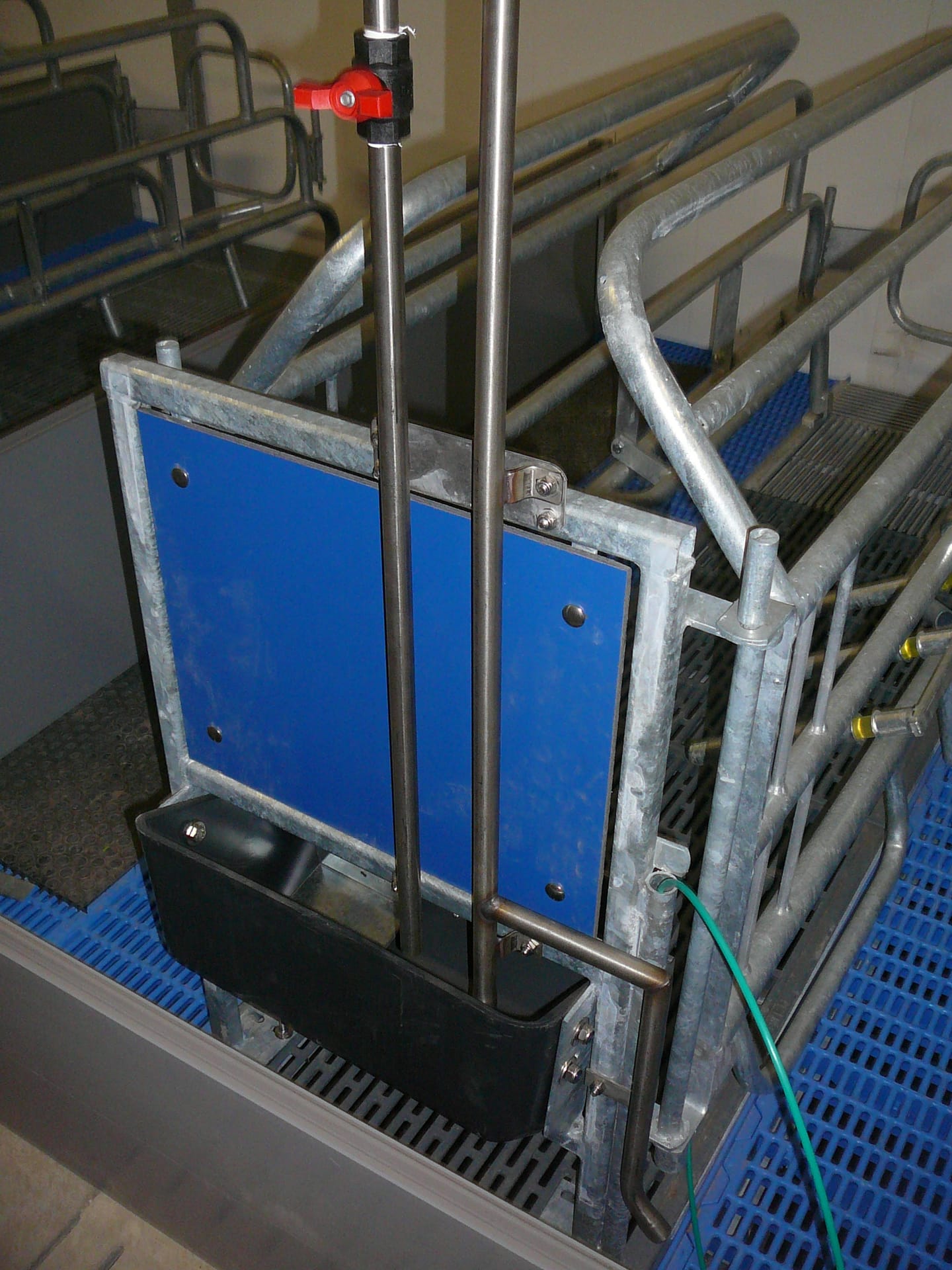
4. Tube laser cutting and sheet metal processing. Since 2024, Van Osch has used Adige tube laser technology to cut tubes to size, including connection cut-outs. This reduces manual fitting and delivers consistent dimensions across an entire row of pens.
5. Robotic welding and assembly. Welding robots produce seams with consistent heat input, helping to limit distortion. Skilled welders handle unusual custom components by hand.
6. Surface finishing. Steel components are galvanised, while stainless steel finishing is used where cleaning demands and corrosion exposure are greatest. The right choice depends on the cleaning routine, not just the budget.
7. Test assembly, packing and transport. Components are checked through assembly before leaving the factory, with fixings supplied for each pen. Export projects also include export documentation and customs clearance.
The key point is simple: stages 4 to 7 deliver precise production. Stages 1 to 3 decide whether that precision produces the right result.
Put this into practice:
- Have the building measured before requesting a quotation, not afterwards. Ask for pit slab, pen depth and feed passage dimensions on the drawing.
- Check the drawing to confirm that slatted floor gaps meet the 10 millimetre requirement for farrowing pens and that slats are at least 50 millimetres wide.
- Ask specifically whether the structure can be converted to a loose farrowing system, and which components would need to be replaced.
- Request one point of contact for pen walls, slats, troughs and drinkers, and agree who is responsible for monitoring interface dimensions.
How do you choose between conventional, convertible and loose farrowing systems?
The comparison below uses common practical dimensions and information from the agreement. Prices have been deliberately omitted because they vary too widely by project and specification to be meaningful.
| System | Typical size per pen | Status towards 2035 | Future adaptability |
|---|---|---|---|
| Conventional farrowing crate | approximately 4.68 to 5.12 m² | phase-out from 2035 under the action plan | limited, often requires full replacement |
| Convertible system | approximately 5 m² with pre-prepared fixings | transitional option until 2032 | high, crate sections can be replaced |
| Loose farrowing pen | larger, requiring a bigger building footprint under the agreement | mandatory from 2032 | not applicable, already compliant |
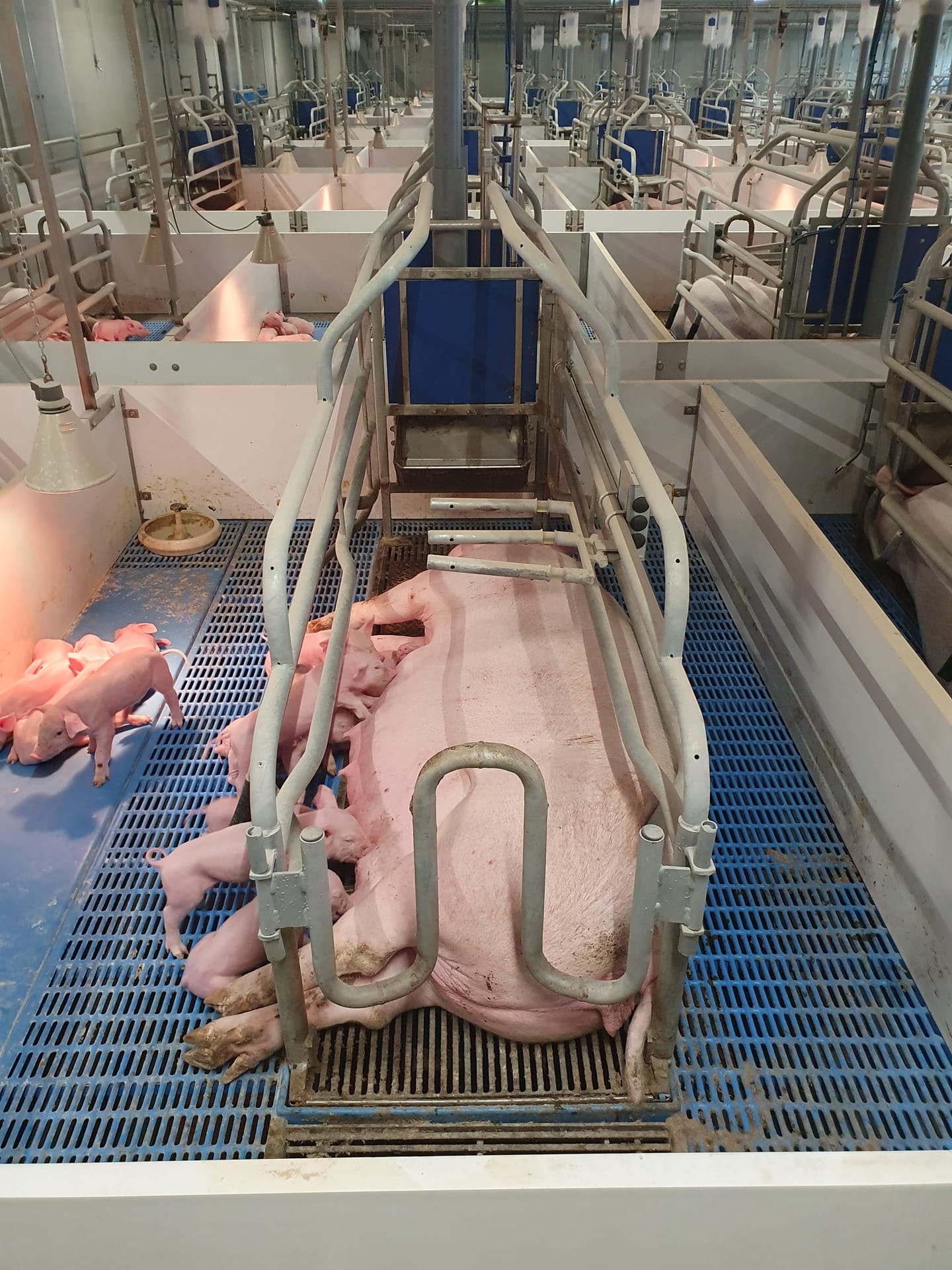
For example, imagine a pig farmer with around 300 sows replacing two farrowing units. If they choose a fully conventional system, depreciation will continue well beyond 2035. A convertible system, however, can have its fixing points and pen width prepared for a future loose farrowing layout. In that case, only the crate sections may need replacing rather than the entire pen installation. That decision is made at the drawing stage, and it cannot be easily reversed later.
What should you check when placing the order and at handover?
The quotation stage is the time to turn promises into clear commitments. Ask for a dimensioned production drawing, not just an item number from a list. Ask about response times in the event of faults. Van Osch sets this out in its Five O’s, including a callback guarantee within one working day. Finally, ask whether replacement parts will still be available after five years. In-house production in Uden makes that a very different proposition from buying imported trading products.
At handover, the most important factor is how everything connects. Check the joint between the slatted floor and pen wall, the height of the trough edge relative to the floor, and the fitting of stainless steel drinking bowls at the correct height for each animal group. Checking these three items in the first completed unit prevents a repeated error across every unit. This final inspection is essential in the farrowing crate manufacturing process.
Put this into practice:
- Inspect every connection joint in the first completed unit before the next unit is installed.
- Include the agreed fault response time in writing in the order confirmation.
- Keep the production drawing digitally. If you expand in a few years, it is the quickest way to achieve identical dimensions.
- If you are unsure about the 2035 phase-out, ask for written confirmation of how the system can be converted.
For more guidance on choosing between adapting an existing pig house and building new, read our article on renovation or new construction for custom pig house equipment.
Frequently asked questions
How long does the farrowing crate manufacturing process take, from drawing to delivery?
Lead time varies by project and depends on the scale of the order, material selection and the overall building schedule. For custom projects, the engineering stage often takes several weeks before production and assembly begin. Always ask for a delivery date that fits the construction plan, because a farrowing unit waiting for pen equipment loses valuable production days.
What are the dimensions of a standard farrowing crate?
Typical farrowing crates measure approximately 1.80 to 1.90 by 2.60 to 2.70 metres, or 4.68 to 5.12 square metres, according to Varkensloket. There are only two broadly worded legal provisions for farrowing pens. In renovation projects, the existing building dimensions are almost always more important than the typical size.
Why does in-house manufacturing matter for custom farrowing crates?
In-house manufacturing means that engineering, tube laser processing, welding and assembly all take place under one roof, without intermediaries. Van Osch manufactures in Uden using its own skilled team, welding robots and, since 2024, Adige tube laser technology. This allows non-standard dimensions to fit into the regular production flow. It also shortens replacement part lead times because the drawing of the supplied system remains available.
Can a conventional farrowing crate be converted to a loose farrowing system later?
Convertibility depends on decisions made at the drawing stage, including pen width, fixing point locations and the connection to the slatted floor. When this is planned in advance, replacement can often be limited to the crate sections. Without that preparation, the entire pen installation may need replacing. Ask about this specifically, as the action plan identifies 2032 and 2035 as key dates.
What slatted floor requirements apply in a farrowing pen?
Gap width and slat width are set by law. For concrete slats in farrowing pens, the maximum gap width is 10 millimetres under the IKB Pig Regulation, compared with 14 millimetres for weaned pigs and 18 millimetres for finishing pigs. According to the RVO, the minimum slat width is 50 millimetres for piglets and weaned pigs, and 80 millimetres for sows. Make sure these dimensions are shown on the production drawing.
Conclusion
The farrowing crate manufacturing process has seven stages, but the final outcome is determined in the first three. Site measurement, engineering and material selection establish whether the crate fits, whether it meets gap and slat width requirements, and whether it can adapt to the agreement’s key dates: 2032 for mandatory loose farrowing systems and 2035 for phasing out conventional farrowing crates. Welding robots and tube laser technology make these decisions highly repeatable, but they cannot correct them.
A reliable farrowing crate manufacturing process therefore starts with real building measurements and a detailed production drawing. If you are renovating a farrowing unit in the coming years, take three practical steps: record actual building dimensions before requesting a quotation, ask for a dimensioned production drawing with connection details, and confirm in writing which parts would need replacement during a future conversion. Do that, and you are not just buying a crate. You are investing in a solution that fits. Find out more about how Van Osch develops custom projects through its project examples.
About Van Osch B.V.
Van Osch B.V. is a Dutch family business based in Uden, founded in 1939. The company designs, manufactures and supplies complete pig housing systems. It produces custom pen equipment for sows, farrowing sows, piglets and finishing pigs in steel, galvanised steel, stainless steel and plastic. Van Osch serves pig farmers and dealers in the Netherlands, across Europe and beyond, both directly and through its international dealer network.
Sources
- Convenant Dierwaardige Veehouderij en het plan van aanpak — Nieuweoogst
- Regeling IKB Varken, interpretatiedocument — Ikbvarken
- RVO — Rvo
- Varkensloket
- CBS meldde in 2025 — Cbs
- Welzijnseisen voor varkens — Rijksdienst voor Ondernemend Nederland (RVO)
- Afmetingen kraamhokken — Varkensloket
- Varkenssector werkt met plan van aanpak toe naar dierwaardigheid — Nieuwe Oogst