


The short answer
The best way to choose materials for piglet housing is by area within each pen, rather than selecting one material for the entire building. At floor level, urine, manure and wash water all come together. Stainless steel and well protected plastic hold up best in these conditions. For pen frames and top rails that stay dry, galvanized steel is often more than adequate. Flooring is subject to legal requirements: where flooring is partially slatted, at least 40% of the required area must be solid. Weaned piglets may have slat openings of no more than 14 mm in concrete slats or 15 mm in other types of slatted flooring. The best combination depends on your cleaning routine, pen dimensions and the intended lifespan of the unit.
Key takeaways
- According to the animal welfare requirements published by the Netherlands Enterprise Agency (current as of 2026), a partially slatted floor must have at least 40% solid flooring.
- The Decree on the Keepers of Animals permits openings of up to 14 mm in concrete slats and 15 mm in other slatted floors for weaned pigs.
- Stainless steel 316 typically contains 2 to 3% molybdenum and withstands chlorides better than stainless steel 304. This matters most in manure areas.
- Divide every piglet pen into three areas, the floor area, middle area and upper area, then select materials accordingly.
Why do material choices so often go wrong in piglet housing?
When renovating piglet units, Van Osch Uden regularly sees the same issue. After years of use, the pen frames are still straight, but the bottom rails, feeder fixings and slat supports are badly corroded. The material itself was not poor quality. It was simply used in a location it was never designed to handle.
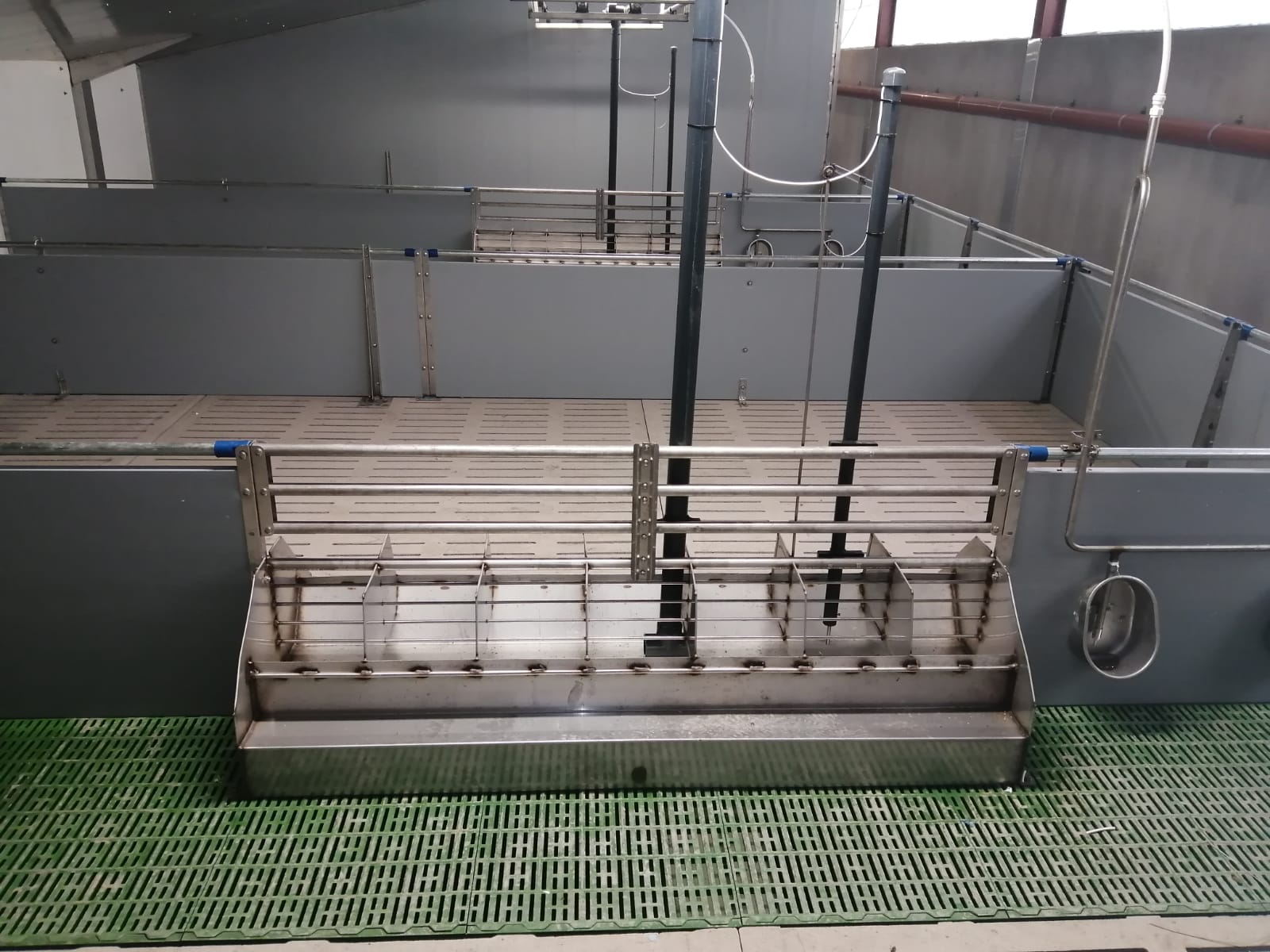
This happens because pen equipment is often ordered as a single package: one material, one standard catalogue size, sometimes sourced from three different suppliers for partitions, slatted flooring and drinkers. Buying this way means paying too much for components that never get wet, while accepting premature wear in the areas exposed to the greatest stress.
The scale of modern pig production makes this an expensive mistake. According to Statistics Netherlands (2025), the Netherlands had 1.900 pig farms on 1 April 2025, while the average number of pigs per farm rose to 5.000. More animals per farm means more cleaning cycles in every unit. A material choice that underperforms slightly in each pen soon becomes a significant cost across dozens of pens.
Where do pen materials wear out fastest in a piglet unit?
Where do you spot the first damage when walking through a piglet unit after a few years? Almost always at the bottom. Wear is not evenly distributed throughout a piglet pen. Ignore that fact, and you will put the wrong material in the wrong place.
Corrosion at floor level
The bottom 20 to 30 centimetres of a pen partition typically come into contact with manure, urine and wash water during every production cycle. Even stainless steel is not immune: according to Laserworx, ammonia from urine can damage stainless steel’s protective oxide layer, particularly where the surface has been scratched or abraded. With galvanized steel, the zinc coating wears away first at this height, especially around welds, drilled holes and cut edges.
Chewing, impacts and exposed edges
Piglets explore their environment with their mouths. Exposed profile edges, protruding screw heads and thin plastic edges can quickly become damaged, particularly after weaning when new groups are first mixed. In practice, a plastic panel enclosed in a closed profile generally lasts much longer than the same panel with an exposed edge.
Cleaning, disinfection and drying
Pressure washing and disinfectants put every material under strain. Hollow plastic panels with poorly sealed ends can retain water, making the unit slower to dry. With metal, the finish around welds determines whether dirt and moisture can collect.
Checklist:
- Inspect the current unit and note the height at which rust or damage first appears in each pen.
- Check welds, drilled holes and cut edges on galvanized components in the lower wall area.
- Check whether plastic panels are enclosed in profiles on all sides or have exposed edges.
- After a cleaning cycle, note which components stay wet the longest.
Why does one material not work for the entire piglet pen?
Using stainless steel throughout may sound like the safe option, while using galvanized steel throughout may seem like the budget option. In a piglet unit, both are compromises that fall short somewhere.
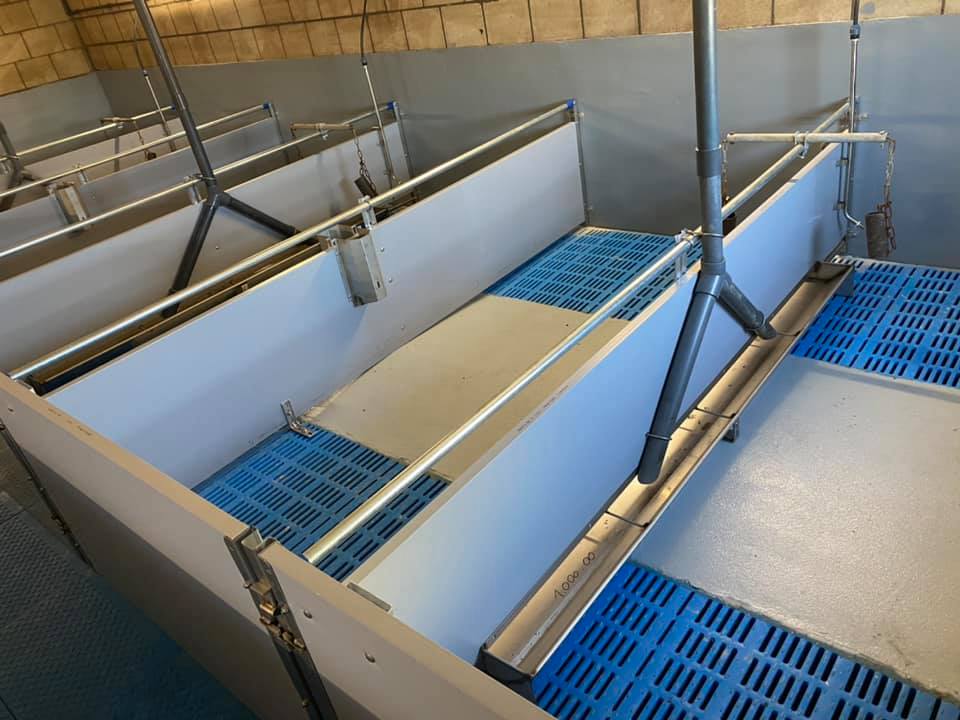
With a fully stainless steel pen, you pay a premium for top rails, hinges and frames that never come into contact with manure. That added cost offers little return. A fully galvanized pen creates the opposite problem. The frame may last for years, but the lower wall area and slatted floor supports become the weak points.
An all plastic pen has a different limitation. Plastic panels are lightweight and easy to clean, but they need a rigid frame for doors, latches and longer spans. Without this support, they can eventually bow or pull loose around their fixings.
There is also the issue of mixing suppliers. Partitions from one supplier, slatted flooring from another and drinkers from a third often have slightly different dimensions and fixings. When different metals are in direct contact in a damp environment, galvanic corrosion can also become a risk. The result is often extra adapters, more installation time and a pen that never quite fits together properly.
How should you choose materials for each part of piglet housing?
Zoning pen materials means choosing the material that can best withstand manure, moisture, cleaning and chewing for each height and function within the piglet pen. Van Osch Uden uses this approach for custom projects: the location in the pen determines the material, not the catalogue. In practice, this comes down to three areas.
Flooring: solid areas and slatted flooring
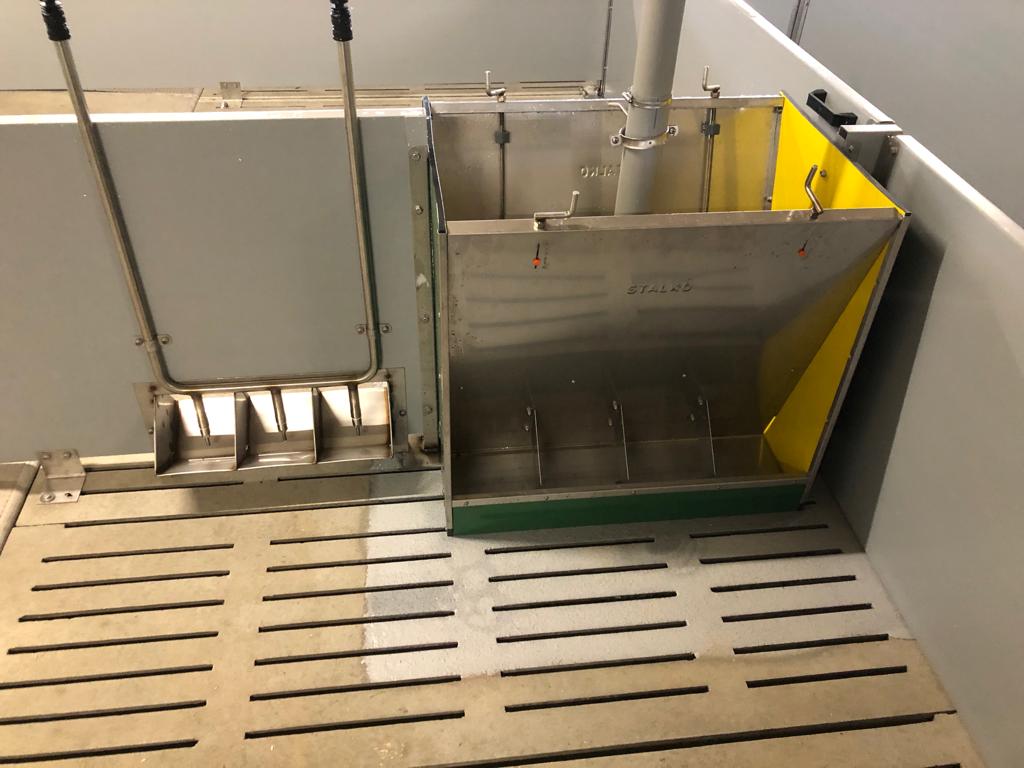
Most of the rules relate to the floor. According to the Netherlands Enterprise Agency, a partially slatted floor must include at least 40% solid flooring within the required area. The same requirements specify a minimum living area of 0,20 m² per animal up to 15 kg. The Decree on the Keepers of Animals limits slat openings for weaned piglets to 14 mm in concrete and 15 mm in other slatted floors. Within these limits, plastic, cast iron or metal can be selected for slatted sections, while plastic or concrete are common choices for the solid area. Pay particular attention to the supports beneath slatted flooring. They are always in the dampest area and should be stainless steel or heavily hot dip galvanized.
Partitions, pen dividers and doors
For partitions, a combination usually works best: smooth plastic panels set into stainless steel profiles at the bottom and galvanized profiles above. Doors and latches need rigidity, so steel should form the basis. For more on durability, see sustainable quality in steel and stainless steel. For guidance on which plastic components can withstand the required loads, read plastic in farrowing crates and piglet housing.
Feed, water and enrichment
Anything piglets touch with their mouths every day should preferably be stainless steel. This includes feeders, drinkers and holders for enrichment materials. For feeder position and type, start with this guide to choosing and positioning piglet feeders in free farrowing crates. Enrichment material is mandatory. The legal basis for pen enrichment is Directive 2008/120/EC, incorporated into the Decree on the Keepers of Animals. A stainless steel holder ensures that the fixing itself does not become the weak point.
| Material | Key characteristic | Typical area | Relevant size or standard | Point to consider |
|---|---|---|---|---|
| Stainless steel 304 | 18% chromium, 8% nickel | Middle area, feeders and drinkers | No specific housing standard | More sensitive to chlorides |
| Stainless steel 316 | 2 to 3% molybdenum | Floor area, slat supports | No specific housing standard | Higher material cost |
| Galvanized steel | Zinc coating on steel | Upper area, frames, doors | No specific housing standard | Wears at welds and cut edges |
| Plastic | Does not corrode | Partitions, slats, solid flooring | Openings max. 15 mm (weaned piglets) | Protect exposed edges |
| Cast iron | Heavy and dimensionally stable | Slatted flooring | Openings max. 15 mm (weaned piglets) | Heavy to install |
| Concrete | Solid or slatted | Solid floor area, slats | Openings max. 14 mm; at least 40% solid | Must fit the existing pit |
Checklist:
- Ask which material and stainless steel grade, 304 or 316, is supplied for every component.
- Check the drawing to confirm that the solid floor section covers at least 40% of the required area.
- Have joints between different metals insulated, or made from the same material.
- Confirm in writing how quickly spare parts will be available.
How should you approach material selection for a new build or renovation?
A renovation rarely starts with an empty building. Existing walls, pits and dimensions are fixed, and the unit often needs to be back in use within a few weeks. A clear sequence of steps works better than comparing materials on paper.
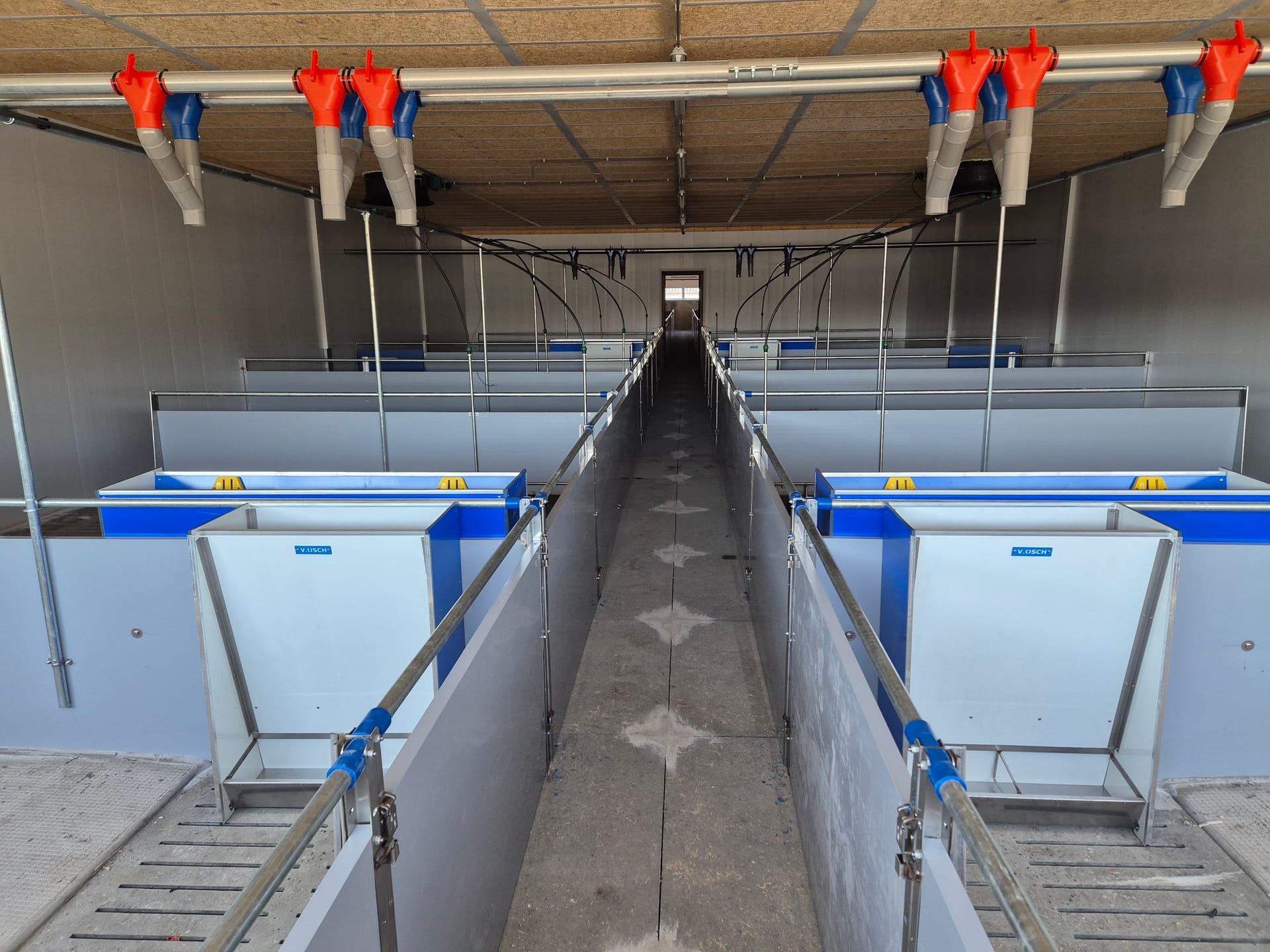
Five steps from inspection to ordering
- Map the damage in the current unit by area and height.
- Set the floor specification within the legal requirements: solid area, slat width and living space at the highest animal weight in the pen.
- Choose materials for each area based on wear, cleaning requirements and accessibility.
- Detail every connection: floor to wall, wall to slats, doors, drinking water lines and any heating.
- Request quotations using the same technical specification, including installation, fixings, warranty period and spare parts availability.
Start with an area plan
A unit for weaned piglets does not experience the same level of wear everywhere. Dividing the space into areas prevents the most expensive material from being used throughout, while also ensuring that vulnerable locations are not fitted with materials that are too light duty.
| Area | Main demands | Practical material choice |
|---|---|---|
| Resting area | Less manure, animal contact | Plastic or concrete with sufficient solid surface |
| Manure area | High moisture, manure and cleaning exposure | Plastic slats, cast iron or suitable concrete slats |
| Feeding area | Abrasion, impacts, feed residues | Stainless steel around feeders, robust plastic or protected galvanized steel |
| Drinking area | Constant moisture, risk of leaks | Stainless steel pipework and corrosion resistant fixings |
| Doors and passageways | Frequent use and impacts | Galvanized steel, stainless steel hinges or robust plastic panels |
| Wall base and corners | Wash water and mechanical wear | Plastic skirting, concrete or stainless steel finishing |
Allow for existing dimensions
During renovation, the available dimensions matter just as much as the material itself. Before ordering, measure:
- the width and length of every pen;
- the location of pit edges, drains and columns;
- the height of existing walls and doors;
- the dimensions and support arrangement of slatted floor sections;
- the clear space needed for feed carts, moving animals and cleaning;
- the location of water, feed and electrical connections.
Do not order slats and pen dividers based on nominal dimensions alone. Check tolerances, bearing lengths and room for expansion. Plastic can expand and contract with temperature changes. A panel fitted too tightly can warp or pull out of its fixings.
What should you look for during installation?
High quality materials only perform as intended when installed correctly. Much of the damage seen in piglet units is caused not by the panel or slat itself, but by a poor connection, inadequate support or unsuitable fixings.
Support slats according to specification
Slats must lie level and be supported over the full specified bearing length. Check:
- that the pit edge is level and strong enough to carry the load;
- that intermediate beams are set at the correct centre to centre spacing;
- that slat ends cannot tip;
- that joints do not create sharp changes in height;
- that there are no exposed edges where legs or claws could get caught.
A slat that moves under load wears faster and unsettles animals. Correct support is particularly important with plastic slats, as localised point loads can cause cracking.
Choose fixings that suit the environment
Use stainless steel fixings in wet areas wherever possible. When installing into concrete, choose anchors that are suitable for both the substrate and the load. An anchor that is sufficient for a lightweight plastic panel may not be suitable for a heavy door or a divider that animals push against.
Pay attention to the following:
- do not drill too close to the edges of concrete or pit walls;
- seal penetrations where moisture and dirt could collect behind them;
- avoid protruding bolts, sharp threaded ends and exposed profile edges;
- use washers or load spreading plates with plastic panels;
- check that doors open and close freely without binding.
Test the unit before stocking
Inspect the unit before piglets are brought in. A short practical test can prevent repairs once the unit is occupied.
Check, among other things:
- all door latches and hinges;
- sharp edges, burrs and protruding fixings;
- the stability of pen dividers;
- the junction between slatted and solid floor sections;
- access to drinkers and feeding areas;
- wash water drainage to the pit;
- access for cleaning and maintenance.
Maintenance: how to extend service life
Maintenance starts with cleaning in a way that suits the material. The combination of high pressure, hot water, aggressive products and limited drying time can significantly shorten service life.
Clean carefully, not just aggressively
First rinse away coarse dirt and, if needed, allow soiling to loosen with a product suitable for the material. Then clean targeted areas. Holding a spray lance too close to plastic, sealant joints or coatings can cause damage that only becomes visible later.
Practical points to remember:
- keep sufficient distance from plastic panels and slats;
- do not direct the jet at seals, bearings and hinges for long periods;
- remove feed residues around stainless steel components and drinkers;
- rinse cleaning products thoroughly;
- allow the unit to dry completely before restocking;
- repair damaged coatings and loose sealant joints promptly.
Inspect after every cycle
Schedule a fixed inspection after every production cycle. Minor faults are usually inexpensive to repair at this stage.
| Inspection point | Look for | Action |
|---|---|---|
| Plastic panels | Cracks, discolouration, loose fixings | Replace or refit |
| Slats | Breakage, bending, sharp edges | Replace damaged slats immediately |
| Steelwork | Rust, damaged coating | Clean, treat or replace |
| Stainless steel | Deposits, pitting, damage | Clean and investigate the cause |
| Doors | Play, binding, loose latches | Adjust hinges and replace parts |
| Sealant and joints | Separation, open gaps | Reseal |
| Concrete | Spalling, sharp edges, cracks | Repair and assess load capacity |
Common mistakes when choosing materials
A low purchase price may look attractive, but it can become expensive when regular repairs or replacements are needed. The following mistakes are common in practice.
Using one material everywhere
A fully plastic or fully steel installation is not automatically the best option. Each area has different demands. Do not choose based solely on appearance or unit price. Choose based on function.
Looking only at visible components
The quality of beams, fixings, pit edges and connections matters just as much as the visible panel. These are often the areas where loose slats, corrosion and leaks develop later.
Failing to consider cleaning
Materials that perform well in a dry storage area can deteriorate quickly in a pig unit. Always ask whether the material can withstand your cleaning method and products.
Ordering too few spare parts
An unusual hinge, slat section or door latch can create unnecessary downtime. Specify which parts should be kept in stock when ordering, and consider ordering critical components at the same time.
Checking legal dimensions too late
Once the floor layout, pen dimensions and slats have been ordered, changes are costly. Check legal requirements and any additional quality standards before finalising the design.
FAQ about materials for weaned piglet units
What is the best material for pen dividers?
It depends on the location. Plastic is often practical for solid dividers because of its smooth finish and corrosion resistance. In areas subject to high mechanical loads, such as doors and feed fronts, galvanized steel or stainless steel are often more suitable. In many units, a combination offers the most durable solution.
Is stainless steel 304 sufficient in a pig house?
Stainless steel 304 can perform well in many applications, but it is not always the best choice for wet or aggressive environments. Where there is permanent moisture, salt deposits, cleaning products or difficult to clean joints, stainless steel 316 may be the better choice. Ask the supplier to confirm which grade is being used and why.
When should you choose plastic slats?
Plastic slats are particularly suitable where comfort, thermal performance and easy cleaning matter most. They are widely used in resting areas and for young animals. However, always check load capacity, support, slat opening width and the connection to adjoining slatted sections.
Are cast iron slats always needed around the feeder?
Not always, but cast iron is often a sensible option in high wear areas because it is strong and highly resistant to abrasion. It can be especially suitable around feeders or in areas with heavy manure loads and frequent animal movement. Its drawbacks are weight and the need for a strong supporting structure.
How can you prevent corrosion between different metals?
Avoid direct contact between metals that can interact electrochemically, especially in a damp environment. Where needed, use insulating washers, plastic separators or fixings made from the same material. Also make sure dirt and moisture cannot remain trapped in gaps.
How long do plastic panels and slats last?
Service life depends on quality, wear, cleaning practices, UV exposure and installation. Well installed plastic components can last for years, but damage from sharp objects, high pressure cleaning or inadequate support can significantly shorten their lifespan. Look beyond the warranty and check whether replacement parts will remain available.
Does the whole floor need to be replaced during a renovation?
Not always. If the pits, supports and existing slats still have adequate load capacity and are compatible with the new system, partial replacement may be possible. However, have the old and new components assessed to ensure they fit together correctly and that the finished floor meets current requirements.
Conclusion
When choosing materials for piglet housing, the best solution for a weaned piglet unit is rarely a single product or one type of material. A durable installation starts by assessing moisture, manure exposure, mechanical wear, cleaning and accessibility in every area.
Plastic is often an excellent choice for solid dividers and comfortable floor sections. Concrete provides a solid base and can work well for solid floors and slats. Cast iron is well suited to heavily used manure and feeding areas. Galvanized steel and stainless steel are particularly valuable for frames, doors, feed fronts and fixings, provided the correct grade and installation method are used.
Before ordering, document the dimensions, floor layout, materials, stainless steel grade, fixings and spare parts availability in writing. This reduces the risk of surprises during installation and costly repairs later on.
Sources
- RVO — Rvo
- Besluit houders van dieren — Faolex
- CBS — Cbs
- wettelijke basis voor hokverrijking — Hokverrijkingvarkens