


Quick summary
At Van Osch B.V., we design and install bespoke pig housing systems. For finishing pigs, we first establish the feeding system and how pigs feed within the group. With wet feeding through a long trough, every pig must be able to eat at the same time, requiring at least 0.3 metres of trough length per animal. With dry feed, the key figure is the number of feeding places, usually one per eight finishing pigs. Only then should you choose between stainless steel, plastic or cast iron. Reversing that order is one of the most common and costly mistakes in refurbishment projects.
Key takeaways
- For wet feeding through a long trough, finishing pigs need a minimum trough length of 0.3 metres per animal so all pigs can eat simultaneously (Varkensloket).
- With dry feed, the number of feeding places matters. Research linked to Wageningen University & Research recommends one feeding place per five piglets and one per eight finishing pigs (Varkens.nl, 2023).
- By law, feeding and drinking systems must be designed and installed to prevent competition between animals (RVO).
- Group housed dry and pregnant sows require at least 2.25 m² per sow, including 1.3 m² of continuous solid flooring (RVO). That solid floor requirement affects where the trough can be positioned.
- Larger farm units change the design brief. The average number of pigs per farm rose to around 5,000, almost 50 percent more than ten years earlier (CBS, 2025).
Why do feed trough choices so often go wrong during refurbishment?
A recurring issue Van Osch B.V. sees in refurbishment projects is that the farmer has already selected the trough before the feeding system has been finalised. The decision is usually based on material, sometimes on price, and rarely on the number of feeding places. The trough may fit within the pen dimensions, but it does not provide enough room for the number of pigs feeding at once.
That is when the problems start. Pigs become unsettled at feeding time, push each other away from the trough, and finish weights vary widely within the same compartment. This is not a material issue. It is a sizing issue that began at the design stage.
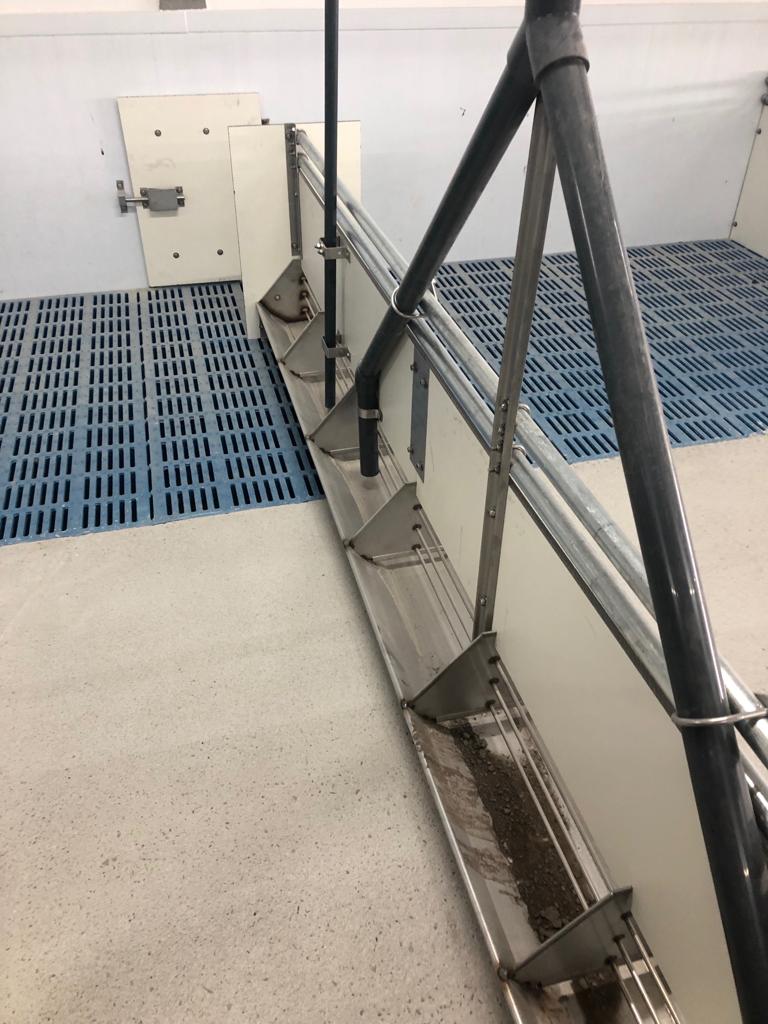
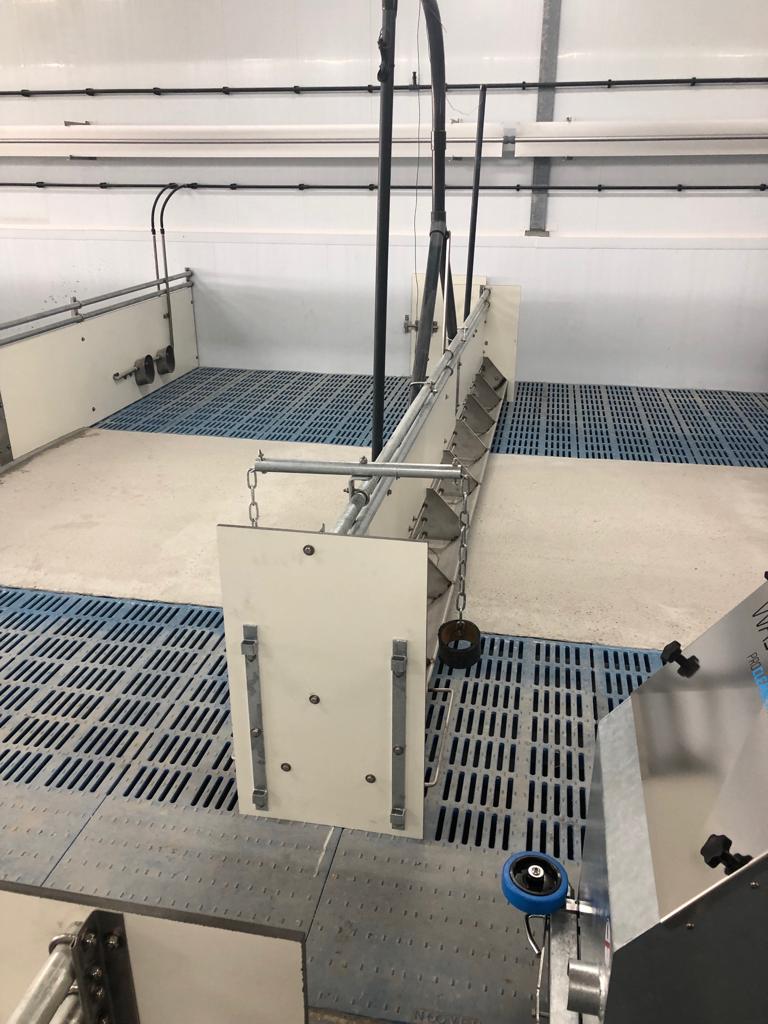
The second recurring problem is fragmented purchasing. Slatted floors come from one supplier, troughs from another, drinkers from a third, and pen divisions from a fourth. Each supplier provides a perfectly sound component, but no one is responsible for how those components work together. That connection is especially important around the trough. The trough edge must align with the pen division, sit on or beside the solid floor, and remain clear of the slatted floor to allow thorough cleaning.
This is not a minor detail from a legal perspective. The requirement that feeding and drinking systems must prevent competition between animals is a design requirement, not simply advice for day to day use. It applies to design, construction and placement. A trough can be perfectly suitable in itself, yet still fail to meet the purpose of the requirement if it is installed in the wrong location.
How much trough space does each finishing pig really need?
Trough length is the usable feeding edge available per animal, measured in metres. It determines how many pigs can eat at the same time.
With wet feeding through a long trough, all pigs must be able to eat simultaneously. Varkensloket uses a minimum trough length of 0.3 metres per finishing pig. This is a minimum, not a target. In practice, heavier pigs and wider animals may need more space.
Dry feeding uses a very different calculation. The focus is on feeding places rather than linear trough length. Research linked to Wageningen University & Research shows that pigs eat more slowly than is often assumed. The usual guideline is one feeding place per five piglets and one per eight finishing pigs.
The calculation to make before requesting a quote
Take a compartment with twelve pens, each holding twelve finishing pigs. With wet feed, each pen needs approximately 3.6 metres of usable trough edge. With dry feed and a double sided feeder, two feeding places per pen meet the guideline. The pig numbers are identical, but the pen layouts are completely different.
If you make this calculation only after the pen divisions have been ordered, your options become limited. That is why the feeding system should be fixed during the design phase, before the trough is specified and connected to the pen equipment for finishing pigs.
Why wet and dry feeding systems are not interchangeable
Comparative research by Wageningen Food & Biobased Research found that feed intake with wet feed is generally equal to or higher than with dry feed, while both systems restrict some natural pig behaviours. A trough designed for wet feed, with a smooth base and gradual transitions, behaves differently when used for dry feed. Feed can build up, turn sour in the corners, and be pushed out by the pigs.
The reverse is also true. Converting a dry feeder for wet feed almost always leads to feed losses around the inlet.
How to apply this in practice:
- Decide on the feeding system first, whether wet, dry or a combination, and record that decision before finalising the pen layout.
- For wet feed, allow at least 0.3 m of trough length per finishing pig. Measure the usable feeding edge, not the outside dimensions of the trough.
- For dry feed, allow roughly one feeding place per eight finishing pigs and one per five piglets.
- Walk through the compartment during feeding time. If pigs are waiting or pushing, feeding space is too limited, regardless of what the drawing says.
Choosing a pig feed trough: which trough suits which housing system?
The table below summarises the options most commonly used in practice. The material column is a guide rather than a rule. The final choice depends on the feed type, cleaning frequency and the service life you expect from the installation.
| Housing system | Trough type | Feeding space guideline | Commonly suitable material |
|---|---|---|---|
| Finishing pigs, wet feed | Long trough across the pen width | Min. 0.3 m per animal (Varkensloket) | Stainless steel or cast iron |
| Finishing pigs, dry feed | Single or double sided dry feeder | Around 1 feeding place per 8 animals (WUR guideline) | Stainless steel, plastic for lighter use |
| Piglets, nursery | Compact feeder or short trough | Around 1 feeding place per 5 piglets (WUR guideline) | Plastic or stainless steel |
| Farrowing sow | Individual trough with sufficient capacity | 1 place per sow | Stainless steel |
| Pregnant sows in groups | Trough at feeding stalls or a feeding station | 1 place per sow with simultaneous feeding | Stainless steel or cast iron |
The row that most often prompts discussion is the one for pregnant sows. Here, trough placement can conflict with the legal requirement for 2.25 m² per sow, including 1.3 m² of solid flooring. Position the trough badly and you lose usable lying space needed to comply with the solid floor requirement. If you are planning to expand group housing, it is worth first considering how much space group housed sows really need.

What does this choice look like in practice?
Illustrative example: a typical finishing pig refurbishment project
Imagine a producer with a finishing unit holding around 500 pigs who wants to switch from dry feed to wet feed. The existing dry feeders are positioned in the centre of the pens. On paper, the change looks straightforward: remove the feeders and install long troughs.
During the design stage, however, the real issue becomes clear. At the current stocking level, the pen width does not provide enough usable trough edge to meet the 0.3 metre per pig guideline. There are two options: reduce the number of pigs per pen, or move the pen divisions so the trough can run across the full width.
In projects like this, moving the divisions is usually the preferred option because a permanent reduction in stocking density affects margins year after year. The result is typically less agitation at feeding time and a more consistent finish weight across the compartment. Exact outcomes vary by farm, but the principle is consistent: the benefit comes from correct sizing, not from the trough brand.
This sequence, calculate first and choose second, is exactly why bespoke housing equipment can be more cost effective during refurbishment than an off the shelf solution that almost fits.
Which trough material should you choose: stainless steel, plastic or cast iron?
Material becomes relevant only after the dimensions have been set. The key questions are what will go into the trough and how often it will be cleaned.

Stainless steel is the workhorse option for wet feed and sow troughs. It has a smooth surface, resists acidic wet feed ingredients, and is easy to clean with high pressure equipment. Cast iron is valued for its weight and rigidity, but needs careful consideration when feed formulations are particularly aggressive. Plastic performs well under lighter loads, such as in nursery accommodation, but may not last as long in intensively used finishing pens, particularly along edges where pigs push and bite.
The honest conclusion is that no single material is best in every setting. There is, however, a logical option for each application. We explore those choices in more detail in our guide to stainless steel, plastic and cast iron for pig housing.
Stainless steel troughs made to match the pen width are among the components Van Osch B.V. manufactures in Uden using its own tube laser technology and welding robots. This means non standard pen dimensions do not have to become a discussion about extra cost.
What can you learn from farms that changed their trough setup?
Three lessons keep coming up.
First, calculate feeding space for every pen, not just for the compartment as a whole. A compartment average hides the very pens where space is tight.
Second, plan for larger farm units. According to CBS (2025), the pig population fell by 5.1 percent to 9.96 million animals in 2025, while the average number of pigs per farm rose to around 5,000. Fewer farms mean larger compartments. A trough layout that worked for 250 pigs needs a different access and cleaning route when scaled up to 500.
Third, assign responsibility for the connections to one supplier. When troughs, slatted floors, drinkers and pen divisions all come from one housing equipment manufacturer, there is no need to spend time resolving millimetre differences between suppliers. That is why trough selection belongs in an integrated project, as described in our approach to coordinating dimensions, feeding and flooring.
How to apply this in practice:
- Create one A4 sheet for each pen type covering pig numbers, feed type, required feeding space and available pen width.
- Check that the trough position does not reduce solid floor space where it is legally required.
- When requesting a quote, ask specifically for the usable trough edge in millimetres, not the external dimensions of the trough.
- Agree who is responsible for the connection between trough, pen division and floor, and put it in writing.
Frequently asked questions
Which pig breeds are suitable for meat production, and does breed affect trough choice?
Breed affects trough requirements through body weight and width, rather than through the breed itself. Breeding and genetics are outside the scope of housing equipment, but expected finish weight and shoulder width do affect the usable trough edge each animal needs. For heavier finish weights, allow more space than the minimum 0.3 metres per pig for wet feed. Discuss your intended finish weight during the design phase, not when placing the order.
At what age are finishing pigs marketed, and why does that matter when choosing a trough?
Finishing pigs are usually marketed at around six months of age, depending on the target weight. They grow substantially during that period, so the trough must work for both entry weight and finish weight. A trough edge that is comfortable when pigs arrive may be too tight by the end of the cycle. Always calculate based on conditions at the end of the batch.
What is the current price of finishing pigs, and how should that affect an investment decision?
Market prices fluctuate, so a trough investment should never be based on the price on a single day. It is more sensible to calculate over the expected service life of the housing equipment, usually several years, and consider the potential impact of adequate feeding space on mortality and variation in finish weights. Current prices are available from independent market sources and statistical organisations. Do not let a temporary price spike determine a long term design decision.
What are the best finishing pig troughs for an existing building?
The best trough is the one that provides the required feeding space within your existing pen width. First measure the clear pen width and calculate the required metres of trough edge or number of feeding places. Only then should you assess the material and mounting system. In existing buildings, a made to measure trough is often more practical than adapting the whole pen layout around a standard size. Always check that the mounting system works with your current pen divisions.
How does Van Osch B.V. help select the right pig feed trough?
Van Osch B.V. develops the trough specification during the design stage, alongside the slatted floor, pen divisions and drinking water system. Because engineering, manufacturing and assembly are all based in Uden, non standard pen dimensions can be produced as bespoke solutions without intermediaries. The service commitment is set out in the Five O’s, including a callback guarantee within one working day. Find out more about the available options in the overview of stainless steel troughs.
Conclusion
When choosing pig feed troughs, the sequence matters: feeding system, feeding space per animal, pen dimensions, then material. Get that order wrong and you may buy a trough that fits in the pen but does not work for the group.
There are three practical next steps. First, count the animals in each pen type and compare this with the guideline: at least 0.3 metres of trough length per finishing pig for wet feed, or roughly one feeding place per eight finishing pigs for dry feed. Next, measure the actual usable trough edge in your existing pens, not the outside dimensions. Finally, place responsibility for the connection between trough, division and floor with one supplier, so there is no grey area if something does not fit.
The biggest gain rarely comes from choosing a more expensive material. It comes from doing the calculation before requesting a quote.
About Van Osch B.V.
Van Osch is a Dutch family business based in Uden, founded in 1939. The company develops, manufactures and supplies complete bespoke pig housing systems. Its range includes equipment for sows, farrowing sows, piglets and finishing pigs in stainless steel, plastic and steel. Van Osch serves pig producers and dealers in the Netherlands, across Europe and beyond, both directly and through an international dealer network.
Sources
- Varkensloket
- Varkens.nl, 2023 — Varkens
- RVO — Rvo
- CBS, 2025 — Cbs
- Wageningen Food & Biobased Research — Edepot
- Welzijnseisen voor varkens — Rijksdienst voor Ondernemend Nederland (RVO)
- Regels voor huisvesting en verzorging van dieren — Rijksdienst voor Ondernemend Nederland (RVO)
- Vraag: hoeveel voeder- en drinkplaatsen bij varkens? — Varkensloket