


The short answer
Van Osch B.V. is a family business from Uden that has designed, manufactured and supplied complete custom pig housing systems since 1939. In finishing pig projects, the company sees the same costly mistake time and again: the watering point is only considered after the slatted floor, feeder and pen partitions have been finalised. If you wait to choose pig drinkers until everything else has been drawn up, you can end up paying later for extra pipework, wet resting areas and pen-by-pen alterations. During the design stage, lock in three things: the number of drinking points per group, the flow rate at each point, and the location in relation to the feeder, resting area and dunging area. Materials and fixings come after that.
Key points
- Pigs over two weeks old must have access to sufficient fresh water 24 hours a day, according to the RVO welfare requirements for pigs. This also applies when liquid feed is used.
- A useful rule of thumb is at least one drinking nipple for every ten finishing pigs, with a flow rate of at least 800 millilitres per minute (Nieuwe Oogst, 2019).
- According to Wageningen Livestock Research (Nieuwe Oogst, 2019), finishing pigs drink 4 to 10 litres per animal per day, depending on factors including age and the protein content of the feed.
- The key design rule is simple: place the drinking point above the slatted floor and outside the resting area, then confirm its location before the pen partitions and pipework go into production.
Why do watering points so often cause problems in custom finishing pig pens?
The pen layout has been drawn up, the slatted floor has been ordered and the pen partitions are on the production schedule. Then the installer asks a straightforward question: where exactly should the water pipe go? At that point, the drinker often fits in only one location, a location no one deliberately chose. It may end up directly beside the feeder, halfway along a pen partition, or even above the solid floor section.
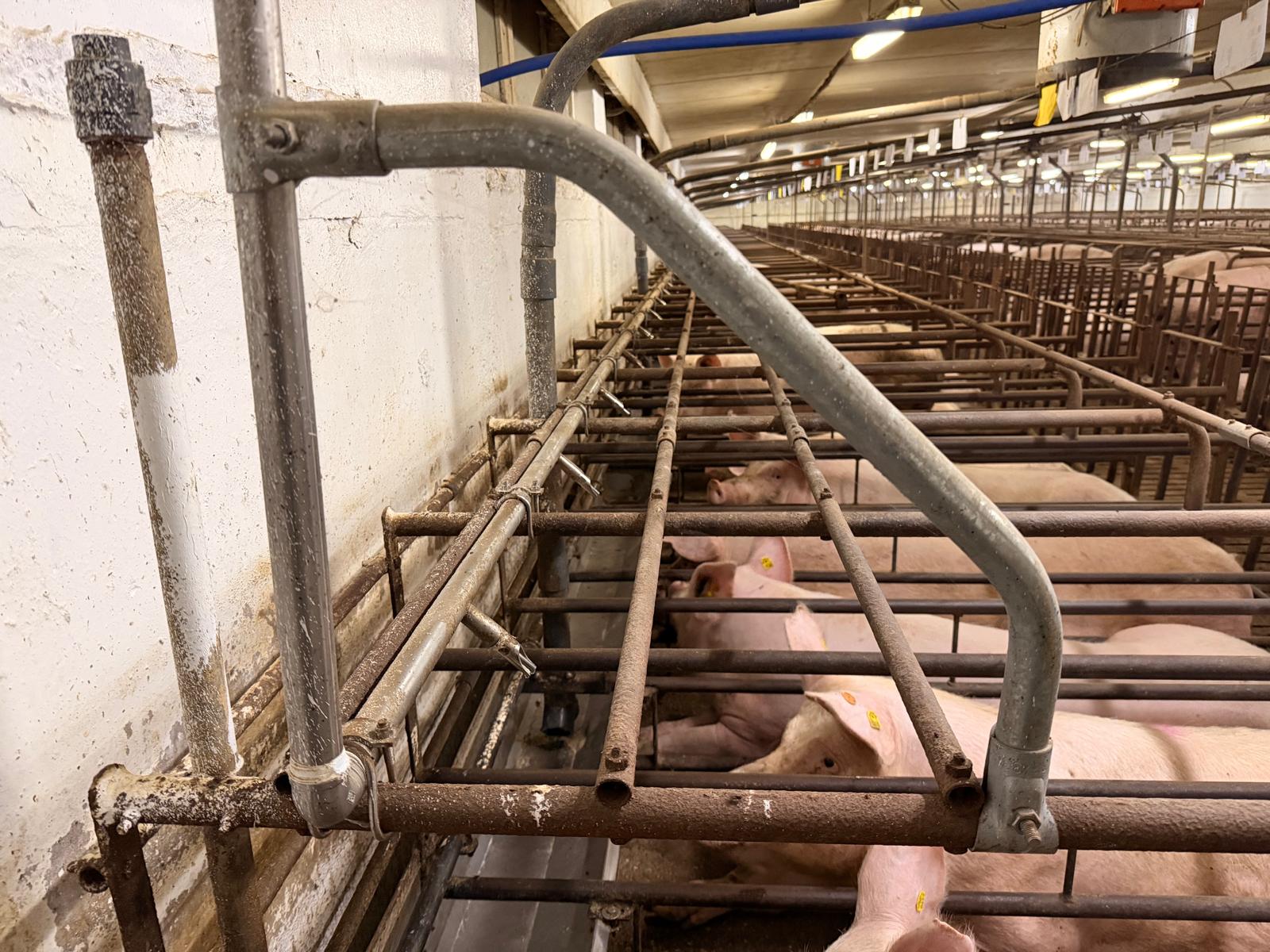
This is especially common in refurbishments and expansions involving several suppliers. One company supplies the slatted floor, another supplies the feeders, and a third provides the drinkers and pipework. Each component may be perfectly sound on its own, but no one is responsible for ensuring they work together within a single pen. The consequences only become obvious once the first batch of finishing pigs is housed: pigs queueing at the feeder, spilled water in the resting area, or a drinker mounted too high for lighter pigs at the start of the finishing period.
A custom pen avoids these issues only when the watering point is designed alongside the floor, feeder and partitions. That is the real difference between a tailored housing solution and a collection of separate components that just happen to be the same size.
What does a poorly positioned drinker cost in a finishing pig house?
The number of pigs per farm has risen by almost 50 percent in ten years, reaching an average of five thousand pigs per pig farm in 2025, according to Nieuwe Oogst (2025). At that scale, every design error becomes more expensive. If a drinking point is in the wrong place in one pen, the same error will be repeated across dozens of pens when the design is replicated. Any correction then has to be made in a building full of animals.
There is also a clear compliance risk. A ruling by the Trade and Industry Appeals Tribunal (2026) concerned sections housing around 84 sows, with one drinker that could be used by just one animal at a time. Inspectors saw animals waiting around the drinker and identified competition for access. In one section, no water came from the drinker at all. The case involved sows, but the principle applies equally to finishing pigs: too few drinking points or inconsistent water pressure is a design problem that better day-to-day management cannot solve later.
The standards themselves may also be changing. With support from the Pig Fund, Wageningen Livestock Research has started the three-year Tip Top Drinken project because current water requirement standards may be outdated (Nieuwe Oogst, 2025). Build some headroom into both flow capacity and the number of drinking points rather than designing precisely to the minimum.
| Design choice | Watering point treated as an afterthought | Watering point included in the design stage |
|---|---|---|
| Drinking points in a pen with 12 finishing pigs | often 1 | at least 2 (rule of thumb: 1 per 10 pigs) |
| Flow rate per drinking point | not measured | at least 800 ml per minute, measured at handover |
| Water requirement basis | not documented | 4 to 10 litres per pig per day |
| Height setting | 1 fixed height for the entire finishing period | adjustable from placement to finishing weight |
| Pipe route | added later through or alongside the pen partition | included in the pen partition drawing from the outset |
Get started yourself:
- Count the animals in each pen at maximum stocking density and divide by ten. Always round up.
- Measure flow rate in an existing pen with a measuring jug and stopwatch. If it is below 800 ml per minute, have the pipework and pressure checked first.
- Record where spilled water ends up in each section. If it reaches the resting area, the drinking point needs relocating, not simply replacing.
- Ask with every quotation whether the pipework has been included in the pen partition drawing.
Choosing pig drinkers: what steps should you follow for a custom pen?
Flow rate is the volume of water a drinking point delivers per minute, and it is the first figure that belongs in a custom design, not the last. When choosing pig drinkers, the sequence below reflects how a practical design should take shape: start with the animal and group, move to the pen, and only then select the individual component.
Step 1: Confirm group size and weight range
Start with the number of finishing pigs per pen and their weight at placement and finishing. These two details determine both the required number of drinking points and the height range a drinker must cover. At Van Osch B.V., a custom housing design project starts with a conversation about how the farm operates, before any drawing is produced.
Step 2: Calculate drinking points and flow rate
Use one drinking point per ten pigs as the minimum, with at least 800 millilitres per minute per nipple. Size the pipework for the moment when all drinking points may be used at once, such as immediately after feeding on a hot day. Without this calculation, the final pen on a long pipe run often receives less water than the first.
Step 3: Set the location in relation to the feeder, resting area and dunging area
Pigs generally divide their pen into resting, feeding and dunging areas, and the location of the drinker strongly influences where the dunging area develops. Position the drinker above the slatted floor and away from the resting area. Find out how pen dimensions, feeding and flooring come together in one design in this article on coordinating pen dimensions, feeding and flooring.
Step 4: Choose the material and fixing for each drinking point
A drinker in a finishing pig pen needs to withstand pushing, twisting and biting. Stainless steel is a common choice, but the fixing to the wall or fencing is at least as important as the material of the drinker itself. A loose bracket can cause leaks and leave the drinker sitting at an angle. For the rest of the pen equipment, this comparison of stainless steel and plastic by component can help.
Step 5: Include pipes and shut-off valves in the pen partition design
Have the pipe route, brackets and shut-off valves shown on the same drawing as the pen partitions. This prevents pipes from running loose alongside a partition where pigs can pull at them. It also means each pen’s drinking points can be isolated for maintenance without leaving an entire section without water.
Step 6: Test every drinking point at handover
At handover, check the flow rate at every drinking point, not just a sample. Record the measurements as a baseline so you have something to compare against if problems arise later. If you use your own water source, IKB Varken requires an annual chemical and bacteriological drinking water test.
How can you keep finishing pig pen equipment adaptable for the future?
A pen layout that works perfectly at handover may not be right ten years later. Group size, finishing weight or feeding system can change. When that happens, you do not want to replace an entire pen system just to alter one drinking point.
Consider the manager of a finishing pig farm with several thousand places who refurbishes the housing in three phases over a number of years. If a different combination of components is selected for each phase, the finished project will have three types of fixings, three types of shut-off valves and three sets of spare parts. But if the first phase establishes fixed connection dimensions and one fixing system for drinkers and feeders, later phases can build on the same design. In practice, this can significantly reduce coordination time in each phase, while a damaged drinker can be replaced using a single stocked spare part.
That calls for a manufacturer that handles both engineering and production. At its own facility in Uden, Van Osch B.V. produces custom components that fit existing pen equipment, so a later expansion does not have to start from scratch. Close coordination between engineering and production can also ensure that changes after handover do not take weeks. The Five O’s service promise, including a callback within one working day, puts that commitment in writing.
Get started yourself:
- For the first phase, request a fixed set of connection dimensions for drinkers, feeders and pen partitions.
- Choose height-adjustable drinkers if pigs in the same pen cover a wide weight range.
- Keep a record of the spare parts held in stock for each section.
- Include a clear response time for post-handover questions in your agreement.
What are the most common drinker mistakes in finishing pig pens?
Surely adding more drinking points always solves the problem? Not if the extra drinker ends up in the resting area. You will create spilled water where the pigs lie and disrupt the natural layout of the pen. When choosing pig drinkers, five mistakes come up repeatedly in practice:
- The drinking point is right beside the feeder. Drinking pigs block access to the feeder, and feeding pigs block the drinker.
- One fixed height for the whole finishing period. Lighter pigs at placement and heavier pigs at finishing need a different height range.
- No flow-rate test after installation. Differences in water pressure between pens may only become apparent once pigs are already drinking less.
- Pipework treated as a separate item from another supplier. The brackets and routes then do not align with the pen partition.
- Using the minimum as the design target. A layout based on exactly one drinking point per ten pigs leaves no margin if stocking density or standards change.
If you are replacing existing drinkers rather than building a new pen, find additional points to consider in this guide to replacing pig drinkers.

Frequently asked questions
How many drinking points do you need in a finishing pig pen?
The number of drinking points should be calculated using a rule of thumb of at least one drinking nipple per ten finishing pigs. A pen with 12 pigs therefore needs at least two drinking points. Always round up and allow extra capacity for hot days and the peak period immediately after feeding.
How much water does a finishing pig drink each day?
Water requirements for finishing pigs are between 4 and 10 litres per animal per day, according to Wageningen Livestock Research. The amount depends on factors including age and feed protein content. Size the pipework for the heaviest pigs at the end of the finishing period, not for the average animal.
Who can help design watering points for a custom pen?
A pig housing manufacturer with its own engineering department can incorporate the drinking point, feeder, slatted floor and pen partition into one design. Van Osch B.V. develops these projects with the pig farmer or dealer, including the pipe route. This reduces coordination between separate suppliers and prevents the drinker from having to fit into a location that has already been fixed.
Where should you place a drinker in a finishing pig pen?
Choose a location above the slatted floor and away from the resting area so spilled water does not reach where pigs lie. Leave space between the drinking point and feeder so drinking and feeding pigs do not obstruct each other. Confirm this location before the pen partitions go into production.
How do you check whether pig drinkers provide enough water?
Measure the flow rate with a measuring jug and stopwatch: hold the nipple open for one minute and measure the volume collected. If it is below 800 millilitres per minute, check the water pressure and pipework first. Test every drinking point at handover and repeat the test if concerns arise.
Conclusion
A custom finishing pig pen rarely fails because of the material itself. Problems arise from the order of decisions: if you wait to choose pig drinkers until the floor, feeder and partitions are finalised, you build a compromise into every repeated pen. The solution is a consistent design sequence. Start with the group and weight range, then determine the number of drinking points and flow rate, followed by location, material and pipe route. Finally, measure the flow rate at handover. At today’s farm scale, a sound decision is repeated just as often as a poor one.
Your next step is to measure flow rates in your current pens, count the number of pigs per drinking point and record where spilled water ends up. Bring this information to your first design meeting. The finishing pig pen equipment page shows the options that can be discussed during that conversation.
About Van Osch B.V.
Van Osch B.V. (Van Osch Uden) is a Dutch family business founded in 1939. The company designs, manufactures and supplies complete custom pig housing systems. From its own production facility in Uden, it produces pen equipment for sows, farrowing sows, piglets and finishing pigs in stainless steel, plastic and steel. It serves pig farmers directly and through an international dealer network.
Sources
- welzijnseisen voor varkens van RVO — Rvo
- Nieuwe Oogst, 2019 — Nieuweoogst
- College van Beroep voor het bedrijfsleven (2026) — Uitspraken
- IKB Varken — Ikbvarken
- Welzijnseisen voor varkens — RVO
- ECLI:NL:CBB:2026:97, College van Beroep voor het bedrijfsleven, 21/566 — Rechtspraak.nl
- Altijd genoeg drinkwater gaat niet vanzelf — Nieuwe Oogst
- Aantal Nederlandse varkens voor het eerst onder de 10 miljoen — Nieuwe Oogst