


The short answer
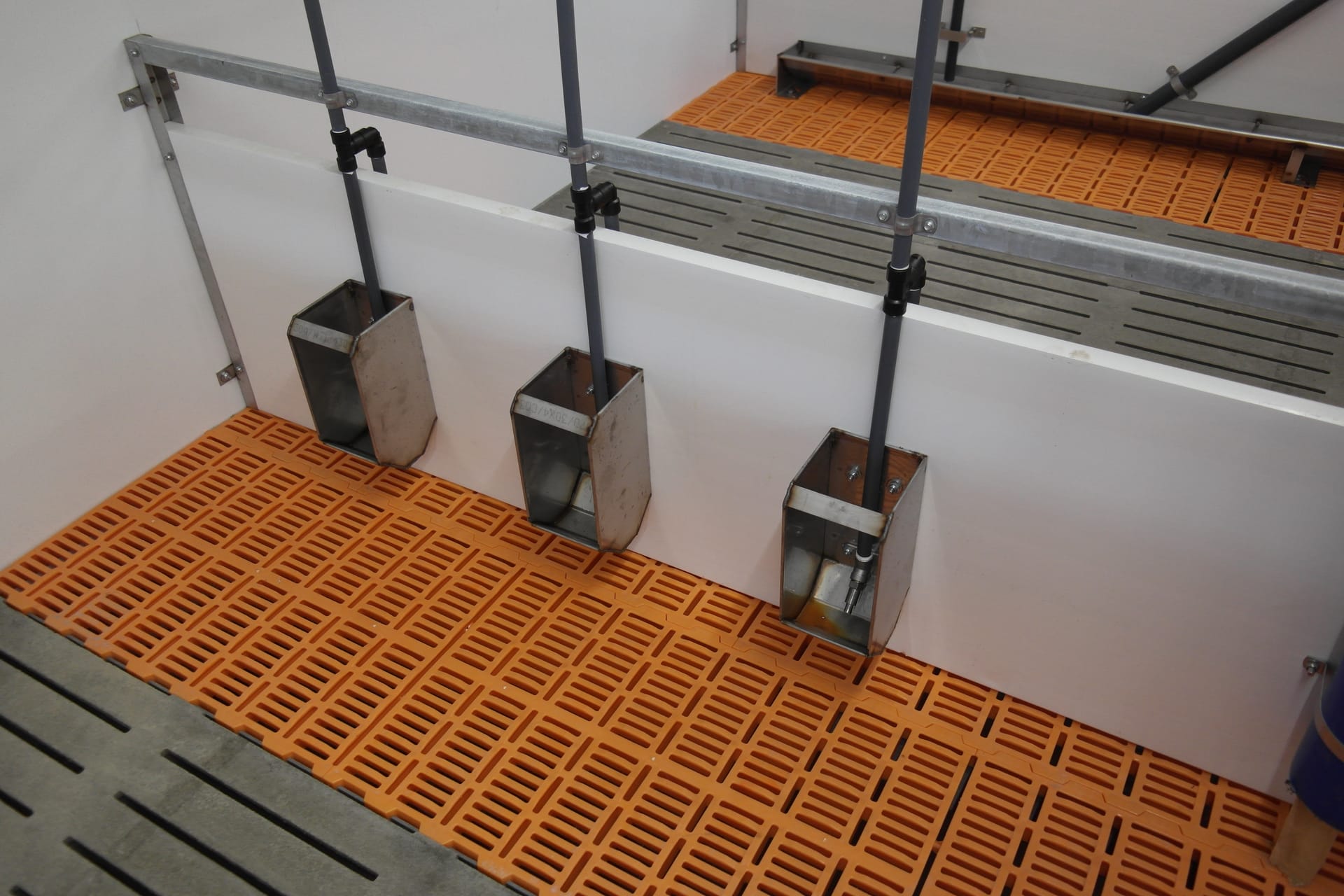
To reduce water spillage from pig drinkers, choose a drinking bowl rather than a standalone nipple drinker, then match its height, flow rate and location to the group of pigs. During farrowing and finishing unit refurbishments, Van Osch B.V. finds that the bowl material is rarely the real issue. More often, the flow rate is too high, the bowl is installed at the wrong height, or the drinking point is poorly positioned in the pen. Researcher Anita Hoofs of Wageningen Livestock Research told Varkensbedrijf.be that a drinking bowl can save up to ten percent of water. You only achieve that saving when the entire drinking point is properly designed.
Key takeaways
- Weaned piglets drink an average of 2.3 litres per day in practice, while the benchmark is 1.8 litres (WAVE project, Nieuwe Oogst 2026).
- The Flemish Agency for Agriculture and Fisheries recommends 0.6 litres per minute for a bite nipple drinker and 1 litre per minute for a drinking bowl.
- A nipple drinker mounted too low can waste substantial amounts of water. A drinking bowl can save up to ten percent of water (Wageningen Livestock Research).
- By law, pigs over two weeks old must always have access to water. The solution to spillage is better adjustment, not less water.
Why is the floor around the drinking point in your pig unit always wet?
Walk into the section and you will spot it straight away: a dark, wet patch on the slatted floor around the drinking point, while the rest of the pen is dry. That patch tells you plenty. Water is missing the bowl, running through the slats into the slurry pit and increasing slurry volume without ever being consumed.
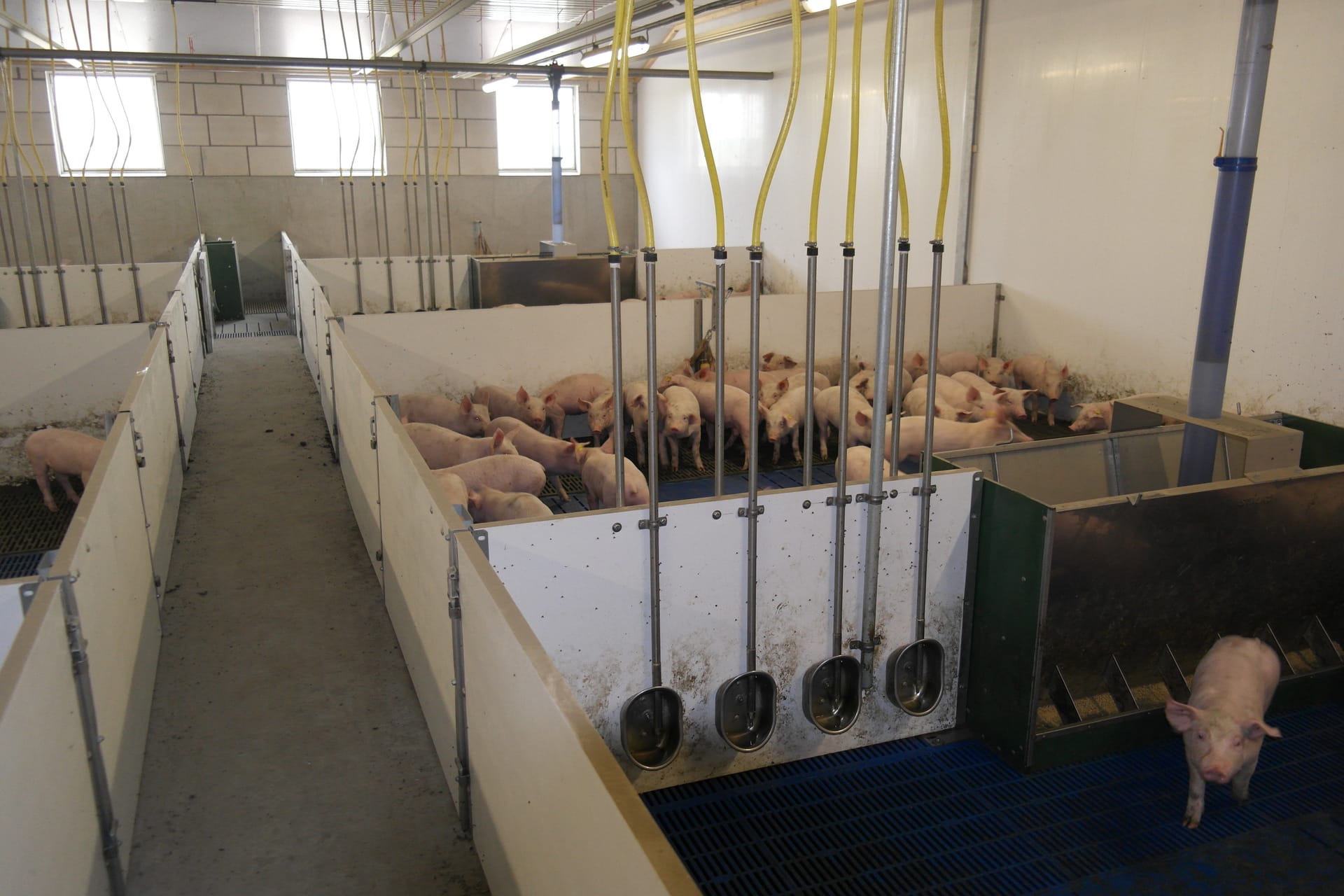
In practice, pigs often dung in wet areas. A leaking drinking point can therefore make a pen much dirtier than you might expect from a few litres of wasted water. It also takes longer to clean, as dirt sticks more easily to a floor that never fully dries.
On many refurbishment projects, the drinking point is addressed last. The flooring, partitions and feeders have already been selected, so the bowl ends up wherever the water pipe happens to be. For more on materials, read our article on which materials make pig drinking bowls last longest. Here, the focus is on something else: keeping water in the bowl.
How much water do pigs waste from drinking bowls and nipple drinkers?
Weaned piglets drink an average of 2.3 litres per day, while the benchmark is 1.8 litres. These figures come from measurements in the international Water Use in Livestock Farming project, known as WAVE, reported by Nieuwe Oogst in 2026. Actual on-farm water use often exceeds permitted benchmarks. Some of that water is not being drunk, it is being spilled.
Water use is often above the benchmark
Most farms do not notice the gap between the benchmark and actual use because they do not have a water meter for each section. You only see the total on the main meter. That makes it impossible to tell whether one section is drinking more or wasting more. Section-level readings are exactly what you need to identify where action is required.
Spillage caused by leaning, playing and wear
Varkensloket identifies three causes of spillage from nipple drinkers. Pigs may lean on them deliberately or accidentally, play with them, and worn nipple drinkers can eventually start to leak. According to the same source, drinking bowls create less waste. However, bowls can still spill: if the flow rate is too high, water splashes over the edge, while a bowl installed too low becomes something for pigs to play with.
Biofilm and dirty drinking points
A third cause is less visible. According to the Flemish Government Department of Agriculture and Fisheries, biofilm often develops around nipple drinkers when minerals build up and bacteria, yeasts and fungi begin to grow. If water is less palatable, it is more likely to end up on the floor than in the pig. Find out how to keep pipework and bowls clean in our guide to keeping drinking bowls and water lines hygienic.
What you can do:
- Read the main water meter at the same time every day for one week, then divide use by the number of pigs.
- If water use in weaned piglets is clearly above 2.3 litres per pig per day, first look for areas where water is being spilled.
- Walk through every section and note which drinking points have wet slats around them.
- Check whether nipple drinkers drip when no pig is drinking. This points to wear.
Why will reducing water pressure or changing the nipple drinker not solve the problem?
The quickest response to a wet floor is often to turn down the pressure. That rarely solves the underlying issue. If the flow rate is too low, pigs spend longer drinking, queues can form at the drinking point, and you may compromise the requirement for animals to have constant access to water. According to Varkensartsen (2022), this is a legal requirement for pigs over two weeks old, as well as a requirement under the Dutch pork quality assurance scheme.
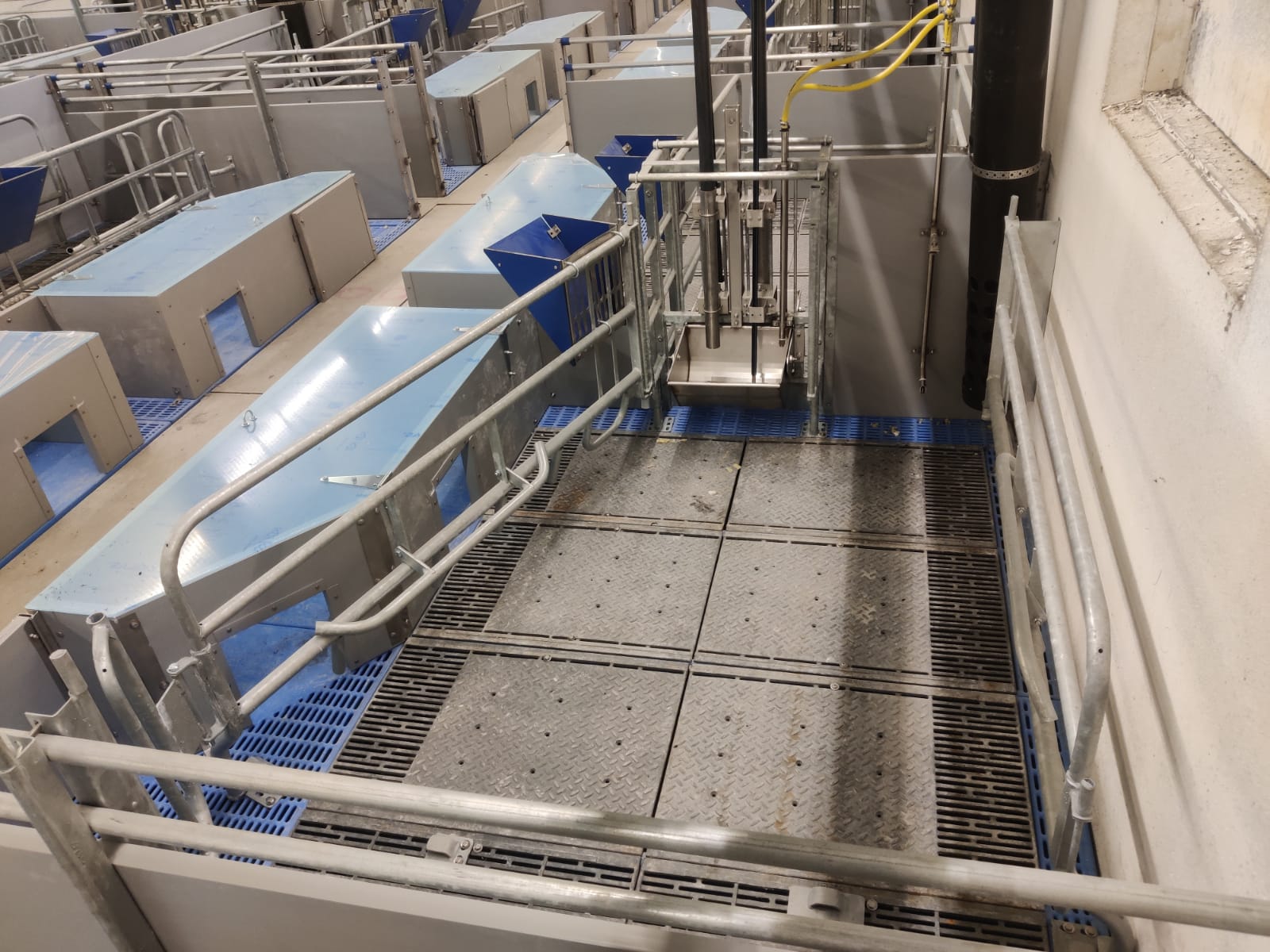
Switching to a different nipple drinker type simply moves the problem elsewhere. Pigs will still lean and play if the drinking point remains at the same height and in the same place. And when the bowl, water line and pen partition come from three separate suppliers, nobody checks that they work together as one system. Once the project is complete, adjustments are rarely made, even though pigs grow considerably during a single batch.
Where should you place a drinking bowl in a conventional farrowing crate or loose housing farrowing pen?
Consider two farrowing pens side by side: one has a fixed farrowing crate, while the other is a loose housing farrowing pen. The drinking bowl may be identical, but spilled water will end up in very different places.
Conventional farrowing crate: fixed position, predictable spillage
In a conventional farrowing crate, the sow stays in the crate and the drinking bowl is usually positioned at the front, beside or inside the feeder. Any spilled water lands in a predictable location, away from the piglet nest. Adjustment is straightforward because the sow has one fixed position, so there is one mounting height and one flow rate to set. Water is unlikely to reach the piglets as long as the slatted floor beneath the feeder drains properly.
Loose housing farrowing pen: more space, different spill pattern
In a loose housing farrowing pen, the sow can turn around and move throughout the pen. She can approach the drinking bowl from several angles and is more likely to play with it. If the bowl is too close to the piglet nest or positioned above a solid floor area, spilled water may end up exactly where the piglets lie. On projects such as the loose housing farrowing unit in Wolferstedt, the location of the drinking bowl in relation to the nest and slatted flooring is therefore an important part of the pen layout.
Piglets need a separate approach. Varkensloket states that piglets learn to drink from a small bowl more quickly than from a nipple drinker. Check the height of the piglet bowl as well, because it needs to be raised as the animals grow. Learn how to measure this in how to check the height, flow rate and placement of a piglet drinking bowl.
What you can do:
- Mark the piglet nest and the sow’s drinking bowl on a plan for every farrowing pen.
- If a bowl in a loose housing farrowing pen is above solid flooring or beside the nest, consider relocating it above the slatted floor.
- Check after a few days that the nest remains dry. If it is wet, the cause is often the drinking point rather than the climate system.
- Keep the piglet bowl separate from the sow’s drinking point, so the sow cannot spill water into it.
How can drinking bowls prevent water spillage in pigs?
A low-spill drinking system is a drinking point where the bowl, flow rate, height and pen location are designed as one integrated solution, keeping the water in the bowl. It sounds obvious, but in practice these four elements are often chosen separately.
From separate components to one complete design
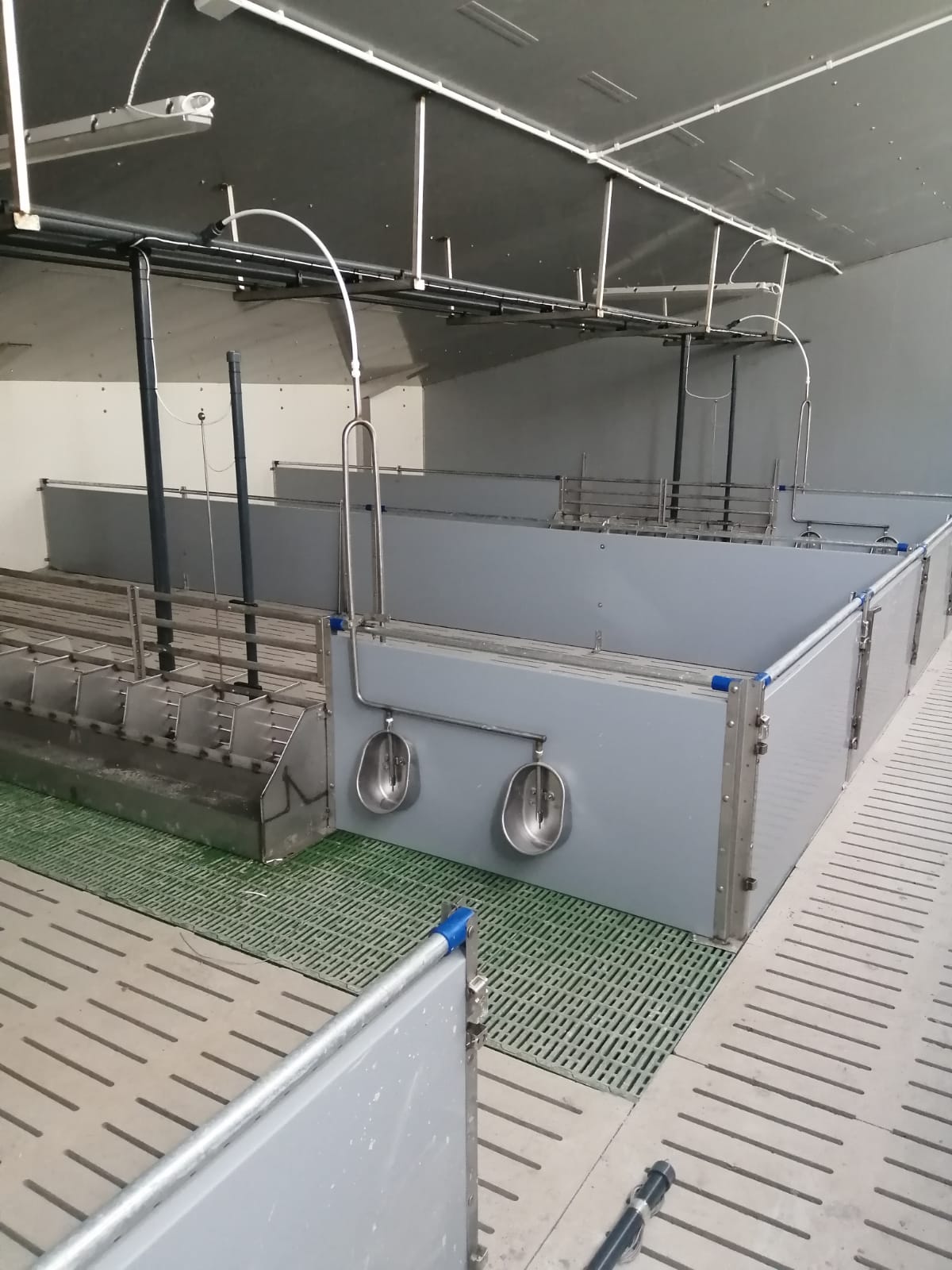
Van Osch B.V. starts during the design phase. The drinking point is drawn together with the pen partition, feeder and slatted floor before anything is manufactured. Because design, engineering and production are all based in Uden, the bowl mounting can be adapted to the real dimensions of an existing pen. This is particularly important in refurbishment projects, where custom work is often needed because standard catalogue sizes do not fit. A stainless steel bowl is fitted where pigs push, root and bite, and a secure mounting prevents it from wobbling and splashing water over the rim. Read more about this approach at custom livestock housing solutions.
Settings for each group of pigs
The second factor is flow rate. According to Vanden Avenne, the Flemish Agency for Agriculture and Fisheries recommends 1 litre per minute for a drinking bowl and 0.6 litres per minute for a bite nipple drinker, taking the number of pigs per drinking point into account. Set the height for the smallest pig in the group. If it is too high, pigs start climbing, while a bowl that is too low encourages play.
| Drinking point | Recommended flow rate | Main source of spillage | Water saving | Check, as a rule of thumb |
|---|---|---|---|---|
| Bite nipple drinker | 0.6 l/min | Leaning, playing, wear | None, baseline | Usually check weekly for drips |
| Drinking bowl without adjustment | Often 1.5 to 2 l/min (practical experience) | Splashing over the rim | Limited | Rarely |
| Drinking bowl adjusted for height and flow rate | 1 l/min | Minimal, when correctly positioned | Up to 10% (Wageningen Livestock Research) | At the start of every new batch |
The difference between the second and third rows is the key point. A drinking bowl does not automatically deliver a ten percent saving. That only happens when its flow rate suits the bowl and its mounting height keeps pace with the group.
How do you adjust drinking bowls and keep them spill-free?
What determines whether a well-designed drinking point is still dry after a year? Above all, it is a consistent routine. These five steps work in farrowing and finishing pens:
- Measure the flow rate with a measuring jug and stopwatch. Hold the valve open for one minute and compare the result with the recommended 1 litre per minute.
- Check the height against the smallest pig in the pen, then adjust it as the group grows.
- Check the location: the bowl should be above slatted flooring, not over a solid area or lying area.
- Clean the bowl and water line between batches to prevent biofilm from making the water less palatable.
- Read the water meter for each section and compare batches.
For example, a finisher producer with around 1,000 places across four sections installs a water meter in each section. One section consistently uses more water than the others. The flow rate there proves to be well above 1 litre per minute. Once adjusted, water use will generally move closer to that of the other sections. The floor stays drier and cleaning takes less time.
If a drinking point still spills after installation, you need to speak quickly with someone who understands the system. Van Osch’s Five O’s include a call-back guarantee within one working day.
What you can do:
- This week, measure the flow rate of three randomly selected drinking bowls in each section.
- Above 1.2 litres per minute: adjust the valve or pressure at each bowl.
- Below 0.8 litres per minute: check for a blockage or limescale build-up in the water line.
- Include a height check at every placement and record the setting for each pen.
Frequently asked questions
How much water does a pig drink per day?
Water use varies by pig group and housing system. The WAVE project found that weaned piglets drink an average of 2.3 litres per day in practice, while the benchmark is 1.8 litres. Measure use by section on your own farm to see whether it is significantly higher.
What is the correct flow rate for a pig drinking bowl?
The recommended flow rate for a drinking bowl is 1 litre per minute according to the Flemish Agency for Agriculture and Fisheries. For a bite nipple drinker, it is 0.6 litres per minute. Check it with a measuring jug and a one-minute stopwatch test. If it differs by more than around 20 percent, make an adjustment.
Who can help design a low-spill drinking point in an existing pig building?
A livestock housing manufacturer with in-house engineering can incorporate the drinking point into the complete pen design. Van Osch B.V. custom designs the drinking bowl location together with the feeder, partition and slatted flooring, including in buildings with non-standard dimensions. This avoids placing the bowl simply where the water pipe happens to run.
Is a stainless steel drinking bowl better than plastic for preventing spillage?
Material choice mainly affects service life, rather than spillage. Stainless steel withstands biting and rooting better, and a securely mounted bowl will not wobble. Spillage itself is usually caused by flow rate, height and location.
How often should pig drinking bowls be checked?
Check them daily during your routine walk-through. A wet patch around the drinking point is the first warning sign. As a rule of thumb, measure flow rate and height at the start of every new batch. Clean bowls and water lines between batches to prevent biofilm.
Conclusion
Preventing water spillage from pig drinking bowls means looking beyond the bowl itself. The flow rate, mounting height and pen location must work together. A drinking bowl can save up to ten percent of water compared with a nipple drinker, but only when it is correctly adjusted. In a conventional farrowing crate, this is relatively simple. In a loose housing farrowing pen, the bowl’s position in relation to the piglet nest needs more careful consideration.
Start by measuring. Install a water meter for each section, check flow rates with a measuring jug and inspect wet areas on the slatted floor. If you are planning a refurbishment or moving to loose housing farrowing pens, include the drinking point in the first design sketch rather than treating it as a final detail. Every farrowing project at Van Osch starts around the table, with the pen layout and drinking bowl location shown in one drawing. Find out more about housing systems for farrowing sows.
About Van Osch B.V.
Van Osch B.V. is a family business based in Uden that has designed, manufactured and supplied complete custom livestock housing systems for pig farms since 1939. The company produces pen fittings for sows, farrowing sows, piglets and finishing pigs in stainless steel, plastic and steel for pig producers and dealers across Europe and beyond.
Sources
- Varkensbedrijf.be — Varkensbedrijf
- Nieuwe Oogst — Nieuweoogst
- Varkensloket
- Varkensartsen
- Vanden Avenne — Vda-ooigem
- Regenwater en hergebruikt spoelwater besparen veehouders kosten — Nieuwe Oogst
- Duurzaam watergebruik in de varkenshouderij — Departement Landbouw en Visserij (Vlaamse overheid)
- Drinkwaterkwaliteit bij varkens — Vanden Avenne